By El Ghali Bennis · Published
How to Ship Coffee Beans: Packaging, Rates & Freshness
Learn how to ship coffee beans with the right valve bags, box sizes, USPS rates and roast-date rules, so every order arrives fresh and profitable.
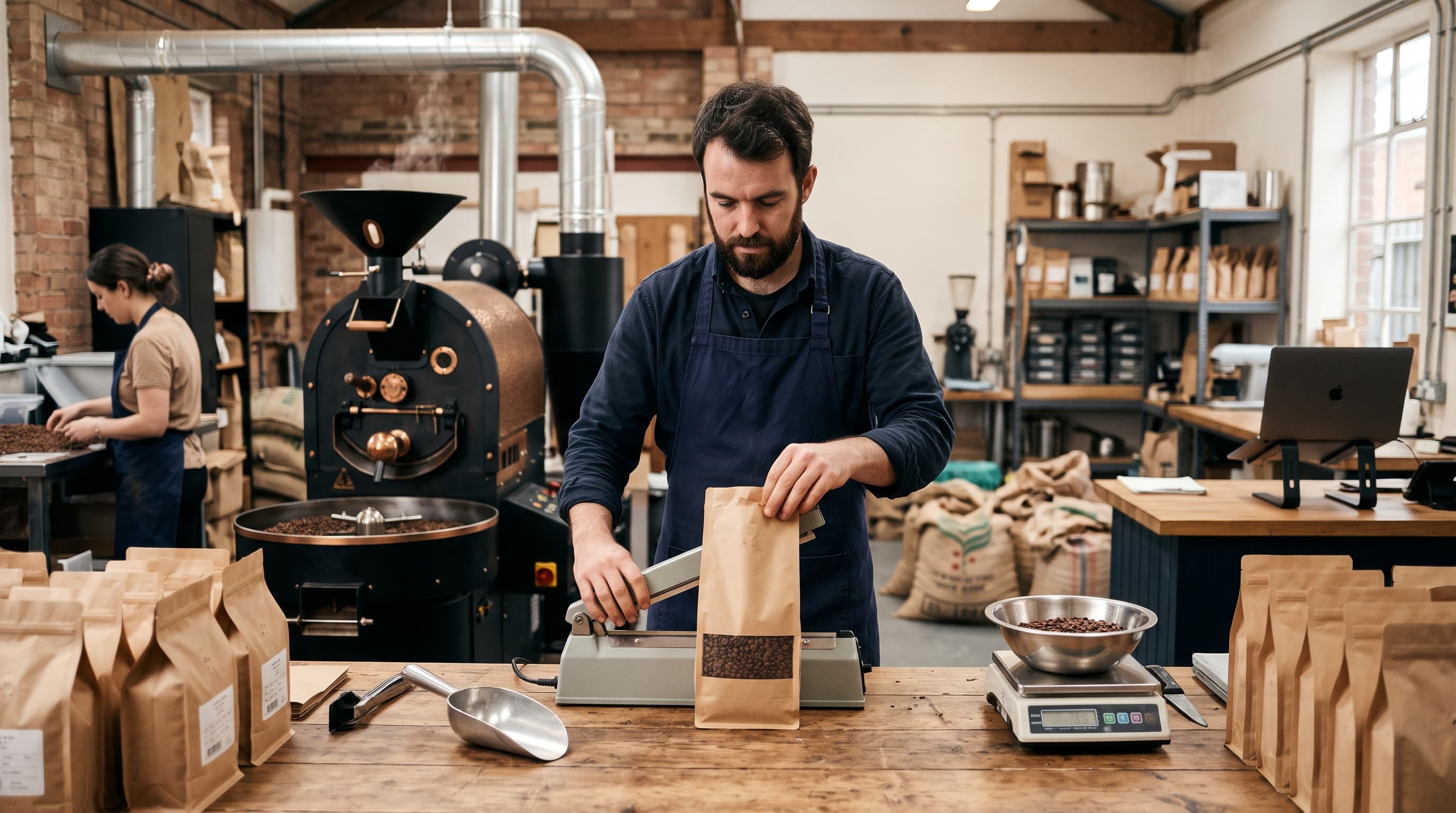
To ship coffee beans, seal them in a foil or kraft-lined bag with a one-way degassing valve, pack the bag snugly in a mailer box or padded mailer, and send it by USPS Ground Advantage or Priority Mail within a day or two of roasting. Keep the packed weight under 1 pound where you can, because that's where the cheapest rates sit.
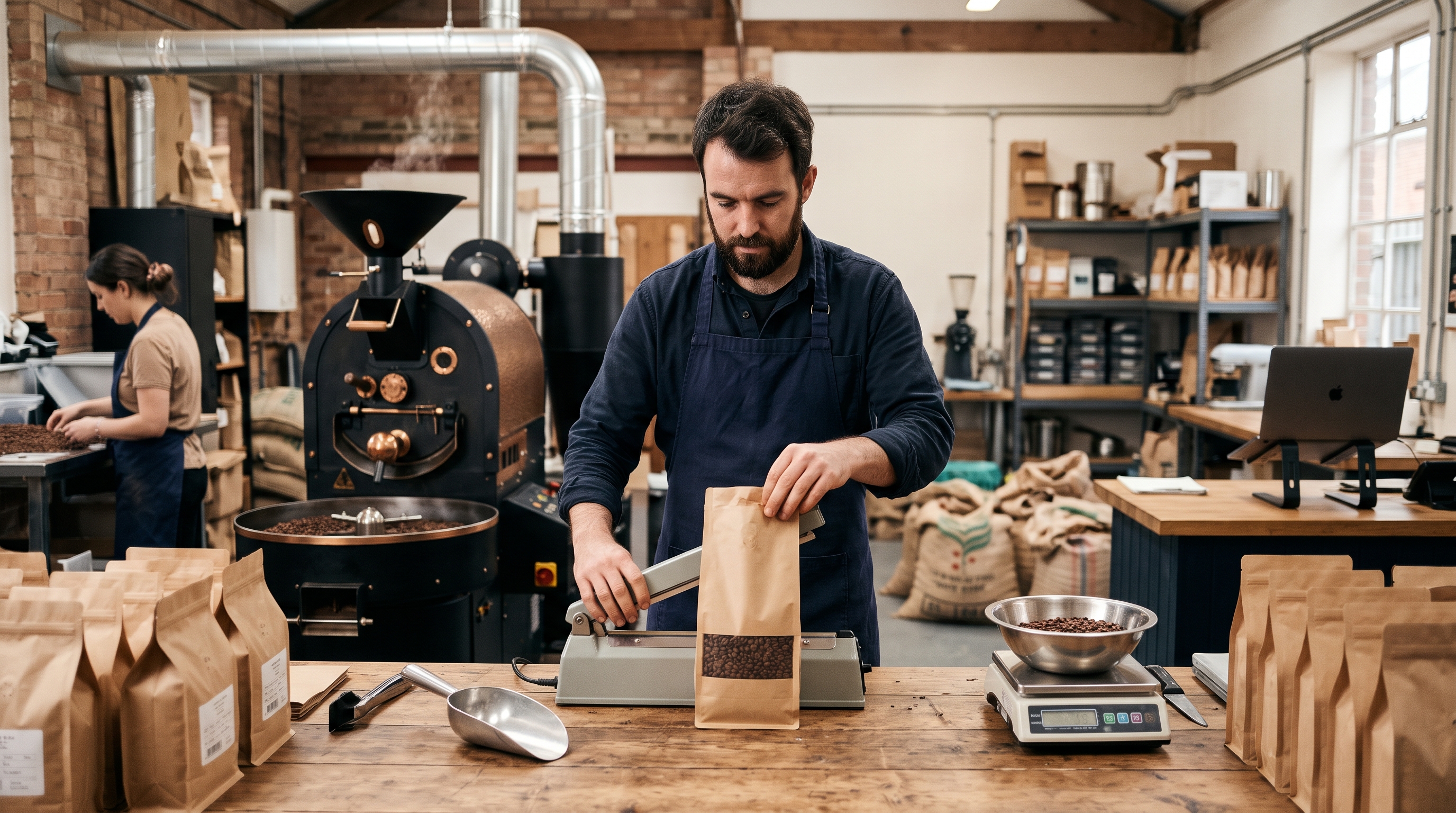
That's the short version. The details are what separate a customer who reorders from one who leaves a two-star review about flat coffee. This guide covers packaging, box sizes, weights, carrier options, costs, heat, international rules, and the freshness decisions that matter most when you're a roaster shipping to real customers.
How to Ship Coffee Beans: Packaging That Protects Freshness
Good coffee packaging for shipping has three layers: a barrier bag that blocks oxygen, light, and moisture; a degassing valve so the bag doesn't swell; and an outer box or mailer that protects the bag from crushing. Skip any layer and you'll see it in complaints.
Start with a coffee bag with a degassing valve
Freshly roasted beans release carbon dioxide for days after roasting. A coffee bag with a degassing valve lets that gas out without letting oxygen back in. Without one, bags puff up like pillows and sometimes split in transit. If you bag within hours of roasting, a valve is close to mandatory for darker roasts, which tend to off-gas faster.
Look for stand-up pouches or flat-bottom bags with a foil or metallized film layer. Plain kraft paper with no inner liner looks lovely on a shelf, but it lets oxygen in and your beans will taste stale sooner.
Choose an outer shell that fits
Empty space is the enemy. A bag that slides around inside a big box gets punctured at corners and can cost you more in dimensional weight. You have three realistic options:
- Padded or poly mailers: cheapest and lightest, fine for a single 12 oz bag if the bag is sturdy.
- Coffee mailer boxes: rigid, branded, and stackable. Best for gift orders, subscriptions, and bundles.
- Corrugated shipper boxes: best for multi-bag orders of 3 or more, where crush protection counts.
Skip loose fill where you can. A properly sized box needs almost no void fill, which saves money and looks better when it's opened.
What Are the Best Coffee Shipping Box Sizes and Bag Weights?
Most roasters ship 12 oz bags (340 g) or 1 lb and 2 lb bags. A single 12 oz bag fits a 6 x 9 x 2 inch mailer box, and 1 lb bags fit about 7 x 10 x 3 inches. Pick the smallest box that closes without pressing on the valve.
Coffee shipping box sizes by order
| Order | Typical box size (inches) | Approx. packed weight |
|---|---|---|
| One 8 oz bag | 6 x 4 x 3 mailer box or padded mailer | 10-11 oz |
| One 12 oz bag | 6 x 9 x 2 mailer box | 14-16 oz |
| One 1 lb bag | 7 x 10 x 3 mailer box | 19-21 oz |
| Two 12 oz bags | 9 x 7 x 4 shipper box | 1 lb 14 oz-2 lb |
| Three to four 12 oz bags | 12 x 9 x 4 shipper box | 3-4 lb |
| Five lb bulk bag | 12 x 10 x 6 shipper box | 5.5-6 lb |
These are our own working estimates based on typical bag and box tare weights (an empty valve bag is roughly 0.5-1 oz, a mailer box 2-5 oz), not industry standards. Packaging varies by supplier, so weigh your own packed box before you set shipping prices.
Why ship coffee bags weight matters so much
Carriers price by weight tiers, and the jump at 1 lb is the one that hurts. USPS Ground Advantage prices parcels of 4 oz, 8 oz, 12 oz, and 15.99 oz as separate tiers, then moves to per-pound pricing from 1 lb up. You can confirm the current tiers on the USPS business price lists, since rates are adjusted periodically. That's why many roasters sell a 10 or 11 oz bag: the packed parcel stays under 16 oz.
Here's a worked example. A 12 oz bag in a 3 oz mailer box packs at about 15.5 oz and ships in the sub-1 lb tier. Switch to a heavier rigid box at 4.5 oz and you land at 16.7 oz, which bumps you into the 1 lb tier. Same coffee, higher postage, for a box that's 1.5 oz heavier. Weigh a sample, then adjust the box, not the coffee.
What Is the Cheapest Way to Ship Coffee?
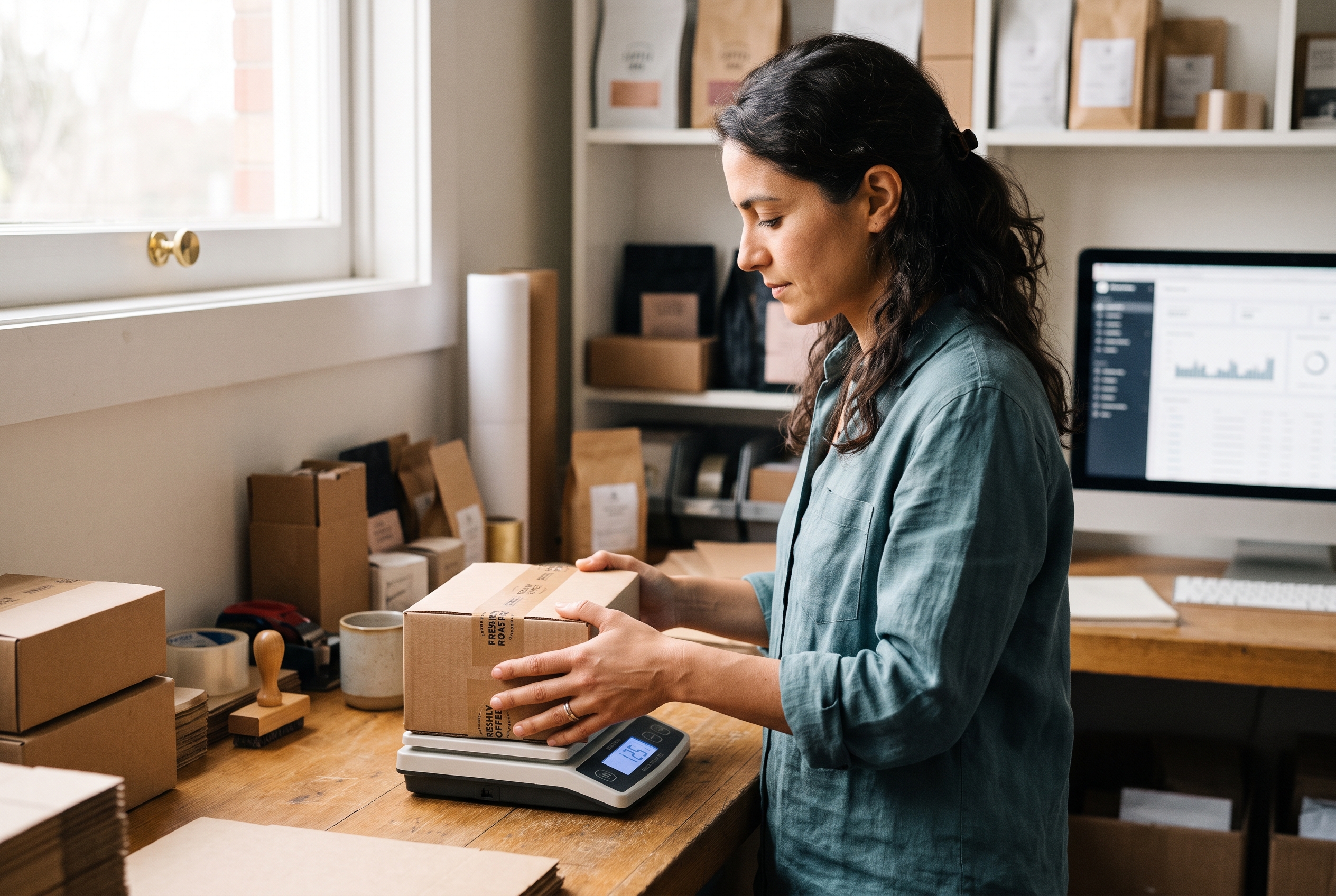
The cheapest way to ship coffee for most small roasters is USPS Ground Advantage for parcels under 1 lb, and USPS Ground Advantage or discounted Priority Mail through a shipping platform for heavier orders. Comparing rates by weight and zone each quarter keeps you honest.
Shipping roasted coffee USPS: the options
USPS is the default for coffee because most parcels are light and residential. Your main choices:
- Ground Advantage: the usual pick, with delivery typically in 2-5 business days depending on distance.
- Priority Mail: faster, usually 1-3 days, with Cubic pricing available for small dense packages. Coffee boxes often qualify, but check the box dimensions against the Cubic limits (a half cubic foot maximum) on the USPS site.
- Priority Mail Express: overnight-to-2-day, but pricey. Reserve it for gifts or rush orders.
UPS and FedEx can win on multi-bag orders over 3 lb to far zones, especially if you ship enough volume to negotiate. Check the current rate cards on UPS and FedEx before committing, since surcharges change. The practical method: price three sample parcels (a 15 oz single bag, a 2 lb two-bag box, and a 4 lb box) to a near zone and a far zone with each carrier, and keep the results in a simple spreadsheet. Re-run it every quarter.
Ways to cut your shipping bill
- Buy labels through a platform. Commercial rates through label software are lower than walking up to the counter.
- Right-size the box. Dimensional weight kicks in with bulky parcels, and a half-empty box costs more.
- Set a free shipping threshold. A threshold of two bags or $40-ish nudges single-bag buyers up, so the postage sits inside a bigger order.
- Offer subscriptions. Repeat orders at known weights let you plan packaging and rates. Our subscription ecommerce guide covers the model.
- Use local delivery for nearby customers. Hand-delivering within your city costs far less than postage. See how much to charge for local delivery.
Don't hide shipping costs and then discover your margin evaporated. Build the real postage and packaging cost into your price from the start.
How Do You Keep Roast Date Freshness During Shipping?
Ship coffee as soon after roasting as practical, ideally within 1-3 days, and print the roast date on the bag. Beans don't need to rest as long as some people claim, and they don't spoil in a few days of transit if the bag is sealed properly.
Roast date freshness shipping rules
Most specialty roasters consider coffee at its best from roughly a few days to a few weeks after roasting, though this varies by roast level and brew method. Many roasters suggest espresso rests about 5-10 days, while filter coffee can shine sooner. That's a common industry rule of thumb rather than a fixed standard, so taste your own coffees at day 3, 7, and 14 and set your ship-by guidance from that. The Specialty Coffee Association publishes guidance on storage and freshness if you want the broader standards.
Practical rules that work:
- Roast to order or in small batches. Ship from batches no older than a week.
- Put the roast date on every bag. It's a trust signal, and customers do look for it.
- Avoid weekend sit-time. Don't ship on Thursday or Friday if the parcel will sit in a hub over the weekend. Set a Monday-to-Wednesday shipping schedule.
- Skip the heat. See the heat section below.
Managing heat in summer shipping
Sealed foil bags tolerate heat better than most people fear, but parcel trucks and porches can get very hot, and sustained heat speeds staling and can flatten delicate flavors. To protect summer orders:
- Ship early in the week so parcels don't wait in a warm hub.
- Choose faster service (Priority Mail) for hot-climate destinations.
- Use a thin insulated liner or bubble-lined mailer; skip ice packs, which add moisture and condensation risk.
- Email tracking so customers can bring the box inside promptly.
Does coffee need to be refrigerated when shipped?
No. Roasted beans ship fine at room temperature. Refrigeration actually introduces moisture risk. Keep them dry, sealed, and out of sustained heat, and you're fine.
How Do You Set Up Coffee Roaster Fulfillment That Scales?
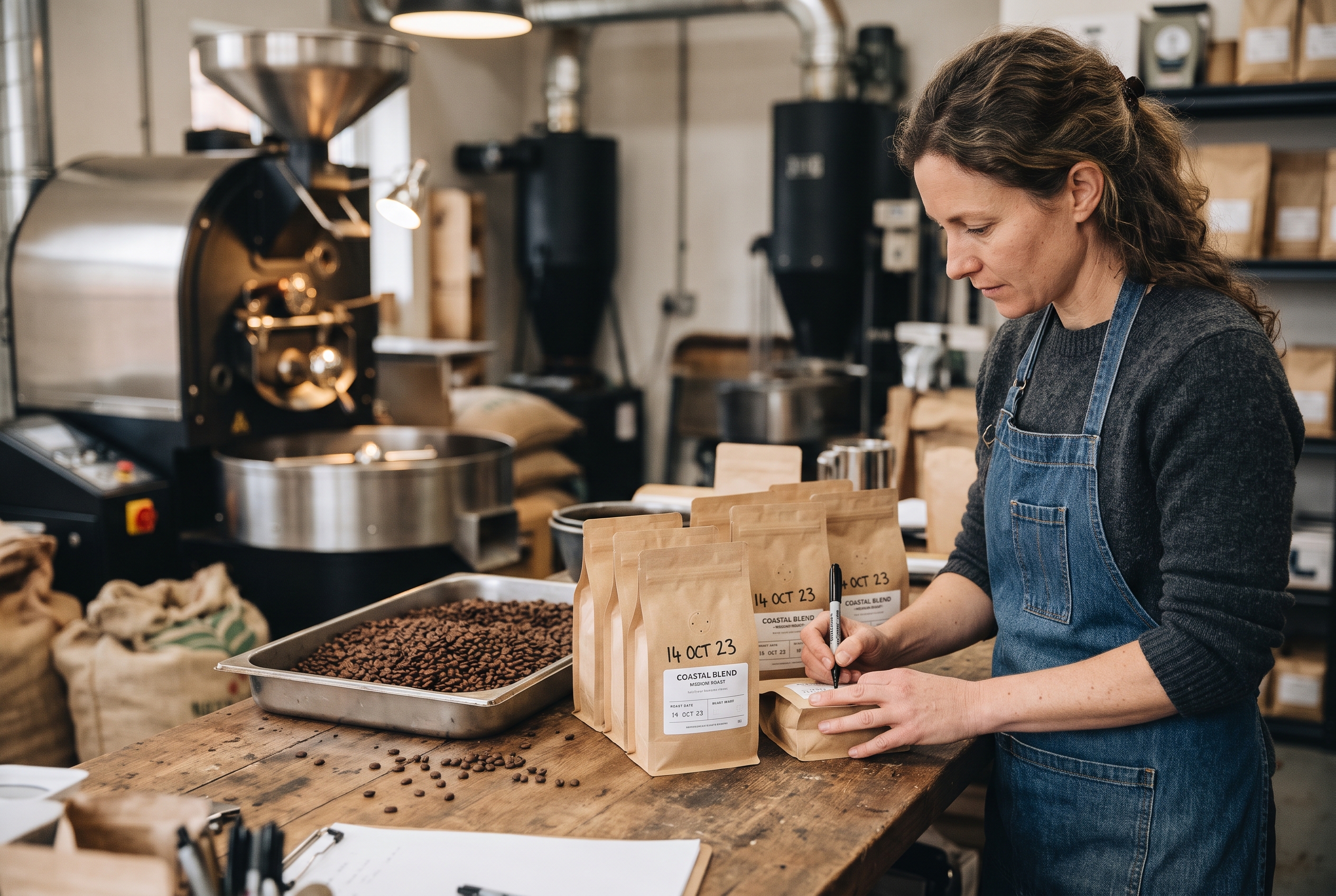
Coffee roaster fulfillment works best as a repeatable weekly routine: roast, rest briefly, bag, label, and ship in fixed batches. A simple system can handle a few dozen orders a week from a spare table. After that, you decide between hiring help or outsourcing.
A simple packing workflow
- Pull orders at a set time, say Monday and Wednesday mornings.
- Roast and bag the quantities needed, with roast date and grind option on each bag.
- Seal and check the valve is clear.
- Place bags in the right-size box, with a thank-you card or brew guide.
- Print labels in one batch and scan them at drop-off or schedule a carrier pickup.
- Send tracking emails automatically, so customers know when to expect the coffee.
When to outsource
Third-party logistics providers can pick and pack for you, but many aren't set up for fresh-roasted goods. Ask whether they can ship within 48 hours of receiving inventory and how they store coffee. Many small roasters self-fulfill until volume makes packing the bottleneck, often somewhere in the low hundreds of orders a week, though your own time and space limits decide the real number.
Your store needs to support the routine
Your online store should handle the pieces that make shipping coffee easier: weight-based shipping rates, grind and size variants, subscriptions, and abandoned-cart emails. If you're still setting that up, read how to sell coffee beans online, and weigh wholesale versus direct-to-consumer before deciding what share of your volume ships in parcels.
Common Mistakes When Shipping Coffee Beans
The most common mistakes are oversized boxes, bags without valves, shipping late in the week, and quoting flat shipping rates that don't match the actual cost. Each one is fixable in an afternoon.
- Using a flat rate that loses money on heavy orders. Use weight-based rates or tiered thresholds.
- Letting the valve get crushed. Keep dense items away from it, and leave room.
- Not testing a package. Mail yourself a box to a far zone, then check three things on arrival: the valve still releases air, the seams are intact, and the bag hasn't scuffed through at the corners.
- Skipping tracking. A tracking number answers most "where's my coffee" emails before they're written.
Shipping coffee internationally
International orders add paperwork and risk. Expect a customs declaration listing contents, value, and country of origin, and be aware that many countries regulate imported food, including roasted coffee. Some require import registration, ingredient or labeling details in the local language, or limit commercial quantities. Transit is also longer, often a week or more, so roast-date freshness takes a bigger hit. Before you open any country to orders, check the destination's import rules and the USPS country listings, and consider shipping only to a few markets you've tested. If margins are thin, selling domestically first is the safer path.
Do you need a license to ship coffee?
In the US, roasters selling food generally need to follow state and local food-business rules, and may need to register with the FDA as a food facility. Requirements differ by state, so check with your local health department. Our business license guide is a good starting point.
Ship Coffee Without Fighting Your Store
Shipping coffee beans well comes down to a sealed valve bag, a snug box, a parcel weight you've tested, and a ship-fast schedule that protects roast date freshness. Get those four right and most of the problems disappear.
If you'd rather spend your time roasting than wrestling with plugins, Rovela builds a complete online store from a plain-language description, with Stripe checkout, shipping tools, abandoned cart recovery, and customer accounts included in one flat subscription. You can see Rovela's pricing or start at rovela.ai.