
By El Ghali Bennis · Published
How to Sell Coffee Beans Online: Step-by-Step Guide
Learn how to sell coffee beans online: pick your model, price bags, ship fresh, add subscriptions and go wholesale, with a 30-day launch plan.
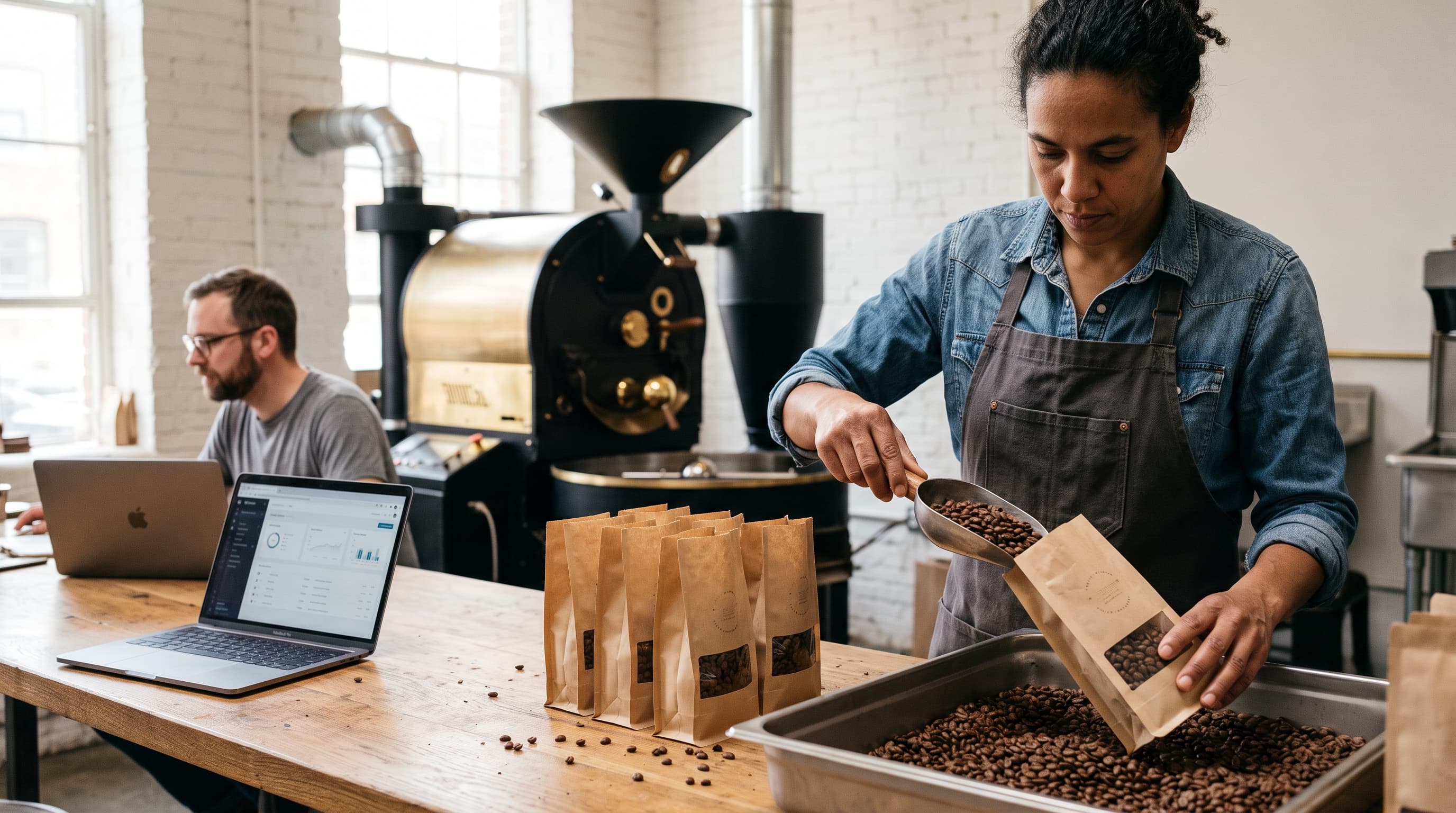
To sell coffee beans online, you need four things: a product you can source or roast consistently, legal compliance for food sales, packaging that protects freshness in transit, and a store with secure checkout. Add a subscription option and you turn one-time buyers into recurring revenue. Here's the full process, step by step.
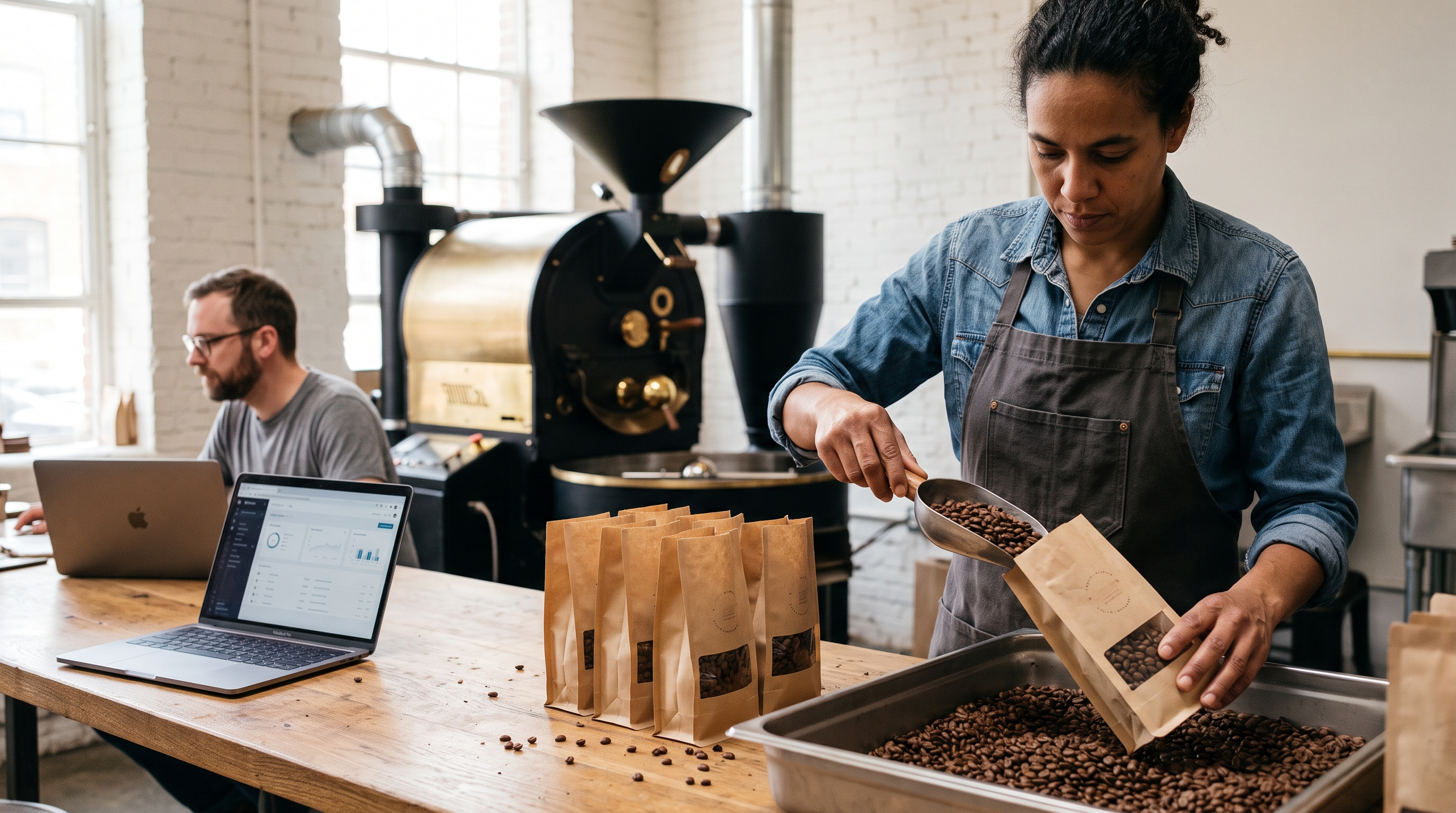
Coffee is one of the best products to sell online. It's lightweight, it's consumable, and people reorder it every two to four weeks. That repeat purchase pattern is what makes a coffee ecommerce store so appealing compared with, say, furniture or jewelry. But it's also a crowded category, so the details matter: how you source, how you describe flavor, how you ship, and how you keep customers coming back. Figures in this guide are planning estimates based on typical small-roaster practice. Where a figure comes from a named body, we say so. Verify everything against your own quotes.
Choose Your Model Before You Sell Coffee Beans Online
You can sell coffee beans online in three main ways: roast them yourself, buy roasted beans wholesale and rebrand them (private label), or resell other roasters' coffee. Each has different margins, startup costs, and legal requirements.
Start a coffee roasting business online
If you want to start a coffee roasting business online, you'll buy green (unroasted) beans from an importer, roast in small batches, and ship within days. Margins are the highest of the three models, because green coffee is the cheapest input. The tradeoff is equipment: a small shop roaster typically runs from a few thousand dollars to well over $20,000, and you'll need space, ventilation, and a lot of practice to roast consistently.
Many roasters start by renting time on a shared roasting facility or using a co-roasting space. You learn the craft and test demand before buying a machine.
Roast-profile software makes consistency far easier. Tools such as Cropster, Artisan (a free, open-source option) and RoastPath log bean temperature curves, so you can repeat a good roast and fix a bad one. Pair a data logger with a cupping notebook and you'll have a record for every batch.
Private label and white label
Private label means an established roaster roasts, bags, and labels the coffee under your brand. You don't touch a roaster. Minimum orders are often modest, and you can focus on brand, photography, and marketing. Margins are lower than roasting yourself, but your risk is too.
Reselling or curating
You can also curate coffees from several craft roasters, like a bottle shop for beans. This works well if you have an audience (a newsletter, a café, a social following) and strong taste. You'll need wholesale agreements and clear pricing so you don't undercut the roasters you buy from.
| Model | Startup cost | Margin potential | Best for |
|---|---|---|---|
| Roast your own | High (equipment, space) | Highest | Craft-focused founders |
| Private label | Low to medium | Medium | Brand and marketing-led founders |
| Curate / resell | Low | Lower | People with an existing audience |
What Do You Need Legally to Sell Roasted Coffee Online?
To sell roasted coffee online in the US, you generally need a business registration, a seller's permit or sales tax registration, and compliance with FDA food facility and labeling rules. Requirements vary by state and country, so check locally before your first sale.
Coffee is a food product, which means it falls under the U.S. Food and Drug Administration's rules. Facilities that manufacture, process, or pack food generally have to register with the FDA, and packaged coffee needs proper labels: product name, net weight, ingredients (for flavored coffee), allergen information where relevant, and your business name and address.
Some states restrict home-based food production under "cottage food" laws, and roasted coffee is treated differently from state to state. Others require a commercial kitchen or licensed facility. If you roast at home, confirm with your state department of agriculture or health first.
Two of our existing guides cover the paperwork in more detail: whether you need a business license to sell online and whether you need a sales tax permit. If you plan to sell food more broadly, the guide to selling food online covers labeling and compliance basics too.
- Register your business (LLC or sole proprietorship, depending on your risk tolerance).
- Get a sales tax permit in states where you have to collect tax.
- Check food production rules for your state or country.
- Get product liability insurance. Most wholesalers and some marketplaces ask for it.
- Label correctly before the first bag ships.
How to Price and Source Coffee Beans for Online Sales
Price your coffee by working backward from your total cost per bag: green coffee, roast loss, packaging, shipping, payment fees, and marketing. A common planning target among small roasters is a gross margin of 50% or more on a 12-ounce bag. This is a rule of thumb, not a published benchmark. Subscriptions can run higher because you spend less on acquisition.
Sourcing green coffee
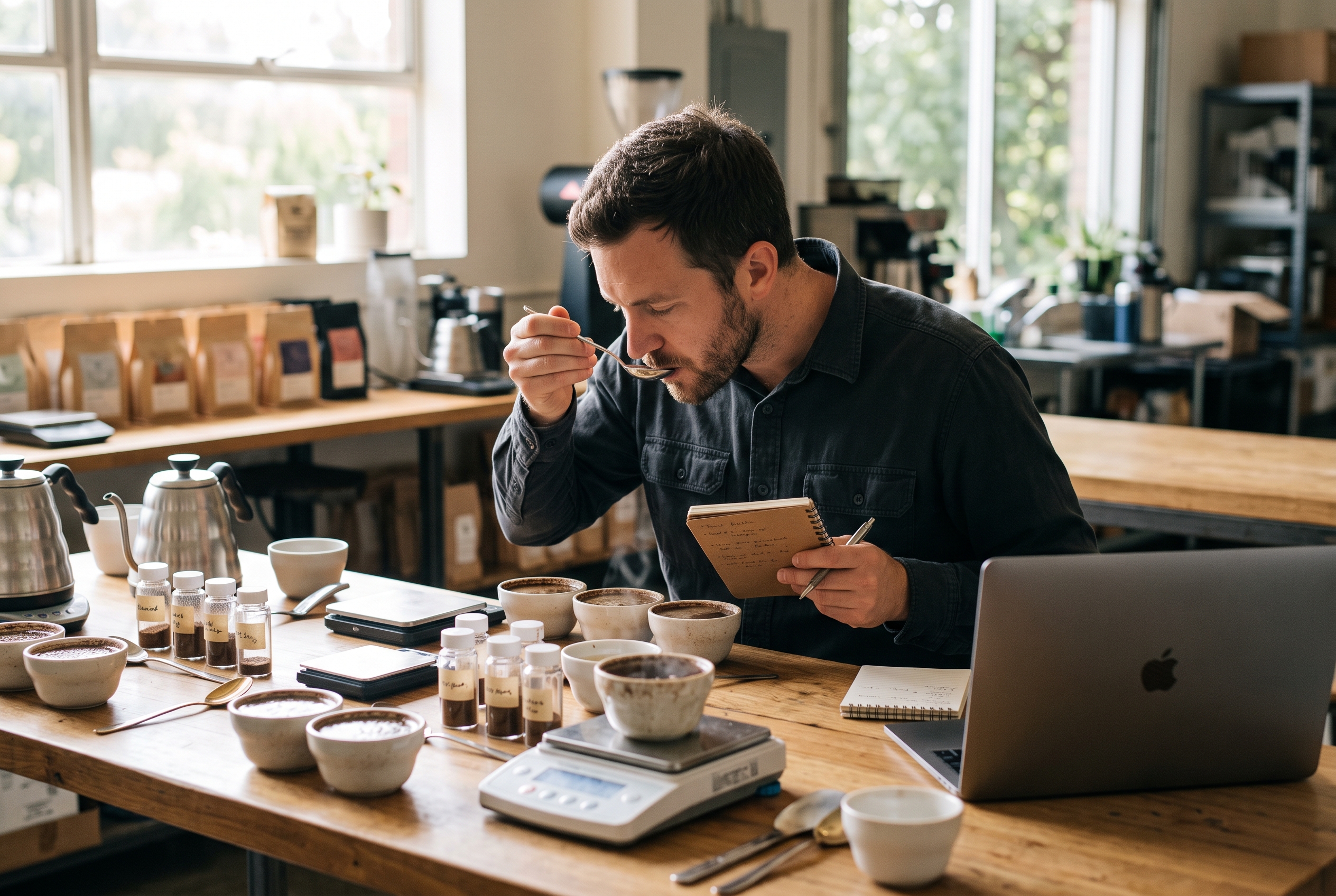
Most small roasters buy from importers and green coffee marketplaces that sell in small lots, sometimes as little as a single 60 to 70 kg bag. Ask for samples, roast them, and cup them before you commit. The Specialty Coffee Association, at sca.coffee, publishes the cupping and grading standards most importers follow. Under the SCA's protocol, coffees scoring 80 points or higher on its 100-point scale qualify as specialty grade, which is a useful filter when comparing offers.
Roasting removes roughly 12 to 20 percent of a bean's weight as moisture, depending on roast level, with darker roasts losing the most. This is a widely cited roaster rule of thumb, and your own roaster's logs will give the exact number. So 10 pounds of green coffee doesn't give you 10 pounds to sell. Build that loss into your cost math. Green coffee prices also swing with the commodity market, so ask your importer about contract pricing for your best sellers.
A simple pricing example
Say a 12 oz bag costs you $5.50 in green coffee (after roast loss), $0.90 in packaging and label, and $0.60 in payment processing. That's $7.00 before shipping and marketing. Sell it at $18 and you have about $11 of gross margin before shipping, which is roughly 61%. Sell it at $14 and you're down to 50%, with very little room to run ads. This is an illustrative example; plug in your own quotes.
Don't price at the grocery shelf. Customers who buy coffee online expect something better: single origins, a roast date, a story. Specialty bags commonly sell at $16 to $24 for 12 oz at independent roasters, and rare lots go higher. Check five competitors' product pages to see where your coffees fit.
Roaster capacity and breakeven
Capacity sets your revenue ceiling, so do this math before buying a machine. Take a 5 kg (about 11 lb) shop roaster. Each batch of 4.5 kg green yields roughly 3.8 kg roasted after about 15% loss, which is around 14 twelve-ounce bags. If a batch takes 20 minutes including cooling and you roast 4 hours a day, that's about 12 batches, or roughly 165 bags a day at the machine's limit. Real days are slower because of cleaning, cupping, packing, and admin, so plan on a fraction of that.
Now breakeven. Suppose your fixed costs are $3,000 a month (rent, loan payment on a $15,000 roaster, insurance, software, and a part-time helper). At the $18 bag and $7.00 product cost from above, with $4.50 average shipping you collect on top, you keep about $11 per bag before marketing. Allow $3 per bag for ads and email tools and you're at $8. Then $3,000 ÷ $8 means about 375 bags a month, or roughly 12 a day, just to cover fixed costs. That is well under capacity, which is why roasting yourself can work, but only if you can find those 375 monthly buyers. A subscription base of 100 customers taking two bags a month covers more than half of it. These numbers are illustrative; swap in your own rent, equipment, and shipping quotes.
Three roasters, three paths
Established brands show how different the models can be. Counter Culture and Stumptown grew from regional wholesale roasters into national brands with direct-to-consumer subscription programs. Trade Coffee took the curation route, building a marketplace that ships bags from many independent roasters. We haven't verified their revenue or margin figures, so use them as product-page references rather than benchmarks. What they share is visible: a clear roast date, flavor notes, and easy repeat ordering. Study their product pages and subscription flows before designing yours.
Build a tight starting menu
Launch with 4 to 6 coffees, not 20. A reasonable lineup:
- One approachable house blend (your bestseller)
- One dark or espresso roast
- Two single origins that rotate seasonally
- One decaf (Swiss Water process sells well)
- A sampler pack so new buyers can try several
Coffee Shipping and Packaging That Protects Freshness
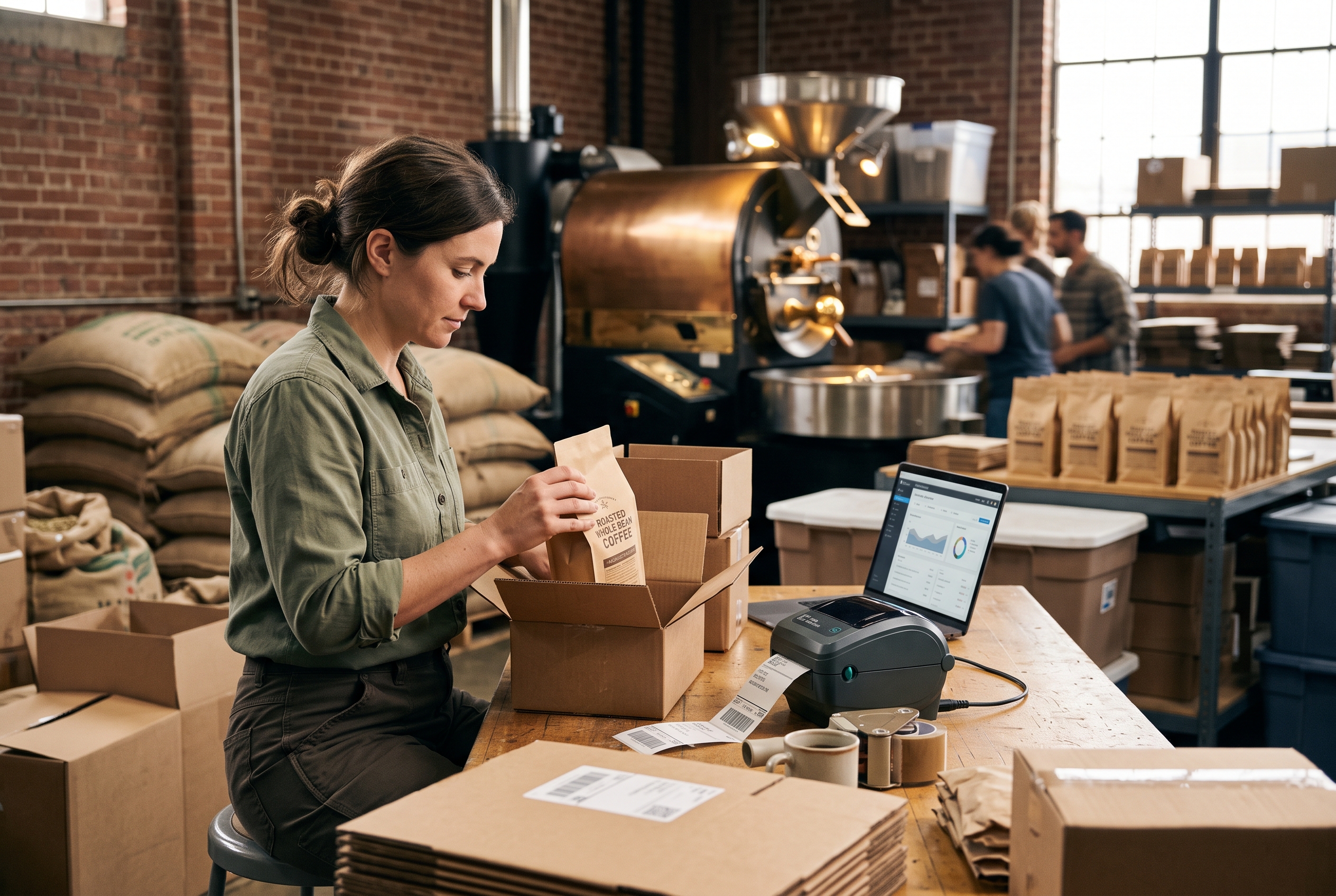
Good coffee shipping and packaging means a sealed, valved, resealable bag, a box that fits snugly, and a ship date within a few days of roasting. Freshness is your product, so you're really selling a roast-to-door timeline.
Bags and labels
Use a one-way degassing valve bag. Freshly roasted coffee releases carbon dioxide for days, and the valve lets gas out without letting oxygen in. Stand-up pouches with a zipper make a better shelf and kitchen presence, and kraft-with-foil-lining bags are the common choice. Print the roast date on every bag. It's the single most trusted freshness signal for coffee buyers.
Boxes and shipping rates
Coffee is dense and heavy for its size, so shipping can eat your margin. A 12 oz bag fits in a small flat box or a bubble mailer and often qualifies for lightweight postal rates. Compare carriers: USPS is usually cheapest for a single bag under a pound, while UPS and FedEx can win on multi-bag orders and zones further away. Use a shipping software or carrier calculator to quote real rates by zone before you set your free-shipping threshold.
Two ways to protect your margin:
- Set a free shipping threshold that nudges buyers to add a second bag (for example, free shipping over $40 when your bag is $18).
- Bundle shipping into the price of subscriptions, so the customer sees one simple monthly number.
Shipping coffee internationally
Cross-border orders add cost and paperwork. Roasted coffee is a food product, so many countries require a commercial invoice, a customs declaration, and sometimes import permits or labeling in the local language. Canada, the UK and the EU each have their own food import rules. Start by shipping only domestically, then test one neighboring market. Decide whether customers pay duties on delivery (DDP versus DAP shipping) and say so clearly at checkout. Because beans age, choose fast international services; a slow shipment can erase the freshness you sell.
Roast schedule and fulfillment
Pick fixed roast days, say Tuesdays and Fridays, and publish a cutoff on your site ("Order by Monday night for Tuesday's roast"). Customers like the transparency, and you avoid roasting for single orders. Many roasters suggest resting beans a few days after roasting so they degas, with espresso often resting longer than filter coffee, and the exact window varies by roast. Ship within 24 to 48 hours of roasting.
Build a Coffee Subscription Business That Pays the Bills
A coffee subscription business works because customers use coffee on a predictable schedule. Offer weekly, biweekly, or monthly deliveries at a small discount (many stores use roughly 5 to 15 percent, a common practice rather than a standard), and recurring orders can become the bulk of your revenue.
Why subscriptions beat one-time sales
Acquiring a new customer through ads or social media costs real money. A subscriber who stays six months pays that cost back several times over. Subscriptions also make roasting predictable: you know about how many pounds you'll roast each week.
How to structure your plans
- Choose-your-coffee: the customer picks a blend and grind size and sets a frequency.
- Roaster's choice: you pick a rotating single origin. This is great for moving small lots.
- Gift subscriptions: a prepaid 3, 6, or 12-month plan. These sell well in November and December.
Make skipping, pausing, and canceling easy. It sounds counterintuitive, but customers who can pause when they're traveling stay subscribed longer than those who feel trapped and cancel entirely.
Keep every plan's math in mind. If you discount 10% and give free shipping, your margin has to survive both. On the $18 bag above, a 10% discount costs $1.80 and shipping of $4.50 comes out of what's left, so your per-bag margin drops from about $11 to roughly $4.70 before marketing. Run the numbers on your lowest-margin option before you launch.
Sell Wholesale to Cafés and Offices
Wholesale is the other half of many roasting businesses, and it pairs well with online sales. Cafés, restaurants, offices, and small grocers buy in 5-pound bags or larger and reorder on a schedule. Wholesale prices are usually well below retail, so margins per pound are thinner, but orders are bigger and steadier.
- Set a wholesale price sheet with tiers by volume, and keep retail prices higher so you don't undercut your own café partners.
- Add a wholesale login or application form to your site so buyers can reorder without emailing you.
- Offer a trial: a free sample bag and a short cupping session win more accounts than a price list.
- Set payment terms such as card on file or net 15, and decide your minimum order.
Build Your Coffee Roaster Website to Sell Coffee Beans Online
Your coffee roaster website needs fast pages, great product photos, clear flavor notes, a roast date, simple checkout, and subscription options. It should also let people find you on Google and recognize you on Instagram.
What your store must include
- Tasting notes and filters: roast level, origin, process, and brew method (espresso, filter, French press).
- Grind options at checkout: whole bean, espresso, drip, coarse.
- Subscription and one-time toggle on each product page.
- Reviews with photos, and a Q&A for brew questions.
- Abandoned cart emails to recover buyers who left at shipping costs.
- Clear shipping and roast schedule information above the fold.
The platform decision matters here. On Shopify, subscriptions, reviews, abandoned cart recovery, and wishlists generally need paid apps on top of the base plan, according to Shopify's pricing page and app store. Those add up fast on a product where margins are already tight. If you're comparing options, our guide to the best apps to sell products online breaks down costs, and how to add products to your online store walks through listing setup.
If you'd rather not wire together a theme and a pile of plugins, Rovela builds a complete store from a plain-language description, with abandoned cart, reviews, loyalty, and Stripe checkout included in one flat subscription. Rovela says new stores go live in hours rather than weeks.
Photography and copy
Coffee is hard to photograph because the product is a bag. Show the bag in context: beans spilling from a scoop, a pour-over in morning light, hands holding a mug. Write flavor notes in plain words ("dark chocolate, orange peel, caramel") instead of jargon. Our list of ChatGPT prompts for product descriptions can speed up the first drafts, but always edit them so they sound like you tasted the coffee.
Getting your first customers
- Start local. Farmers markets, cafés, and office managers become your first reviewers. If you also have a physical presence, see how to start selling online from a physical store.
- Use Instagram and short video. Roasting, grinding, and pour-over clips perform well, and the same social selling principles apply to any physical product.
- Build an email list from day one with a first-order discount. Coffee reorders happen on a schedule, which makes email reminders very effective.
- Send samples to local food writers and podcasters who review gear and drinks.
- Rank for search terms like "fresh roasted coffee delivery" with origin pages and brewing guides.
Common Questions About How to Sell Coffee Beans Online
Is selling coffee beans online profitable?
It can be, if you control costs and sell to repeat customers. Gross margins of 50 to 65 percent are achievable on the pricing math above, but the business only becomes profitable after you cover marketing, shipping, and fixed costs. Subscriptions are the main lever.
Can I sell coffee on Amazon or Etsy instead?
Yes, but marketplaces take fees and own the customer relationship. Use them for discovery, then move buyers to your own store and email list. The same logic applies to other categories, like candles.
How much does it cost to start?
If you use private label, you can launch for under $2,000, covering branding, a first order, and your store. Roasting yourself usually means $10,000 or more once you add a roaster, a scale, a packing station, and insurance.
How long does coffee stay fresh?
Whole beans are at their best for roughly two to four weeks after roasting, though they stay drinkable longer. That's why small, frequent orders and subscriptions suit coffee well.
Your Launch Plan: First 30 Days
- Week 1: Choose your model, register your business, and confirm food rules.
- Week 2: Source samples, lock in 4 to 6 coffees, and finalize bags and labels.
- Week 3: Build your store, photograph the products, and set up shipping rates and subscriptions.
- Week 4: Soft launch to friends, local customers, and your email list. Collect reviews and fix friction.
Selling coffee beans online comes down to freshness, margin math, and repeat orders. Get the sourcing and shipping right, and the store becomes the easy part. When you're ready to build it, Rovela can generate a full coffee ecommerce store from a short conversation, with subscriptions-ready checkout, reviews, and abandoned cart recovery already built in. Check the pricing page to see how a flat plan compares with stacking apps, then launch your store this month.
