June 22, 2026
How to Sell Clothes on Instagram: A Step-by-Step Guide
Learn how to sell clothes on Instagram step by step — set up Shopping, tag products, run shoppable posts, and convert followers into buyers.

Knowing how to sell clothes on Instagram is one of the fastest ways to turn a phone full of outfit photos into actual revenue. More than 2 billion people open the app every month, a huge share of them looking for outfit inspiration, and Instagram is built to put your products one tap away from a checkout. The catch: scattering pretty photos around isn't a strategy. You need product tags, a clean catalog, a way to take payment, and a feed that gives people a reason to buy. This guide walks you through the whole thing — from connecting your clothing store to Instagram to closing the sale.

Why Instagram works so well for clothing brands
Apparel is visual, emotional, and impulse-driven. That's exactly the kind of buying Instagram is engineered to trigger. People scroll to feel something, see a piece they want to be seen in, and tap before they overthink it.
Social commerce for clothing brands keeps growing because the discovery and the purchase now live in the same place. A shopper doesn't have to leave the app, open a browser, and hunt down your site. The product tag, the price, and the "View Shop" button sit right on the image they already stopped to admire.
The numbers back this up. Apparel and accessories are consistently the single largest social-commerce category, accounting for roughly a quarter of all social-driven sales, and fashion engagement on Instagram tends to run higher than the platform's overall average — branded apparel posts commonly see engagement rates in the 1–3% range versus the sub-1% norm for most industries. Conversion on shoppable apparel posts is modest in raw terms (often 1–2% of taps to purchase), but because the traffic is free and intent-loaded, the math works. For context, the Shopify guide to social commerce tracks how fashion repeatedly tops the category charts across channels. If you sell clothes and you're not active on Instagram, you're skipping the storefront window your buyers already walk past every day.
Here's what makes it click for clothing specifically:
- Outfit context. A shirt on a hanger sells; a shirt styled on a person sells far better.
- Reels reach. Short video gets pushed to people who don't follow you yet — free discovery.
- Tagging. Shoppable Instagram posts for clothing let buyers price-check and buy without breaking their scroll.
- Social proof. Comments, saves, and shares act as instant reviews.
How to sell clothes on Instagram: the setup steps
Before you can tag a single dress, you need the plumbing in place. Selling clothes online through social media works when your catalog, payment, and shop are all connected. Here's the order that actually works.

1. Switch to a business or creator account
A personal account can't sell. Go to your settings and switch to a Business account. This unlocks Instagram Insights, contact buttons, and — critically — Instagram Shopping eligibility.
2. Meet the commerce requirements
Instagram requires you to sell physical goods, comply with its commerce policies, and have a connected website domain where the products live. Review the official Commerce eligibility requirements before you apply, because rejected accounts lose days waiting on re-review.
3. Build a product catalog
Your catalog is the database Instagram pulls from when you tag a product. Each entry needs a name, image, price, and a link to the product page on your store. You can build this manually in Meta Commerce Manager or — far less painful — sync it automatically from your e-commerce platform.
4. Connect your clothing store to Instagram
This is the step that trips people up. To connect your clothing store to Instagram, you link your Facebook Page and your product catalog through Meta Commerce Manager, then submit your account for shopping review. Approval usually takes a few days. Once you're approved, the "Tag products" option appears whenever you create a post or Reel.
5. Turn on Instagram Shop
After approval, set up your Instagram shop for your clothing store from the Commerce Manager dashboard. Choose a checkout method, pick which collections to feature, and your Shop tab goes live on your profile. Now your whole feed becomes a catalog people can browse.
Creating shoppable Instagram posts for clothing that convert
A live shop is only half the job. The content has to make people want the clothes. Shoppable Instagram posts for clothing only earn money when the photo stops the scroll and the tag removes the friction.

Photograph clothes the way people wear them
Flat-lays have their place, but worn-on-body shots win. Show movement, fit, and styling. Pair the same top three different ways across a carousel so one post becomes three reasons to buy.
Tag products clearly — but don't bury the image
Add product tags to the items in frame. Keep it to one or two tags per image so the photo stays clean. In carousels, tag a different piece on each slide to spotlight more of your range.
Use Reels for discovery, posts for the catalog
Reels are your reach engine. Consider a concrete pattern: a small loungewear label posts a 12-second "styling one set three ways" Reel on a Tuesday. The feed posts that week reach maybe 1,500 of its existing followers, but the Reel surfaces to roughly 18,000 non-followers through the recommendation engine. Even at a 1.5% tap-through to the tagged product and a 2% purchase rate, that single clip puts the set in front of thousands who'd never heard of the brand and produces a handful of sales the feed alone never would. That's the mechanism behind "Reels accelerate sales" — discovery volume the static feed can't match. Feed posts and the Shop tab are where browsers who already like you go to buy. You need both.
A few content formats that reliably move apparel:
- Styling videos — one piece, multiple looks.
- Restock and drop alerts — scarcity drives urgency.
- Customer photos — repost buyers wearing your pieces.
- Behind-the-scenes — fabric, design process, packing orders.
- Try-on hauls — fit and feel answered before the question's asked.
Write captions that answer buying questions
Sizing, fabric, fit, and shipping kill more sales than price. Answer them in the caption before someone has to DM you. "Runs true to size, 100% organic cotton, ships in 48 hours" removes hesitation.
Instagram vs. TikTok Shop: where should clothing brands sell?
Instagram isn't the only stage. Plenty of merchants ask how to sell clothing on TikTok Shop too, because the discovery there is brutal-fast and the native checkout keeps buyers inside the app. The honest answer: most growing clothing brands eventually sell on both, but they start where their audience already lives.
| Factor | Instagram Shop | TikTok Shop |
|---|---|---|
| Audience age | Broad, skews 25–44 | Younger, skews 16–34 |
| Content style | Polished photos + Reels | Raw, fast, native video |
| Discovery speed | Steady, builds over time | Explosive, viral spikes |
| Best for | Brand-building, repeat buyers | Trend-driven, impulse buys |
| Checkout | In-app or your site | In-app native checkout |
How TikTok Shop registration and fees actually work
To start selling clothing on TikTok Shop, the process is more involved than just tagging a post. You register through TikTok Shop Seller Center, verify your business with documents (business registration or a government ID for sole proprietors), and provide a bank account for payouts. Once approved, you sync your catalog — manually, via a product feed, or through an integration with your e-commerce platform — and then sell three ways: organic videos with product tags, a pinned product showcase on your profile, or affiliate partnerships where creators earn commission for promoting your items.
The fee structure is the part most guides skip. TikTok Shop charges a per-transaction commission (commonly in the single-digit percentages, with promotional reduced rates for new sellers in many regions) plus standard payment processing. If you run the affiliate program, you set an additional creator commission on top — often 10–20% for apparel — which comes out of your margin but buys you reach. Compared with Instagram, where checkout often routes to your own site and you only pay your own processor, TikTok's native checkout is more convenient for buyers but takes a larger cut. Price that into your margins before you commit a hero product to it.
The mechanics otherwise mirror Instagram: catalog, tags, checkout. The tone is just louder and faster. The smart move is to keep one source of truth for your catalog and inventory, then push it to every channel. When your stock lives in one store and syncs out to Instagram and TikTok, you don't oversell, double-count, or update prices in five places. That's the difference between a side hustle and a business.
From social feed to a store you actually own
Selling clothes online through social media has one quiet trap: you're building on rented land. Instagram owns the algorithm, the reach, and the rules. A policy change or a shadow-banned account can cut your sales overnight. The feed should drive traffic — the sale should land on a store you control.
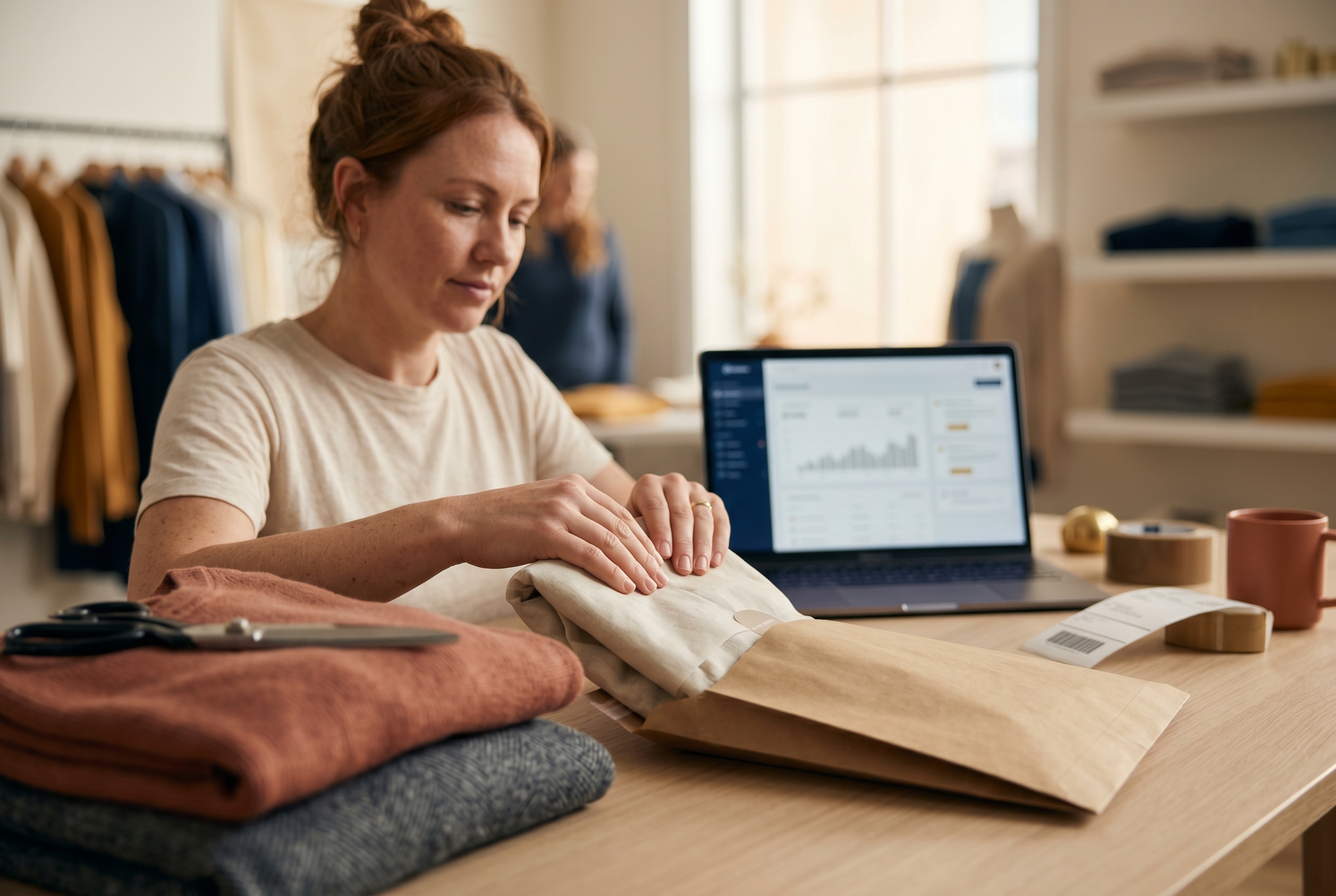
That's why the merchants who last treat Instagram as the top of the funnel and a real storefront as the foundation. Picture two boutiques that each hit 20,000 followers: one sends every "shop now" tap to a Linktree of social links, the other routes taps to its own product pages with saved customer accounts and abandoned-cart emails. Same traffic, but the second captures emails, recovers carts, and earns repeat orders the first never sees — that gap compounds every month. Your own store handles checkout, customer accounts, abandoned-cart recovery, email flows, and the catalog that feeds every social channel. Instagram tags then point straight to it.
Setting that store up used to mean weeks of theme tweaks, a stack of paid plugins for basics like wishlists and abandoned-cart emails, and a developer on retainer. It doesn't anymore. Rovela's conversational store builder creates a complete clothing store from a plain-language conversation — storefront, catalog, Stripe checkout, customer accounts, and 100+ features like abandoned cart, reviews, and loyalty included by default, with no per-app billing. You describe your brand; the store ships in hours.
A few principles to keep your social-to-store funnel tight:
- One catalog, many channels. Update a product once; it flows to Instagram, TikTok, and your site.
- Own your customer list. Capture emails so you're not dependent on the algorithm.
- Recover abandoned carts. Most first-time buyers don't checkout on the first visit — automated reminders win them back.
- Keep the site fast. Slow mobile pages tank both conversion and SEO; speed is non-negotiable for fashion.
If you want to compare what an all-in-one setup costs against stitching together a platform plus apps, the Rovela pricing breakdown lays it out, and the Rovela e-commerce blog has more guides on building and scaling an online clothing business.
Common questions about selling clothes on Instagram
Do I need a website to sell clothes on Instagram?
Yes. Instagram requires a connected domain where your products live, even when buyers check out inside the app. Your store is the catalog source and the place that handles payment, shipping, and customer records.
How much does it cost to start?
Instagram Shopping itself is free to set up. Your real costs are inventory, photography, shipping supplies, and the store platform that powers your catalog and checkout. Keeping that platform cost low and predictable protects your margins.
How long until I make sales?
With a connected shop and consistent posting, most new clothing brands see first sales within a few weeks. Reels accelerate it by reaching people who don't follow you yet. Consistency beats perfection.
Turn your feed into a real clothing business
Selling clothes on Instagram comes down to four moves: switch to a business account, build and connect your catalog, turn your feed into shoppable posts, and route every sale to a store you actually own. Do those well and the app becomes a discovery machine feeding a real business — not a hobby that vanishes with the next algorithm change.
If you're ready to give those Instagram tags somewhere worth pointing, Rovela's all-in-one clothing store platform builds your complete store from a single conversation, with everything you need to sell included from day one. Describe your brand, go live in hours, and start turning followers into buyers.