By El Ghali Bennis · Published
Jewelry Web Design Pricing: What You'll Really Pay in 2026
Jewelry web design pricing runs from under $500 to $60,000+. Compare template, freelance, agency and AI builds, plus retainers and hidden costs.

Jewelry web design pricing typically runs from under $500 a year for a template-based store to $15,000-$60,000+ for a custom agency build, plus $200-$3,000 a month in maintenance and retainers. Where you land depends on catalog size, custom features, and who builds it. This guide breaks down every model.

Most quotes look cheap until you add the pieces they leave out: product photography, apps, ongoing edits, SEO, and security. Below you'll see what each pricing model includes, what it hides, and which one fits your stage. Figures here are market ranges compiled from published platform pricing and typical agency and freelancer rate cards, not fixed quotes, so confirm them with providers. If you want the broader picture first, our guide on how much a jewelry store website costs covers the total budget.
How Much Does Jewelry Web Design Pricing Run in 2026?
Expect four tiers: template builds at $0-$500 upfront, freelancers at $2,000-$10,000, agencies at $15,000-$60,000+, and AI-built stores on a flat subscription. These ranges vary by region and scope.
| Model | Upfront cost | Ongoing cost | Best for |
|---|---|---|---|
| Template (Shopify, Wix, Squarespace) | $0-$500 | $30-$400/month plus apps | Testing a collection |
| Freelancer | $2,000-$10,000 | $50-$150/hour for changes | Defined, one-off projects |
| Agency | $15,000-$60,000+ | $1,000-$5,000/month retainer | Fine jewelry, large catalogs |
| AI-built store | Low or none | Flat subscription | Brands that want speed and control |
The upfront number is only half the story. A $3,000 freelance site with $400 a month in apps costs more over three years than it seems. We'll come back to that below.
For platform costs specifically, check the official Shopify pricing page and compare against the plan you'd actually need once you add reviews, wishlists, and abandoned cart recovery.
What Drives Your Custom Jewelry Website Price?
A custom jewelry website price rises with catalog complexity, design depth, and integrations. A 30-piece handmade line is cheap to build. A 2,000-SKU fine jewelry store with certified stones, engraving, and ring sizing is not.
Features that add real cost
- Variant logic: metal, stone, ring size, and chain length can mean hundreds of combinations per product.
- Product configurators: engagement ring builders often add $3,000-$15,000. See product configurator pricing for the breakdown.
- Rich media: 360-degree spins, zoom, and video need clean assets. Our jewelry photography guide explains what to budget.
- Trust elements: certificates, returns, insurance shipping, and reviews.
- Integrations: inventory, ERP, Klaviyo, Meta, and Google Ads feeds.
Design versus development
Jewelry web design and development are billed separately at many agencies. Design (layout, brand, photography direction) might be $5,000-$20,000. Development (theme code, variants, integrations) adds a similar amount. Ask for both lines in any quote so you can compare like with like.
Costs people forget: photography, timeline, and SEO
Three budget lines are routinely missing from quotes:
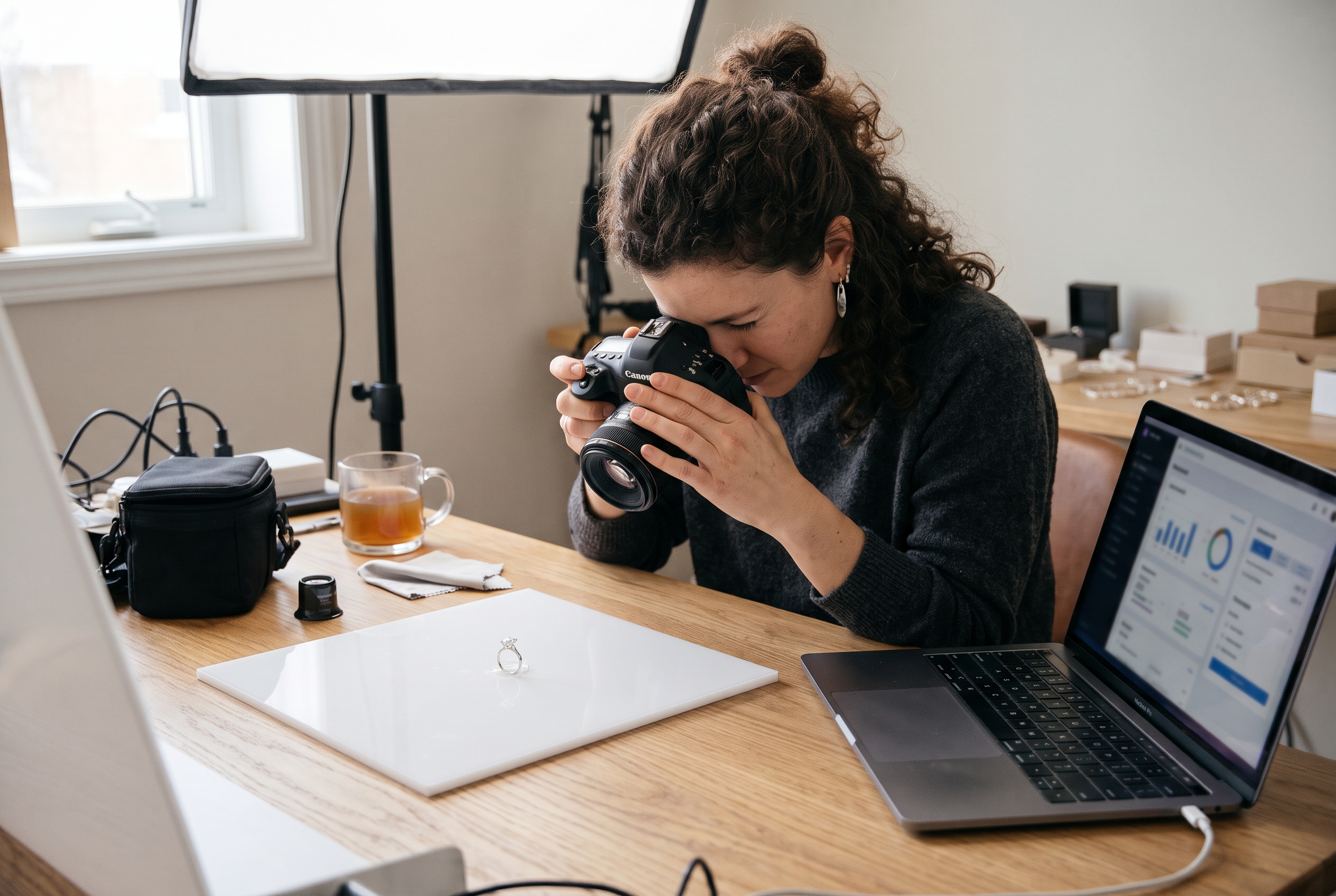
- Photography: professional jewelry photography commonly runs $15-$75 per image, so a 100-piece catalog with three angles each can reach $4,500-$22,500 before retouching. Many new brands shoot in-house with a lightbox and a macro lens to cut this.
- Build time: a template store can launch in one to three weeks. A freelance custom build usually takes four to10 weeks, and an agency project often takes three to six months once discovery and QA are included. Longer timelines mean more billed hours.
- Ongoing SEO: category copy, product descriptions, and link building often cost $500-$3,000 a month from an SEO freelancer or agency. Many jewelers start with a one-time technical setup and write their own descriptions.
If you sell high-end pieces, the design side matters more than usual. Our article on fine jewelry website design shows what premium buyers expect before they enter a card number.
Freelance vs Agency Jewelry Website: Which Costs Less?
A freelancer almost always costs less upfront, usually $2,000-$10,000 against an agency's $15,000-$60,000+. An agency costs less in risk: you get project management, QA, and a team that doesn't vanish mid-build.
When a freelancer makes sense
Pick a freelancer when your scope is clear: a theme customization, a collection page redesign, a migration. Vet their jewelry portfolio specifically. Our guide on how to hire a jewelry website developer gives a checklist and interview questions.
When an agency is worth it
Choose an agency if you're launching a fine jewelry brand, running multiple markets, or need strategy plus design plus development. Jewelry ecommerce agency pricing usually includes discovery workshops, UX, build, and QA, which is what the extra money buys. Browse jewelry web design services for options at each level.
The risk with both: you pay again for every change. A new collection page, a holiday banner, a size guide. That's where retainers come in.
Jewelry Website Retainer and Maintenance Costs
A jewelry website design retainer typically costs $1,000-$5,000 a month at agencies, while jewelry website maintenance cost for a self-managed store runs $50-$500 a month in hosting, apps, and security. Retainers cover updates, campaigns, and support.

Here's what typically sits inside the monthly bill:
- Platform plan: $39-$399 a month on Shopify's standard tiers, per Shopify's pricing page.
- Apps: reviews, wishlist, upsells, abandoned cart. Often $50-$200 a month combined, based on typical app-store listing prices.
- Developer time: bug fixes and plugin conflicts, billed hourly or in retainer blocks.
- Transaction fees: 0.5-2% if you don't use the platform's own payments.
Retainers deserve scrutiny. Ask how many hours are included, what happens to unused hours, and whether you can cancel with 30 days' notice. Our deeper look at ecommerce agency retainer pricing shows typical hour allotments. And if you're on Shopify's top tier, Shopify Plus pricing adds another layer.
WooCommerce deserves a warning too. Hosting runs $30-$100 a month, but maintenance, patching, and developer retainers of $500-$5,000 a month are the merchant's problem. That burden is why some small shops move to hosted platforms.
Jewelry Website Template vs Custom: The Honest Math
For most independent jewelers, a template is the right starting point. Custom tends to pay off when your product logic or brand positioning can't be expressed in a template. As a rule of thumb, not a hard threshold, that point often arrives when online sales reach the mid six figures and a better site can lift conversion enough to cover the build.
Template strengths and limits
Templates launch in days and cost little. The limits show up later: your site looks like thousands of others, and missing essentials such as wishlists, advanced product pages, and customer Q&A usually require paid apps. Each app adds weight, which hurts mobile speed, and slow pages hurt both search rankings and conversion.
Custom strengths and limits
Custom gives you distinct branding and bespoke features. It also locks you into a developer relationship. Every change becomes a ticket, and in our estimate the total over three years often lands at two to three times the quoted build price once retainers and changes are included.
Three-year cost comparison
| Scenario | Year 1 | 3-year total (estimate) |
|---|---|---|
| Template + 6 apps | $3,000-$5,000 | $8,000-$14,000 |
| Freelance custom + apps | $7,000-$16,000 | $15,000-$30,000 |
| Agency custom + retainer | $30,000-$100,000 | $60,000-$180,000 |
These are our own estimates, built by adding the ranges above (build, platform, apps, and retainer), not quotes. Use them to sanity-check what you're offered.
Example: a 40-piece handmade brand
Picture a solo maker with 40 pieces and a $60,000 annual sales target. A template store at $39 a month, $100 a month in apps, and a $1,200 photography budget costs roughly $3,700 in year one. A $12,000 freelance custom build would take most of a year's revenue before a single order. This is a hypothetical, but the arithmetic is why templates win at this stage. For more on that stage, see how to sell handmade jewelry online.
How to Get a Jewelry Web Design Quote You Can Compare
A useful jewelry web design quote itemizes scope, timeline, ownership, and ongoing costs. If it's a single lump sum, push back. Send the same brief to three providers so the numbers are comparable.
- Define your catalog: number of products, variants, and any made-to-order pieces.
- List must-have features: ring sizing, engraving, wishlists, financing, gift options.
- Ask about code ownership: can you take the site elsewhere?
- Request the monthly total: platform, apps, hosting, and support after launch.
- Check change costs: what a new collection page or banner costs after launch.
- Confirm the timeline: launch date, review rounds, and what delays cost.
Jewelry web design packages from agencies often bundle three or four of these, but photography, copywriting, SEO, and migration are commonly excluded. Ask for them by name.
The AI-built alternative
A newer option skips the quote cycle. Rovela builds a complete store from a plain-language description: storefront, catalog, Stripe checkout, admin, and 100+ features like abandoned cart, wishlist, loyalty, and reviews included in one flat subscription, with no sales commission. Stores run on standard Next.js code you can download and own, so any developer can take over. Weigh it against the Shopify alternatives for jewelry brands and the AI builder vs web designer tradeoffs.
Which Option Should You Choose?
Match the model to your stage. Under $100,000 a year in sales, start with a template or AI-built store and spend saved money on photography. Between $100,000 and $500,000, add a freelancer for targeted improvements. Above that, or for fine jewelry, an agency may justify its cost. These bands are guidelines drawn from the cost ranges above.
- Just launching: template or AI-built store. Our jewelry store website builder guide compares builders.
- Growing handmade brand: flat-fee platform plus a freelancer for occasional work.
- Established fine jewelry house: agency build with a capped retainer and full code ownership.
Whichever you pick, make sure the features in our jewelry ecommerce website features checklist are covered before you sign.
Final Take on Jewelry Web Design Pricing
Jewelry web design pricing isn't one number. It's a build cost, a monthly run cost, and the price of every future change. Template and AI-built stores keep all three low. Agencies make sense only when your catalog or brand truly demands it, and the retainer should be negotiated as carefully as the build.
If you'd rather skip the quote cycle, Rovela can build your jewelry store from a conversation, with the features most merchants pay apps for already included. See the Rovela pricing page to compare the flat subscription with your current monthly stack.