By El Ghali Bennis · Published · Updated
Jewelry Store Website Builder: The 2026 Buyer's Guide
Compare the best jewelry store website builders for 2026 — Shopify, BigCommerce, WooCommerce, Wix, and AI-native options — by true cost, setup time, and fit.

Selling jewelry online is a visual sport. Your customer needs to see the cut of a stone, the weight of a chain, the warmth of recycled gold — all before they trust you with $80, $800, or $8,000. That's why choosing the right jewelry store website builder matters more for your category than almost any other. The wrong choice buries your craft under generic templates and plugin bloat. The right one makes every piece feel like the only piece in the room.
This guide compares the serious options for building a jewelry ecommerce website in 2026 — from established platforms to AI-native generators — and shows you exactly what to look for before you commit.

What a jewelry store website builder actually needs to do
Jewelry is a high-consideration, high-trust category. Your builder isn't just a publishing tool — it's the entire sales floor. Before comparing brands, get clear on the non-negotiables.
- Image-first product pages with zoom, 360° spin, and video. Customers want to see a ring on a hand, not just on a white background. Look at how Mejuri and Catbird structure their product pages — both run on heavily customized Shopify stacks.
- Variant handling for ring sizes, chain lengths, metal types, and stone options without forcing customers to dig.
- Trust signals built into checkout: secure payment badges, certified materials, sizing guides, return policies, and customer reviews.
- Fast mobile load times, because mobile accounts for roughly three out of four jewelry sessions according to Statista's US jewelry market data, much of it during evening downtime.
- Editorial storytelling space for collections, the maker, sourcing, and craft — jewelry sells on narrative as much as product.
If a builder forces you to install five apps just to handle ring sizes and gift wrapping, it's failing the basics for your category.
The main types of jewelry store website builders
There are three real architectures competing for your money. Each has a distinct cost and skill profile, and the right online jewelry store builder for you depends on which one matches your team and stage.
Hosted ecommerce platforms (Shopify, BigCommerce)
The default choice for most established jewelry brands. Shopify powers a huge slice of independent jewelry stores — including Mejuri, Aurate, and Vrai — because of its app ecosystem and theme marketplace. You pick a template, customize it, and add apps for everything not covered out of the box — reviews, ring sizers, Klarna, abandoned cart, advanced search.
BigCommerce is the closest direct competitor. It includes more native features (reviews, multi-currency, B2B pricing) without app installs, which appeals to jewelry brands tired of monthly app fees. The trade-off is a smaller theme and app ecosystem and a steeper learning curve. Brands like Skullcandy and Solo Stove run on BigCommerce; in jewelry specifically, it's a quieter but legitimate option for catalogs above 500 SKUs.
The trade-off for both is cost stacking. Industry analyses from Littledata and Shopify partner agencies consistently show the average mid-market Shopify merchant running six to eight paid apps at $100–$200/month combined, on top of platform fees and payment processing. Factoring in theme work, app subscriptions, and typical agency or freelance support, total cost of ownership for a jewelry brand doing $1–5M annually generally lands in the $75K–$130K range — a methodology echoed in BigCommerce's own TCO breakdowns and independent agency reports.
Open-source builders (WooCommerce on WordPress)
WooCommerce is free to install but expensive to run well. You own your code, but you also own your security, your plugin conflicts, and your hosting. WooCommerce works for jewelry brands who already have a developer on retainer. Without one, maintenance becomes a second job. Data from BuiltWith's ecommerce tracking shows substantial WooCommerce churn each year as small operators abandon stores that became too complex to maintain — the freedom of open source is real, but so is the upkeep.
AI jewelry store builders
The newest category. Instead of choosing a template, you describe your brand and an AI generates the storefront — copy, layout, product structure, and checkout flow included. Several approaches now exist: Shopify's own Magic and Sidekick tools generate copy and themes inside Shopify; Wix ADI builds a site within Wix's editor; Durable and Hostinger AI assemble basic storefronts on their own infrastructure; and Rovela generates a complete ecommerce website end to end with payments, hosting, and an admin dashboard already wired up.
Each has limitations worth naming. In-platform AI tools (Shopify Magic, Wix ADI) inherit the cost and app dependencies of their host platform. Lightweight AI site builders often skip ecommerce essentials like variants, tax handling, or multi-currency. The category is real, but it isn't a single thing — evaluate each tool against the jewelry-specific checklist above.
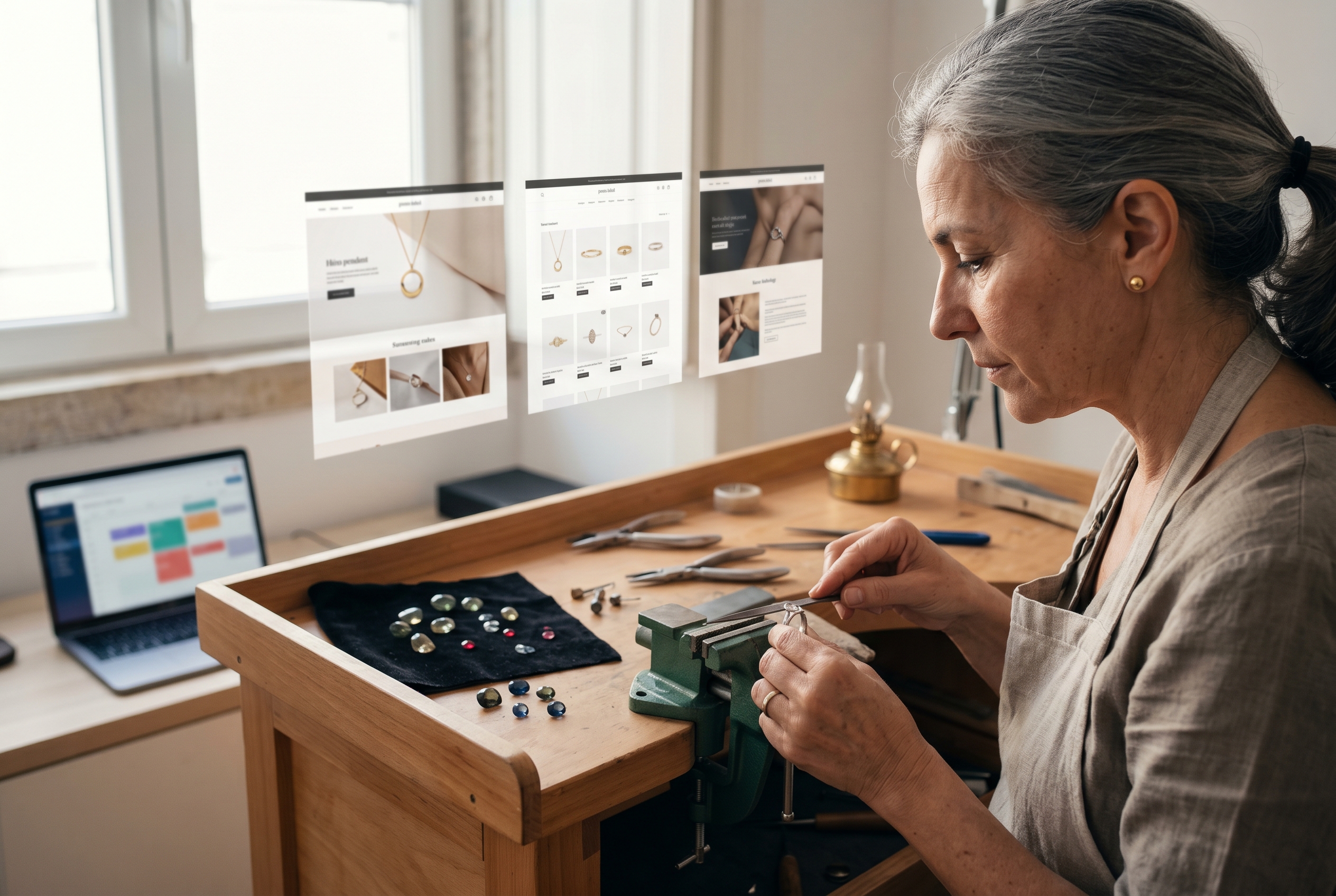
Side-by-side: jewelry ecommerce builders compared
Here's how the most common options stack up across the criteria that actually matter for a jewelry ecommerce builder.
| Builder | Starting price | True monthly cost* | Setup time | Best for |
|---|---|---|---|---|
| Shopify | $39/mo | $150–$500+ | 1–4 weeks | Established brands with app budgets |
| Shopify Plus | $2,300/mo | $8,000–$20,000 | 2–6 months | Brands above $5M/year |
| BigCommerce | $39/mo | $120–$400 | 2–5 weeks | Mid-market catalogs that want fewer apps |
| WooCommerce | Free plugin | $200–$1,500 | 4–12 weeks | Technical founders who want code ownership |
| Wix / Squarespace | $29/mo | $50–$150 | 1–2 weeks | Hobby sellers and side projects |
| Rovela | $29/mo | $29–$99 | Under 10 minutes | New launches and Shopify migrations |
*True cost includes platform, essential apps, payment processing, and typical hosting. Excludes agency or freelancer fees. Figures synthesized from public pricing pages, Littledata benchmarks, and BigCommerce/Shopify TCO reports.
The gap between "starting price" and "true monthly cost" is the single most underestimated factor when people pick a jewelry ecommerce builder. A $39/month plan that needs $400/month of apps to function like a real store isn't actually a $39/month plan.
How much does it cost to build a jewelry website?
This is the question almost every founder asks, and the honest answer is: it depends on the path. Here's the realistic range in 2026.
- DIY on Wix or Squarespace: $300–$1,500 for the first year if you do everything yourself, including basic photography.
- Shopify with a paid theme and light customization: $3,000–$8,000 to launch, then $200–$500/month in platform plus apps.
- Shopify with an agency build: $15,000–$60,000 for a custom theme and integrations, plus ongoing retainer.
- WooCommerce with a developer: $5,000–$25,000 to launch depending on plugin choices and hosting setup.
- AI jewelry store builder like Rovela: $29–$99/month with no separate launch fee — the storefront, hosting, and admin are included.
What is the best website builder for a jewelry store?
There's no single best — the right answer depends on revenue stage, technical comfort, and how much story your brand needs to tell. For most independent jewelers launching today, an AI jewelry store builder or a lean Shopify Basic setup will get you live fastest. For brands above $1M with complex catalogs and B2B channels, BigCommerce or Shopify Plus become serious options. For founders with a developer already in-house, WooCommerce remains defensible. The worst choice is whichever one your competitor uses simply because they use it.
How AI jewelry store builders changed the math
For the last decade, the only path to a polished jewelry brand website ran through templates and developers. Pick a Shopify theme. Pay $3,000–$15,000 to customize it. Add apps. Hire a designer for product photography layouts. Six weeks later, you have a store.
An ai jewelry store builder compresses that timeline. You describe your brand — let's say "demi-fine jewelry made from recycled 14k gold, minimalist, inspired by Cycladic sculpture, price points from $180 to $900" — and the generator produces a working ecommerce website. Product pages, collection structure, About story, sizing pages, checkout, and admin panel are all live.
The quality depends entirely on the depth of input. Brands that provided rich, specific descriptions to AI builders consistently produced stores that needed only light editing before launch. Vague inputs produced vague outputs. This is the same logic that separates a good brief to a designer from a bad one.
If you want to build a jewelry store online without the six-week wait or the app stack, an online jewelry store builder powered by AI is now a credible option — not a prototype, but a production storefront.

Choosing the right jewelry store website builder for your stage
Match the tool to where you actually are, not where you hope to be in three years.
You're launching your first collection
You don't need Shopify Plus. You don't need a $15,000 custom theme. You need a live, payment-ready jewelry ecommerce website you can put in front of friends, press, and paid traffic this week. An AI jewelry store builder or a lean Shopify Basic setup is right-sized. Spend the saved money on photography and ads.
You're doing $100K–$1M a year
This is the painful middle. Shopify works, but your app stack is creeping toward $400/month and your developer invoices are climbing. Look hard at whether your current builder is supporting growth or taxing it. Many brands at this stage migrate to a consolidated platform to recover margin — see our comparison of Shopify alternatives for jewelry brands for the math behind that move.
You're scaling past $1M and feeling the platform tax
This is where a managed migration to a single-vendor platform becomes attractive. The total cost of staying on Shopify Plus with a full app stack often exceeds $100K/year. A single-vendor alternative that includes the equivalent of theme, apps, hosting, and dev work can cut that by half or more.
You're a craftsperson, not a tech operator
Pick the builder that demands the least of you. Every hour spent fighting a plugin conflict is an hour not at the bench. Read more side-by-side ecommerce platform reviews before committing to a stack that will own your evenings.
Common mistakes when choosing a jewelry ecommerce website
A few patterns show up again and again when jewelry brands pick the wrong builder.
- Optimizing for theme aesthetics over checkout reliability. A beautiful homepage that breaks on iPhone checkout costs you sales every day.
- Underestimating app costs. Always price the full stack, not the headline plan. Tools like the G2 ecommerce platforms category can help you see what merchants in your category actually run.
- Choosing enterprise tools too early. Shopify Plus is overkill below $3M/year, and the contract makes downgrading painful.
- Ignoring variant complexity. If you sell rings in 12 sizes across three metals, your builder needs to handle that without 200 SKU rows.
- Forgetting about content. Jewelry sells on story. A builder that treats your About page as an afterthought will cap your conversion rate.
The right builder is the one that gets out of your way
A jewelry store website builder is infrastructure. It should disappear behind the work — the metal, the stones, the photography, the customers. Whether you go with Shopify, BigCommerce, WooCommerce, or an AI-native option, judge it by how little of your week it demands once your store is live.
If you want to see what a finished jewelry ecommerce website looks like generated from a single business description — not a template, not a prototype — Rovela builds your jewelry brand website in under ten minutes with payments, hosting, and admin already handled. Describe your brand, watch your store come to life, and start selling the same afternoon.