July 6, 2026
How to Sell Handmade Jewelry Online: A Full Guide
Learn how to sell handmade jewelry online — from pricing and photos to building your own store and reaching buyers beyond Etsy.

Learning how to sell handmade jewelry online is the difference between a hobby that drains your weekends and a business that pays for itself. You already know how to make pieces people love. The hard part is getting those pieces in front of buyers, pricing them so you actually profit, and building a shop that runs without eating your whole day. This guide walks through every step — from your first product photo to owning a jewelry website that grows with you.

Where to Sell Handmade Jewelry Online
The first decision matters most: where do you set up shop? The answer shapes your fees, your brand, and how much control you keep. There's no single right choice — but there are trade-offs worth understanding before you commit.
Most sellers start on a marketplace because it's fast. Others build a dedicated handmade jewelry website because they want to own their customer relationships. Many run both. Here's how the main options compare.
| Channel | Setup effort | Fees | Who owns the customer |
|---|---|---|---|
| Etsy marketplace | Low | Listing + 6.5% transaction + payment fees | Etsy |
| Instagram / TikTok Shop | Medium | Platform commission per sale | The platform |
| Your own store | Medium | Flat subscription, no sales commission | You |
| Local markets + online | High | Booth fees + online costs | Split |
Marketplaces give you traffic on day one. But you're renting space, competing on price against thousands of near-identical listings, and handing over your buyer data. Your own store flips that: you keep every customer email, set your own margins, and build a brand nobody can bury in search results. For anyone serious about how to start a handmade jewelry business online, the smart move is usually a marketplace to test demand, then a home base you actually control.
How to Sell Handmade Jewelry Online Without Etsy
Plenty of makers reach a point where Etsy's fees, ad pressure, and lookalike competition stop making sense. To sell jewelry online without Etsy, you build a store that's yours — where you keep 100% of the sale price minus payment processing, and where your brand isn't sharing a page with ten competitors.

The old objection was that building your own site meant hiring a developer or wrestling with themes and plugins. That's no longer true. Modern tools build a full store — storefront, checkout, customer accounts, shipping tools — from a plain-language description of your business. Here's the path when you skip the marketplace:
- Claim your domain. A name like yourbrand.com signals you're a real business, not a booth.
- Set up a store with checkout built in. You need a cart, secure payments through Stripe or PayPal, and order management from day one.
- Own your email list. This is the single biggest reason to leave marketplaces — repeat buyers cost nothing to reach again.
- Optimize for search. When your store ranks for "custom birthstone rings," you get free buyers forever. On Etsy, that traffic belongs to Etsy.
The financial case is real. A store doing $50,000 a year on Etsy pays roughly $3,250 in transaction fees alone — before listing fees and ads. Move that same volume to your own handmade jewelry ecommerce store on a flat subscription and most of that money stays in your pocket.
Pricing and Photographing Your Handmade Jewelry
The two things that make or break online jewelry sales are price and photos. Get these wrong and even a great store won't convert. Get them right and you can sell the same pieces for more.
How to price handmade jewelry so you actually profit
Most makers underprice. They cover materials, forget their time, and wonder why the business never grows. Use a simple formula: (materials + labor at a real hourly rate + overhead) × 2 for wholesale, × 2 again for retail. That retail multiplier isn't greed — it covers marketing, returns, platform costs, and the profit that lets you reinvest.
A quick example. A pair of earrings with $6 in materials and 45 minutes of work at $20/hour costs you about $21 to make. Wholesale lands near $42, retail near $84. If that feels high, remember: you're not selling metal and beads. You're selling design, craft, and a story mass-market brands can't touch.
Photos that turn browsers into buyers
Online, your photo is the product. Shoppers can't hold your piece, so the image has to do all the persuading. You don't need a pro studio — a window, a $15 white foam board, and a phone shot in daylight beat most amateur setups.
- Shoot on a clean, neutral background so the jewelry stands out.
- Include a scale shot — on a wrist, ear, or neck — so size is obvious.
- Capture detail close-ups showing texture, clasps, and finish.
- Keep lighting and style consistent across every listing for a cohesive shop.

The National Retail Federation notes that clear, detailed product imagery is one of the strongest drivers of online conversion — see the National Retail Federation for broader consumer research. For jewelry, where craftsmanship is the whole pitch, this matters double.
Building a Handmade Jewelry Website That Sells
A great handmade jewelry website does three jobs: it loads fast, it earns trust, and it makes buying effortless. Miss any one and you leak sales. Here's what a store needs before you send a single visitor to it.
The features that recover lost sales
Roughly 70% of online carts get abandoned. For jewelry — often a considered, emotional purchase — that number can run even higher. The features below aren't nice-to-haves; they're the difference between a browser and a buyer:
- Abandoned cart recovery — automatic emails that bring back shoppers who left mid-purchase.
- Wishlists — buyers save pieces for later, then get nudged when it's time.
- Reviews and customer Q&A — social proof that answers hesitation before it kills a sale.
- Loyalty rewards — repeat buyers are cheap; give them a reason to come back.
- Made-to-order options so you can sell custom jewelry online without spreadsheets and back-and-forth DMs.
On Shopify, most of these arrive as separate paid apps — the average store runs six, and app bills stack up fast on top of the base subscription. That's fine until you're paying $150 a month in plugins to do what should ship by default. When you compare platforms, count the total cost, not just the sticker price. See Shopify's pricing and then add up the apps you'd actually need.
Speed and search are non-negotiable
A slow store kills both rankings and conversions. Google's research on page experience is blunt about it — every extra second of load time drops conversions measurably. Jewelry sites lean heavy on images, so architecture matters. A store built on fast, modern code stays quick even with big photo galleries, while a plugin-stuffed site crawls.
Being search-ready on day one means clean structure, fast pages, and metadata done right so buyers searching "personalized silver name necklace" can actually find you. That's how you build a personalized jewelry store online that pulls in traffic without paying for every click.
Marketing Your Jewelry and Reaching the Right Buyers
A store nobody visits sells nothing. Once your shop is live, the job shifts to bringing in the right people — buyers who value handmade work and will pay for it.
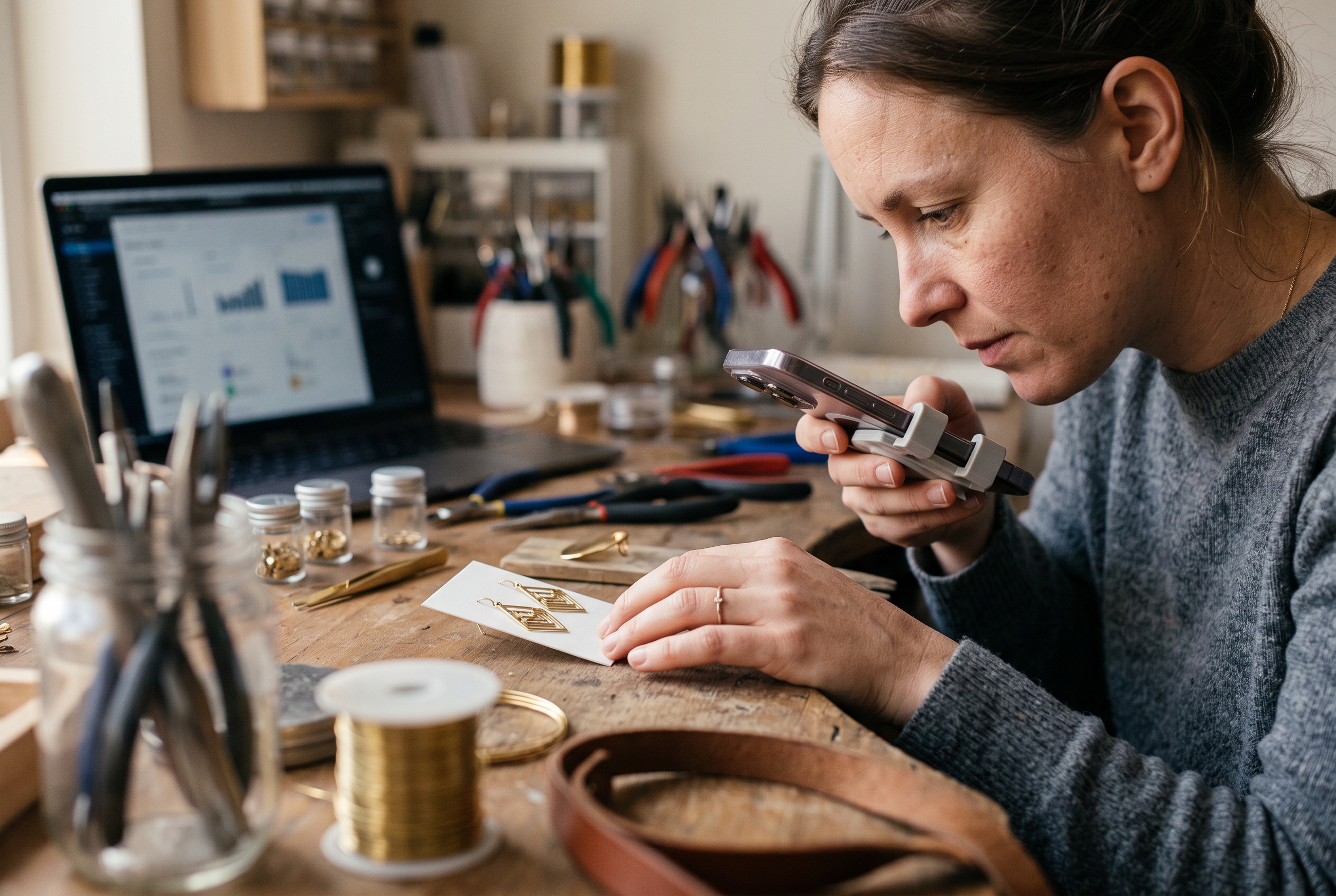
You don't need every channel. Pick two or three and go deep. For handmade jewelry, the highest-return moves are usually these:
- Show the making. Short videos of the process on Instagram Reels and TikTok convert because they prove it's genuinely handmade. Craft is content.
- Build your email list from day one. Offer 10% off the first order. Email routinely returns more per dollar than any paid channel.
- Rank for what buyers search. Write helpful pages — care guides, gift roundups, ring-size help — so you show up when people look for where to sell handmade jewelry shifts to where to buy handmade jewelry.
- Run small, sharp ads. Once organic works, amplify your best sellers with modest Meta or Google budgets and connected analytics so you know what's actually paying off.
Track everything. If you can't see which pieces sell, which emails convert, and where buyers drop off, you're guessing. A store with built-in dashboards and Klaviyo, Meta, and Google integrations saves you from stitching tools together and paying for the privilege.
Putting It All Together
Selling handmade jewelry online comes down to a handful of decisions done well: choose where you sell, price for real profit, shoot photos that persuade, build a fast store with the features that recover sales, and market where your buyers already spend time. Do those and you've got a business, not a side hustle that stalls.
If you want to skip the app stack and developer bills, Rovela builds a complete jewelry store — storefront, checkout, abandoned cart, wishlists, reviews, loyalty, and 100+ features — from a plain description of your business, live in hours instead of weeks. Built by operators who scaled real stores past $15M in sales, it's made for makers who'd rather create than configure. Browse the blog for more guides, or see what a store built for your brand would look like today.