By El Ghali Bennis · Published
How to Create a Press Kit for an Online Store
Learn how to create a press kit for an online store with a copyable template, boilerplate and founder bio examples, and a pitch structure journalists answer.

To create a press kit for an online store, gather your brand story, a short company boilerplate, founder bio, high-resolution logos and product photos, key facts, and a press contact email. Then publish everything on one public page, plus a downloadable ZIP, so journalists and creators can cover you without emailing you for assets.

Most small shops skip this step, then lose coverage over something silly: a journalist can't find a usable logo, or the founder's name is spelled three ways across the web. A good press kit takes an afternoon to build and works for years. This guide walks through exactly what goes in it, how to write each piece, and where to put it.
What Is a Press Kit and Why Does Your Store Need One?
A press kit (also called a media kit) is a single package of facts, images, and contact details that lets writers, podcasters, and influencers cover your brand accurately and fast. For an online store, it's your pre-answered list of every question a journalist would otherwise email you.
Journalists work on deadlines. If your assets take two days to arrive, a competitor's arrive in two minutes. A brand press kit removes that friction. It also protects your story: when you supply the approved description, the approved logo, and the approved product photos, that's what gets published.
It isn't just for newspapers. Gift-guide editors, newsletter writers, podcast hosts, affiliate partners, retail buyers, and event organizers all ask for the same things. One kit serves all of them.
Press kit vs. media kit vs. influencer media kit
The terms overlap, but the audience changes the emphasis:
- Press kit: story, facts, founder bio, news angles, product imagery. Built for journalists and editors.
- Media kit for small business: often adds audience data, such as email list size, social reach, and traffic, so partners can judge sponsorship value.
- Influencer media kit: a lighter version with product photos, usage guidelines, affiliate terms, and discount codes, sent to creators you want to work with.
Build one master kit, then trim it into the other two. You'll save hours.
What to Include in a Press Kit: The Essentials
What to include in a press kit comes down to eight items: a company overview, boilerplate, founder bio, fact sheet, logos, product images, press coverage or testimonials, and a press contact. Skip the fluff. Every item should save a writer time.
1. Company overview and brand story
Write 150 to 250 words covering who you are, what you sell, who it's for, and why you started. Lead with the problem, not your birth year. "We started in a garage in 2021" tells a writer nothing. "Hiking socks kept blistering my feet, so I tested 40 wool blends" gives them a hook.
2. Company boilerplate example
The boilerplate is a 50 to 80 word paragraph that goes at the bottom of press releases and gets pasted into articles. Keep it factual and third-person. Here's a company boilerplate example you can adapt. Northfold Goods is a fictional brand we invented for illustration, so all names and numbers are placeholders:
Northfold Goods is a Lyon-based online store selling small-batch leather accessories made from vegetable-tanned hides. Founded in 2022 by Camille Roy, the brand ships to 28 countries and has sold more than 12,000 orders. Every product is made by hand in workshops within 100 km of the founder's studio. Learn more at northfoldgoods.com.
Notice the structure: what you do, where, who founded it, one proof number, one differentiator, URL. Update the numbers twice a year. A quick test: delete the brand name and see whether the paragraph could describe any competitor. If it could, add a more specific detail.
3. Founder bio for press kit
Write a founder bio for press kit use in two lengths: 50 words and 150 words. Include the name, role, relevant background, and one human detail. Add a clear headshot, ideally two orientations. Give the pronunciation of your name if it's unusual. Keep claims verifiable, because journalists will check.
Here's a 50-word example for the fictional Northfold founder: "Camille Roy founded Northfold Goods in 2022 after a decade as a footwear pattern-maker in Lyon. Frustrated by accessories that wore out within a year, she began making wallets from vegetable-tanned leather. She leads a team of six and is happy to speak about slow manufacturing and small-shop economics."
4. Fact sheet
A fact sheet is a scannable list. Include:
- Founding date and headquarters
- Number of products and price range
- Countries you ship to
- Team size
- Notable milestones, such as a retail partnership, award, or funding
- Social handles
5. Logos and brand assets page
Your brand assets page should offer logos in PNG and SVG, on light and dark backgrounds, plus your brand colors (hex codes) and font names. Add two lines of usage rules: don't stretch, don't recolor, keep clear space around it.
6. Product images
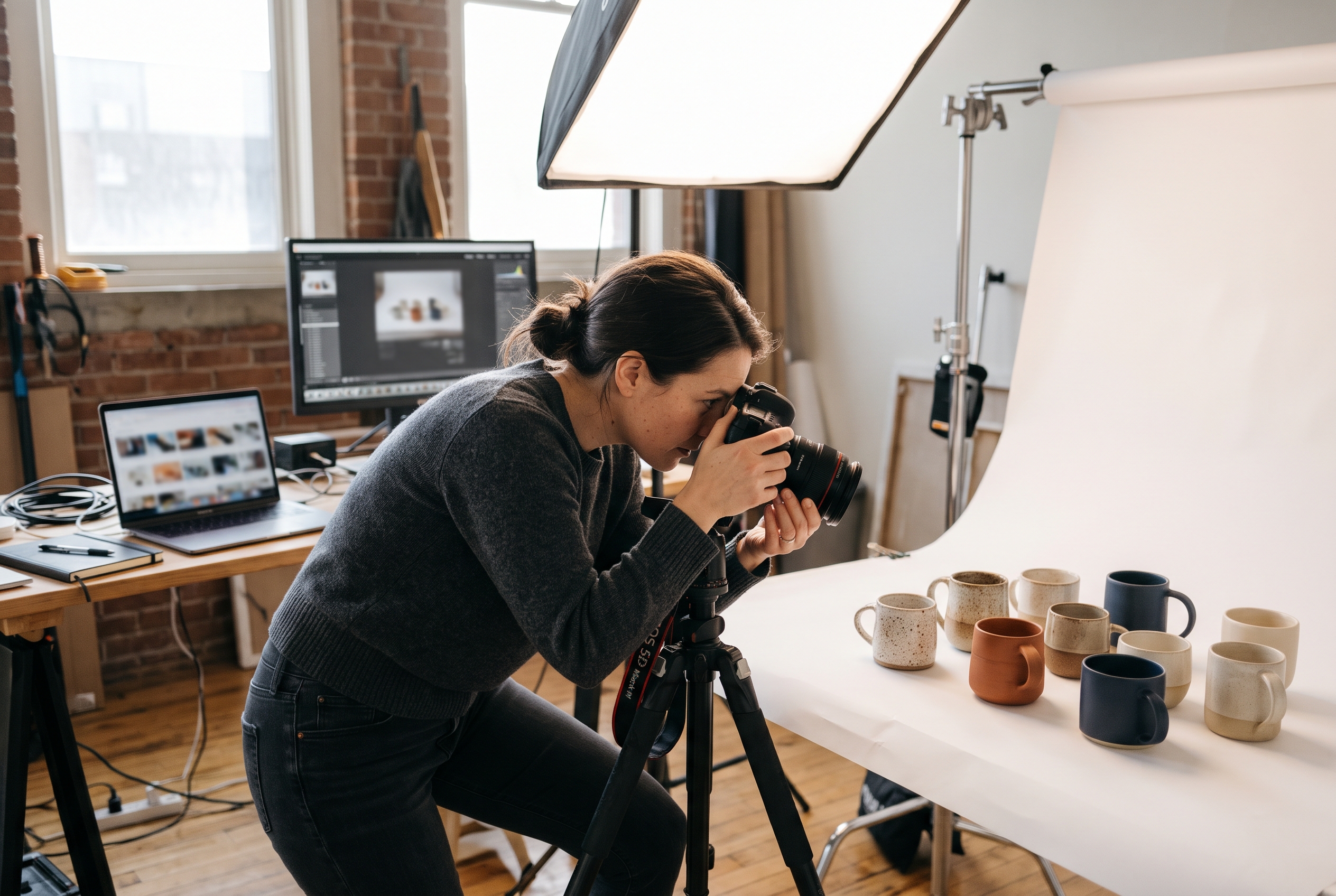
Supply 8 to 15 high-resolution images: white-background shots, lifestyle shots, and a couple of detail shots. Name files sensibly (northfold-card-wallet-tan.jpg, not IMG_4471.jpg). If you lack photography, our guide to creating product images with AI covers a fast way to fill gaps.
7. Press mentions and testimonials
List previous coverage with outlet name, headline, and date. Add two or three customer quotes with permission. Even a podcast interview or a local newspaper blurb counts as social proof for the next writer.
8. Press contact email
Use a dedicated press contact email such as press@yourstore.com, forwarded to a monitored inbox. List a name, a phone or WhatsApp number if you'll answer it, and your time zone. Promise a response window, like "We reply within one business day."
Press Kit Template You Can Copy
This press kit template works as a single document or as the structure of your web page. Copy the outline, fill each field, and cut anything you can't back up with facts. The lengths below are our recommended rules of thumb, not an industry standard.
| Section | Length | What to write |
|---|---|---|
| Headline summary | 1 sentence | What you sell and for whom |
| Brand story | 150-250 words | Problem, origin, what makes you different |
| Boilerplate | 50-80 words | Third-person description with one proof number |
| Founder bio | 50 and 150 words | Background, credibility, one personal detail |
| Fact sheet | 6-10 bullets | Dates, locations, numbers, milestones |
| Product highlights | 3-5 products | Name, price, one-line description, image link |
| Assets | Logos, photos | PNG/SVG logos, 8-15 images, color codes |
| Coverage | 3-6 items | Outlet, headline, date, link |
| Contact | 1 block | Name, press email, phone, response time |
Add a "current news angles" box if you can. Three bullets such as "Launching a recycled-packaging line in March" or "Founder available to comment on tariff impact on small shops" give writers a reason to call you now rather than later.
How to Create a Press Kit for an Online Store, Step by Step
Here's the sequence that, in our experience, takes most owners about four to six hours. You don't need a designer.

- Audit what exists. Pull your About page, best product photos, logo files, and any past coverage into one folder.
- Write the text pieces. Draft the story, boilerplate, and two bios. Read them aloud; if you wouldn't say it, rewrite it.
- Prepare the images. Export logos as PNG and SVG. Resize photos to around 2,000 px on the long edge. Compress lightly so downloads stay quick.
- Create a ZIP. Package logos, photos, bios, and the fact sheet into one download. Name it
yourbrand-press-kit.zip. - Build the press page. Publish the content on a public URL like yourstore.com/press, with the ZIP link at the top.
- Link it. Add "Press" to your footer and mention it in your email signature.
- Test it. Open the page on your phone, download the ZIP, and check every image opens.
Press page for website: what makes it work
A press page for website visitors should load fast, avoid login walls, and put the download button above the fold. Keep the text selectable so writers can copy it. Don't hide the contact email behind a form. Journalists won't fill one out.
If you're still setting up your storefront, you can create an online store first and add the press page as a standard content page. Make sure your About page and press page tell the same story, since writers read both.
Ecommerce press kit examples worth studying
Real brands show the patterns well. Based on the public press or media pages of Allbirds, Glossier, and Warby Parker, here is what each tends to do well. Pages change often, so check them live for the current version.
- Allbirds: leans on a sustainability story backed by specifics, such as materials and carbon-footprint labeling. Takeaway: pair your brand story with a measurable claim, not an adjective.
- Glossier: treats its press page as part of its brand voice, with a short, quotable description and a named contact. Takeaway: your kit should sound like your store, not like a legal notice.
- Warby Parker: offers a clear route to logos and imagery plus a company-facts focus (mission, founding story, programs). Takeaway: a fact-led structure makes writers' jobs easier.
Across all three, the shared traits are a one-click asset download, a short brand description near the top, recent coverage with dates, and clear logo rules. A small shop doesn't need their scale. A first-time visitor should just find the same things within 30 seconds.
One insight from small-store practice: the facts writers ask for most often are the ones owners forget to publish, such as pronunciation, shipping countries, and whether images are free for editorial use. Answer those three and your kit already beats most.
How to Pitch Journalists for Ecommerce Coverage
To pitch journalists, send a short, personalized email with one clear angle, one proof point, and a link to your press page. Keep it under 150 words. The kit supports the pitch; it isn't the pitch.
A simple pitch structure
- Subject line: specific and short, like "Gift guide pick: wool socks that fix blisters."
- First line: reference something the writer published recently. Be genuine.
- The angle: why this matters to their readers now.
- Proof: one number or fact, such as sales, reviews, or a unique process.
- Offer: samples, an interview, or exclusive data.
- Link: your press page. Don't attach a large ZIP.
This is how to pitch journalists in ecommerce without sounding like a mass blast. Target five to ten writers who've covered stores like yours, not 500 random names. Timing matters too: gift guides are typically assembled months ahead, so pitch holiday products in late summer.
Where to find the right contacts
Search for articles about products similar to yours and note the bylines. Check newsletter writers and niche podcasts on Substack. Follow up once after about a week. If there's no answer, move on politely.
For deeper guidance, the Public Relations Society of America publishes resources on media relations, and the U.S. Small Business Administration has a marketing guide for small businesses. Both are useful for checking your approach against professional standards.
Adapting the kit as an influencer media kit
For creators, trim to a one-page influencer media kit: product images, key talking points, your affiliate commission, discount code, shipping times, and what you won't allow (for example, health claims). Creators appreciate clear do's and don'ts. If you run a creator program, tie it to your shoppable lookbook so their audience can buy straight from the content.
In the US, the Federal Trade Commission's endorsement guidance expects creators to disclose free products and affiliate relationships. Add a line about disclosure to your creator kit.
Press Kit Mistakes to Avoid and How to Keep It Fresh
The biggest mistakes are outdated numbers, low-resolution images, hidden contacts, and vague copy. A stale kit is worse than none because it signals that nobody's home.
- Vague superlatives. "Revolutionary, premium, world-class" gives writers nothing. Use specifics.
- Giant PDFs only. A 40 MB PDF is hard to copy from and slow on mobile. Offer text on the page and images as a ZIP.
- No licensing note. State clearly that editorial use of the images is free.
- Unverified claims. "Best-selling" needs a source. If you can't prove it, drop it.
- No update rhythm. Review the kit every quarter and after any launch or coverage hit.
Quick quality check
Before you publish, ask three questions. Could a writer finish a 300-word piece using only this page? Could a podcast host introduce your founder without emailing you? Could an editor grab a clean logo in under 30 seconds? If all three are yes, you're done.
For legal basics around your store, such as whether you need paperwork before you sell, see our guide on whether you need a business license to sell online. Getting that right before press arrives avoids awkward questions.
Create a Press Kit for Your Online Store Without the Busywork
A press kit is a small investment with a long tail: one afternoon of work, then every journalist, creator, and partner gets what they need in seconds. Start with the boilerplate and founder bio, add your best ten images, publish the page, and use a real press contact email.
If you'd rather not wrestle with page builders, Rovela lets you describe your store in plain words and builds the pages for you, so adding a press page is a chat message, not a project. You can see how it works on the Rovela homepage or check the pricing page to compare it against your current stack.