By El Ghali Bennis · Published
Should Online Prices Match In-Store Prices? A Retailer's Guide
Should online prices match in-store prices? For most small retailers, yes, with a few smart exceptions. Here's how to protect your margin per order.
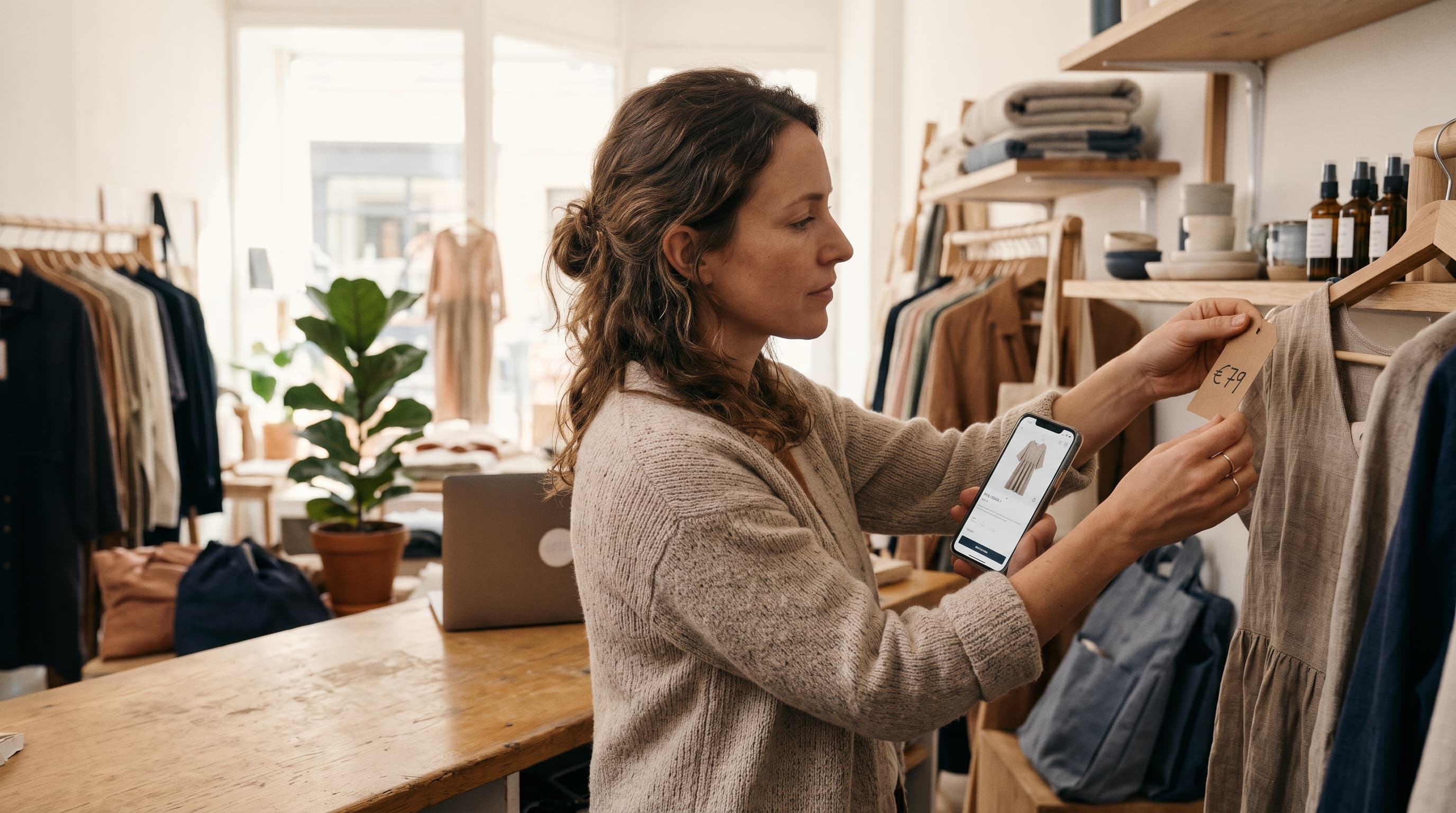
For most small retailers, online prices should match in-store prices. Customers compare on their phones, and a gap erodes trust fast. Break the rule only for clear reasons: shipping costs, pickup incentives, or online-only bundles. Keep the shelf price identical and adjust fees, thresholds and offers around it.
That's the short answer. The longer one depends on what an online order really costs you. Below, you'll see the math, the three pricing models that work, and how to handle card fees, shipping and pickup without ending up with a margin you regret.
Should Online Prices Match In-Store Prices?
Yes, in most cases. Matching prices protects retail price consistency across channels and keeps your staff from arguing with customers who hold up a phone at the register. Mismatches are the exception, and they need a reason a customer can understand.
Think about how people actually shop. Someone walks into your store, scans a barcode or searches your name, and checks your website. If the website is cheaper, you've taught them to buy online and treat your shop as a showroom. If it's higher, they'll wonder if you're padding prices, and they'll check Amazon next.
There's also a practical reason. Running two price lists doubles your admin. Every sale, supplier price change and markdown has to be updated twice, and mistakes pile up. If you're already syncing stock between channels, our guide on how to sync in-store and online inventory shows why one source of truth saves hours.
When a different online price is justified
- Online-only bundles or sizes: a three-pack that doesn't exist on your shelf isn't a price mismatch, it's a different product.
- Pickup incentives: a small discount for collecting in store saves you shipping and packing time.
- Clearance: an online-only markdown to move stock that takes up back-room space.
- Cost pass-through: shipping or handling that you can't absorb.
What an Online Order Really Costs You
An online order costs more than an in-store sale because of payment fees, packaging, shipping labor and returns. To judge your margin per online order, subtract all of those from the sale price before you decide whether prices should match.
Start with payment processing. According to Stripe's pricing page, standard online card payments in the US are 2.9% plus 30 cents per successful charge. That fixed 30 cents is why Stripe fees on small orders hurt. On a $10 item you pay about 59 cents, or 5.9%. On a $100 item you pay $3.20, or 3.2%.
| Order value | Stripe fee (2.9% + $0.30) | Fee as % of order |
|---|---|---|
| $10 | $0.59 | 5.9% |
| $25 | $1.03 | 4.1% |
| $50 | $1.75 | 3.5% |
| $100 | $3.20 | 3.2% |
Now add the rest. Packaging runs roughly $0.75 to $2 per box for a small shop. Pick-and-pack takes 3 to 8 minutes of someone's time. Returns and exchanges are more common online than in store. Add them up and a product with a 50% gross margin on the shelf might net 35% to 40% when it ships.
That gap is real, but it doesn't automatically mean raising the product price. It means you need to recover cost through other levers, which the next sections cover.
Can You Pass Credit Card Fees to Customers?
Sometimes, but it's rarely worth it. Card surcharging is restricted in several US states and regulated by card network rules, and customers react badly to a fee added at checkout. A better move is to build the cost into shipping thresholds and bundles.
If you're considering whether to pass credit card fees to customers, check three things first. Your state's rules, since a few states restrict or ban surcharges. Your card network's rules, which cap surcharge amounts and require clear disclosure. And your customer's reaction. A surprise line item at checkout is one of the most common reasons people abandon carts, as the Baymard Institute has reported in its checkout research on unexpected extra costs.
Skip the surcharge and use these instead:
- Set a minimum order value. Even $15 removes the worst small-order fee drag.
- Push bundles. Raising average order value dilutes the fixed 30 cents.
- Offer a pickup discount. Pickup orders skip shipping, and you can steer customers toward them.
- Negotiate or review processor rates once you pass a steady monthly volume.
Online vs In-Store Pricing Strategy: Three Models
Most small retailers use one of three models: identical prices everywhere, a pickup or online-only incentive on top of identical prices, or a modest online markup. The second model is the safest for local shops.
Model 1: Identical prices, shipping covers the gap
The shelf price and web price are the same. Shipping is charged separately, or free above a threshold. This is the cleanest approach for small retailer pricing online and the easiest to explain. It works well for items above $30 where fees are a small slice.
Model 2: Identical prices plus a pickup discount
Keep prices equal, then offer 5% to 10% off for in-store pickup. A pickup discount incentive gets customers through your door, where they often add impulse items. It also saves you the box, label and carrier fee. If you're setting up collection or delivery, see our walkthrough on setting up an online store with local delivery.
Model 3: Online markup of 3% to 8%
Some shops add a small premium online to cover fees and handling. It can work for commodity-style products, but it's risky. Customers who spot the difference feel penalized for buying the convenient way, and Amazon is a click away. If you go this route, make the reason visible, such as "includes free local delivery."
What about an online only discount for a local shop?
An online only discount for a local shop is the riskiest option. It trains regulars to stay home, and it undercuts the staff who sell your products face to face. Use it sparingly: a first-order code of 10% for new customers, or a limited clearance. Don't make it permanent.

Free Shipping Thresholds for Small Retailers
A free shipping threshold for a small retailer should sit about 20% to 30% above your average order value. That nudges customers to add one more item while keeping your margin per order intact.
Here's how to set yours in four steps:
- Find your average order value (AOV). Pull the last 90 days of online orders.
- Calculate your true shipping cost. Include postage, box and labor, not only the carrier rate.
- Set the threshold at AOV plus 20% to 30%. If AOV is $42, try $50 or $55.
- Check margin at the threshold. After fees and shipping, you should still clear your target, say 25% net.
A quick example. A candle shop sells a $28 candle at 55% gross margin, so $15.40 in gross profit. Stripe takes $1.11, packaging $1.25, and shipping $6.50. Net profit is $6.54, or 23%. Add a $12 match-stick set to reach a $40 order, and the shipping and fixed costs barely move while profit nearly doubles. That's why thresholds work better than price markups.
If you're still in the early stages of going digital, how to start selling online from a physical store covers the groundwork before you get to pricing detail.
Common Questions About Online and In-Store Pricing
Is it legal to charge different prices online and in store?
Generally yes. In the US, retailers can set different prices by channel as long as the pricing isn't deceptive or discriminatory. Advertised prices must be honest, and any extra fees must be disclosed clearly. Check your state's rules and consult an advisor for specifics.
Should I price match Amazon?
Usually no. You can't win a pure price fight with a marketplace. Compete on service, speed of local pickup, expertise and bundles. Price match only on a handful of known-value items that customers use to judge you.
How do I keep prices in sync?
Use one catalog that feeds both channels. If you're updating a spreadsheet and a website by hand, prices will drift. A platform with built-in point-of-sale sync or a single admin avoids that.
Do customers notice small price differences?
Yes, especially on items they've bought before. A $2 gap on a $20 product is enough for a screenshot and a complaint. Keep differences explicit and explainable, like a labeled pickup discount.
Build a Pricing Setup You Won't Have to Babysit
Start with matching prices, then protect your margin through thresholds, bundles and pickup incentives rather than hidden markups. Calculate your net margin per online order once, set a floor, and review it every quarter.
The tooling matters too. When pickup discounts, free-shipping thresholds, and bundles are built into your store instead of bolted on through paid apps, you spend less and make fewer mistakes. If you want that setup, Rovela builds a complete store from a plain-language description, with checkout, shipping tools, and 100+ features included in one flat subscription. You can see the plans on the pricing page.