By El Ghali Bennis · Published
Salon Retail Pricing Strategy: Markups, Margins & Online
How to price salon retail: the right markup, healthy margins, stylist commission math, and how to set online prices that don't undercut your chairs.

A solid salon retail pricing strategy starts with keystone markup: price products at roughly twice your wholesale cost, which gives a 50% gross margin. Then adjust by category, pay stylists commission from that margin, and keep online prices equal to in-salon prices so you never undercut your own chairs.

Most salon owners set prices by gut feel or by copying the manufacturer's suggested retail price. That works until you add commission, shrinkage, and an online store. This guide walks through the math, the decisions, and the traps, so every bottle you sell actually earns its shelf space.
How much should you mark up salon products?
The standard answer for how much to mark up salon products is keystone: 100% markup, or 2x wholesale. A shampoo that costs you $12 sells for $24. Many professional brands also publish an MSRP built on that same logic, so following it keeps you consistent with the brand and with other salons.
Markup and margin get confused constantly, so pin them down:
- Markup is the percentage added on top of cost. $12 cost to $24 price is a 100% markup.
- Margin is the share of the price you keep. $12 profit on a $24 sale is a 50% margin.
Your salon retail profit margin should be calculated after commission, not before. A 50% gross margin sounds great until you hand 10-20% of the sale price to the stylist. We'll do that math below.
Salon retail markup by product type
Not every product deserves the same markup. Fast movers can carry less; niche items can carry more.
| Category | Typical markup | Why |
|---|---|---|
| Shampoo and conditioner | 90-100% | High repeat volume; customers compare against Sephora and Amazon |
| Styling products | 100% | Stylist-recommended, tied to a specific look |
| Treatments and masks | 100-120% | Perceived as premium; lower comparison shopping |
| Tools (dryers, irons) | 40-70% | High ticket, thin brand margins, easy to price-check |
| Accessories and gifts | 120-150% | Impulse buys, little price comparison |
These ranges are working benchmarks from common industry practice, not fixed rules. Your wholesale terms decide the real numbers, so check each brand's price sheet before copying any table, including this one.
What is a healthy salon retail profit margin and revenue percentage?
A healthy salon retail profit margin is 45-50% gross before commission and roughly 30-40% after it. Retail typically should also account for a meaningful slice of total sales. A common industry target for salon retail revenue percentage is 15-20% of total revenue, though many salons sit closer to 10%.
If you're at 8-10%, you're leaving money behind. On a salon doing $300,000 a year, moving from 10% to 15% retail adds $15,000 in sales. At a 50% gross margin, that's $7,500 in gross profit from products that clients already wanted.

The three numbers to track monthly
- Retail revenue percentage: retail sales divided by total sales.
- Retail attachment rate: the share of service tickets that include a product purchase.
- Inventory turns: how many times per year you sell through your stock. Aim for 4-6.
Slow turns kill margin quietly. A bottle that sits for ten months ties up cash and often ends up in a discount bin, wiping out the profit on two sold at full price.
How does stylist commission on retail sales work?
Stylist commission on retail sales usually runs 10-20% of the sale price, often tiered. It's lower than service commission because the product already costs you 50% of the price. Pay too little and stylists stop recommending products; pay too much and retail stops making money.
Here's the salon retail sales commission math on a $24 bottle that costs you $12:
| Commission rate | Stylist earns | Salon keeps | Net margin |
|---|---|---|---|
| 10% | $2.40 | $9.60 | 40% |
| 15% | $3.60 | $8.40 | 35% |
| 20% | $4.80 | $7.20 | 30% |
Even at 20%, you keep $7.20 per bottle. That's still better than most service lines once you count labor and chair time. The aim isn't to minimize commission; it's to make recommending products the easiest money a stylist earns.
Structures that actually motivate stylists
- Tiered rates: 10% up to $500 a month, 15% to $1,000, 20% beyond.
- Flat bonus: $50 when a stylist hits a retail attachment rate of 40%.
- Team goals: a shared bonus when the salon reaches its retail percentage target.
Tiers tend to work best because top sellers earn more and your margin per bottle stays protected on lower volume. Whatever you choose, put it in writing and pay it on the same schedule as service commission.
Online vs in-salon pricing: should they match?
Yes, in almost every case your online and in-salon prices should match. Different prices train clients to buy from the cheaper channel, upset stylists who earn commission in-chair, and can violate brand agreements. If you want to add a perk online, use delivery convenience or bundles, not a lower sticker price.
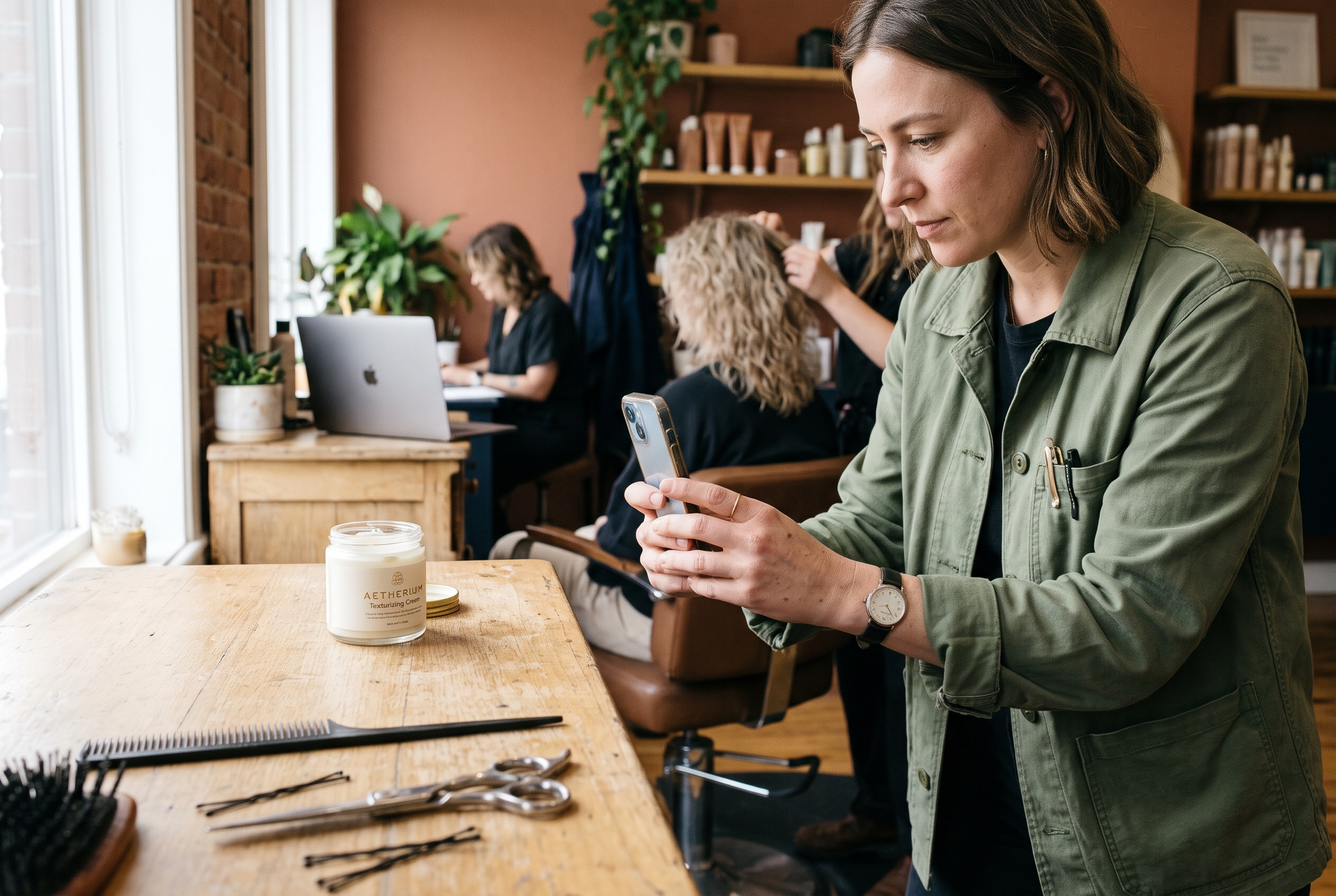
We cover the broader logic in our guide on whether online prices should match in-store prices. For salons specifically, the bigger issue is the brand. Many professional lines restrict online sales or require authorized retailers, so read your agreement first. Our breakdown of whether salons can sell professional hair products online explains the common rules.
Salon product pricing online: what changes
Your price stays the same, but your costs shift. Online orders add payment processing, packaging, and shipping. Stripe's standard US card rate is 2.9% plus 30 cents per transaction, according to Stripe's pricing page. On a $24 bottle, that's about $1.00 gone before you pack the box.
Three ways to protect margin online:
- Set a free-shipping threshold at $60-75 so orders bundle up.
- Offer local pickup at the salon, which costs nothing and brings clients back through the door.
- Sell kits (shampoo, conditioner, mask) priced slightly under the sum of parts but with a higher total ticket.
Should stylists earn commission on online orders? If a stylist recommended the product, yes. Many salons use a referral code or a "my stylist" field at checkout so credit flows to the right person. That keeps your team invested in online sales rather than seeing them as competition. For a full walkthrough of the channel itself, see how to sell products online for a hair salon.
A step-by-step salon retail pricing strategy
Here's the process to build your salon retail pricing strategy from scratch or fix the one you have.
- Pull your costs. List every SKU with wholesale cost, including freight and any volume discount.
- Start at keystone. Multiply cost by 2, then compare with the brand's MSRP. Don't go below MSRP.
- Adjust by category. Raise accessories and treatments; hold shampoo near MSRP; lower tool markups.
- Subtract commission. Confirm each category still clears at least 30% net.
- Check the market. Compare against Sephora, Ulta, and Amazon for your top 10 sellers. If an item is much cheaper there, you're not competing on price; compete on advice and convenience.
- Round to clean numbers. $23.50 and $24 are both fine. Avoid $23.97; it signals discount retail.
- Review quarterly. Wholesale costs rise. If you haven't updated prices in 12 months, your margin has probably slipped.
Common pricing mistakes
- Discounting to move stock. Bundle slow items with fast ones instead.
- Ignoring shrinkage. Testers, samples, and theft can run 2-5% of inventory. Build that into your target margin.
- Pricing by feel. A bottle that "seems like $18" may need to be $26.
- Letting stock sit. Cash tied up on shelves is a hidden cost.
If you're also rethinking what to stock, our list of the best products for salons to sell online helps you decide which items deserve prime space and which should be cut.
Putting it together
The formula is simple: price at about 2x cost, adjust by category, pay 10-20% commission in tiers, and keep online and in-salon prices identical. Track retail revenue percentage and attachment rate monthly, and review prices every quarter. Salons that do this routinely push retail from 10% toward 15-20% of revenue without adding a single client.
If you're ready to sell those same products online, Rovela builds a complete store from a plain-language description. Checkout, abandoned cart recovery, and loyalty features come built in under one flat subscription, so you don't pay per app. You can check Rovela's pricing to see how that compares with your current setup.