By El Ghali Bennis · Published
Print On Demand Profit Margin Clothing: POD vs Cut & Sew
Real per-unit costs, break-even points, returns and ad math: see how print on demand profit margin for clothing compares with manufacturing.
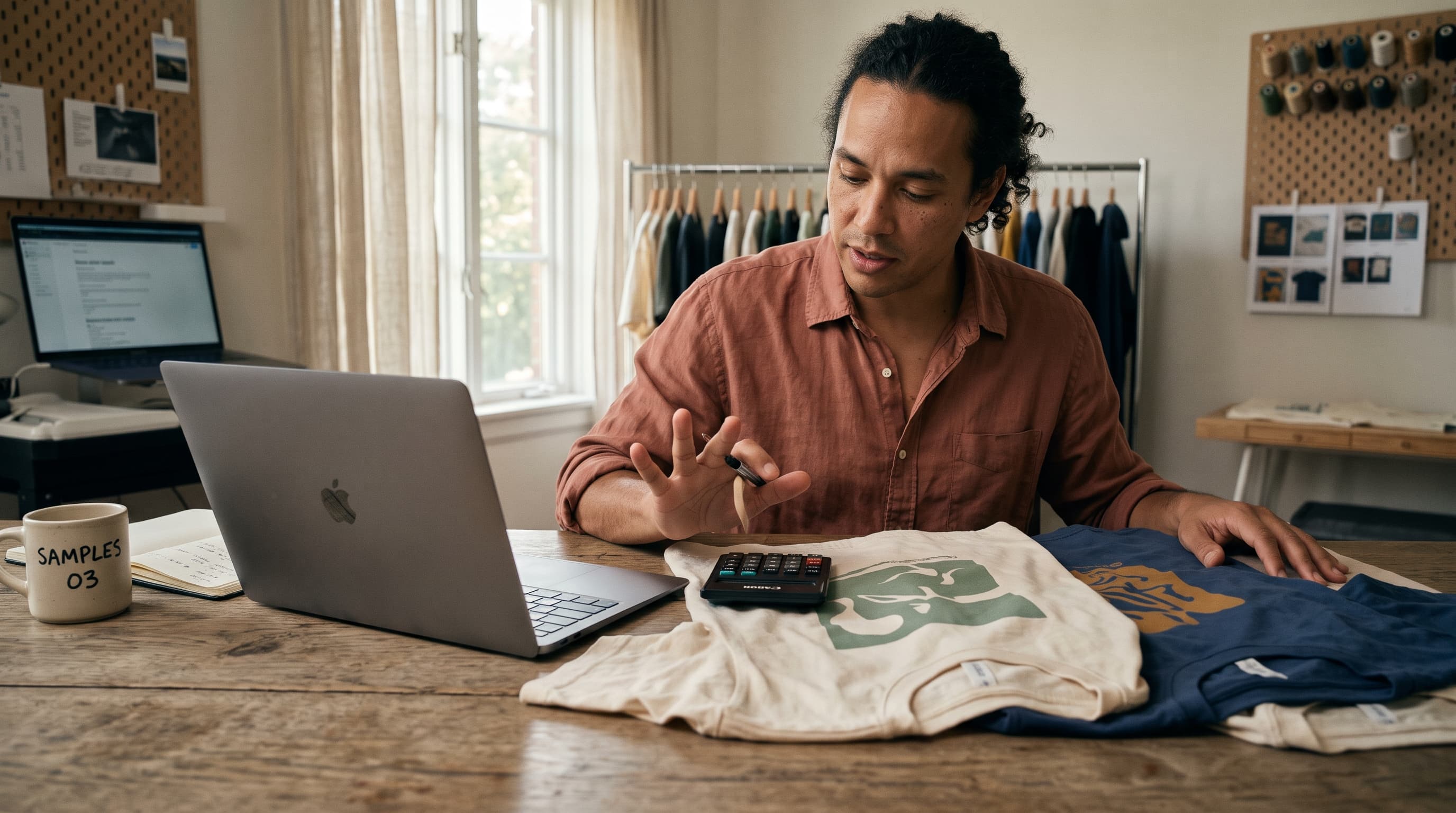
The typical print on demand profit margin for clothing is 40% to 50% gross on a tee priced at $30, or roughly $12 to $16 per shirt before ads. Manufacturing in bulk can reach 60% to 75% gross margin, but you pay for inventory upfront. POD wins on risk and cash; manufacturing wins on margin once demand is proven.
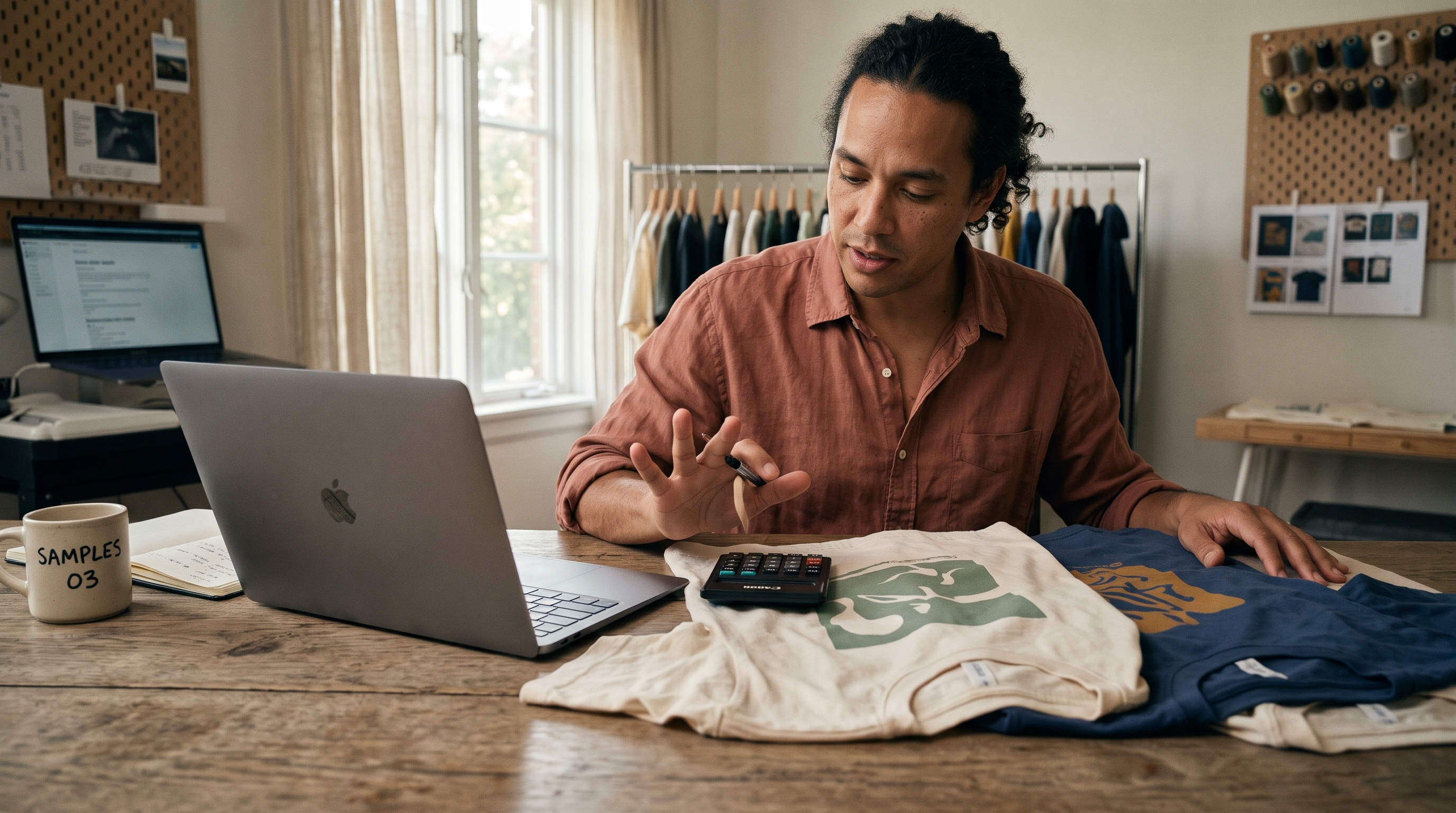
The figures below are worked examples built from public provider catalogs (Printful and Printify base prices), Stripe's published US card rate of 2.9% + $0.30, and Shopify's published plan pricing. They are not results from a specific brand, and supplier prices shift, so check your own quotes before you commit. What won't change is the logic: the two models trade margin for risk, and the right choice depends on how much cash you have and how much demand you've already proven.
Is Print on Demand Profitable for Clothing?
Yes, print on demand is profitable for clothing, but thinly. Most brands keep 40% to 50% gross margin on tees and 40% to 50% on hoodies when priced at $30 and $65. Discounts, fees, and returns can pull that toward 30%. After advertising, net margin often falls to 0% to 15%, and a brand running paid traffic on first purchases can land near zero. It's a reasonable way to test designs with almost no capital, and a hard way to build a high-margin business at scale.
Here's why margins stay modest. Your POD partner (Printful, Printify, Gelato and similar) handles blanks, printing, packing, and shipping. They need their own margin on each step, and you pay a premium for the convenience of zero inventory.
POD t-shirt profit per sale
A typical example looks like this. Confirm the current base cost on your provider's catalog, such as Printful.
- Retail price: $29.99
- Base cost plus print: about $13 to $16 for a standard cotton tee
- Shipping charged to the customer: usually covered by what you collect at checkout
- Payment processing: about 2.9% + $0.30 on Stripe's standard US rate, roughly $1.17
- Gross profit per sale: about $13 to $16 before fees, or 43% to 53% of the sale price, and roughly 40% to 50% after fees
Now subtract advertising. If you spend $10 to acquire each customer, your POD t-shirt profit per sale shrinks to roughly $3 to $6, before returns. A cheap blank at the low end of the cost range lands near 50% margin, while a premium blank with a large print lands closer to 40%. The 30% figure applies once you add discounts and returns. For a deeper walk through pricing, see our guide on how to price clothing for profit.
Hoodies and premium items do better in dollars
Hoodies carry higher base costs ($28 to $38 on most POD catalogs) but retail at $55 to $75. Dollar profit per unit is higher, often $15 to $25, though the percentage margin stays in the same 35% to 50% band as tees. Embroidery and all-over print cost more still.
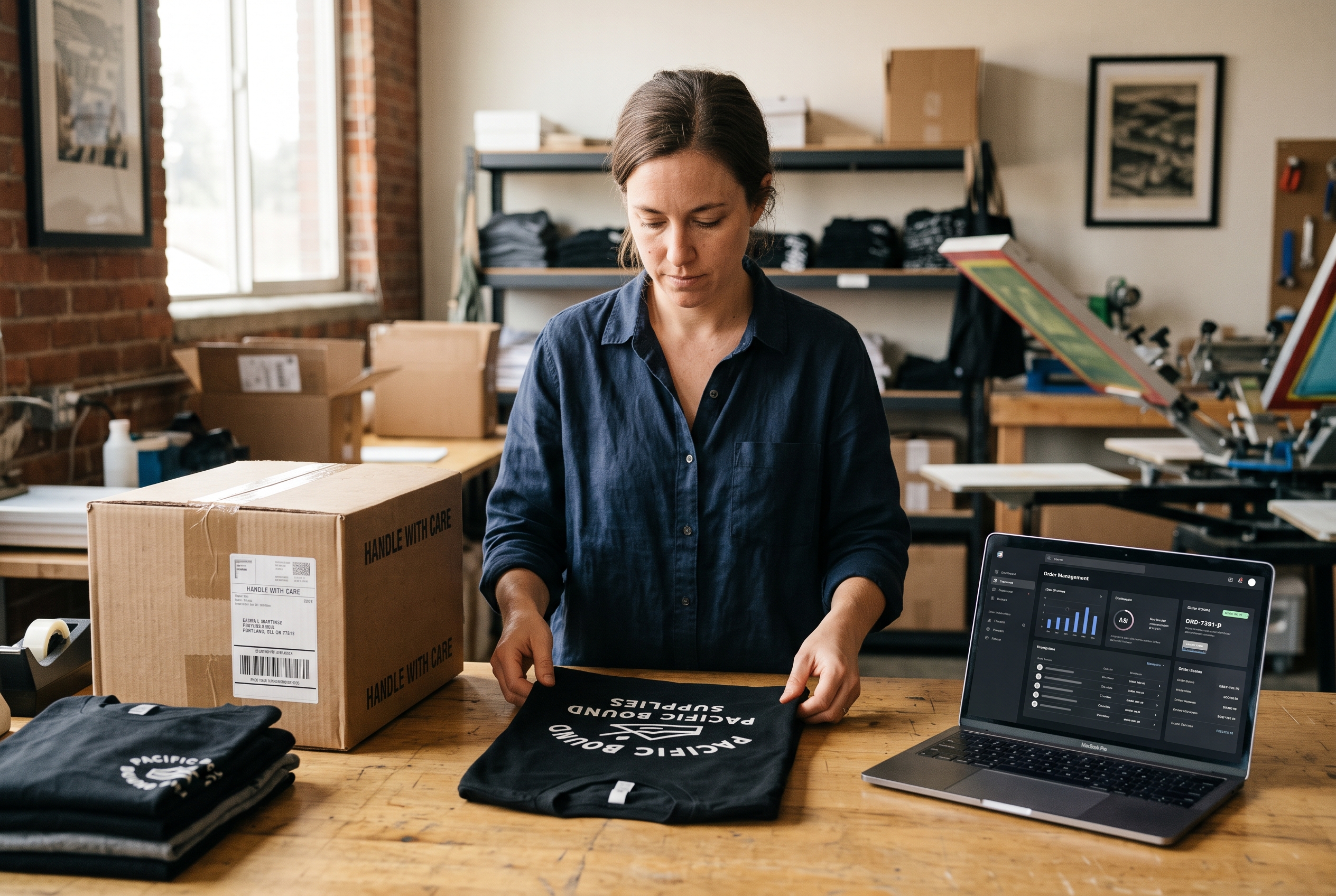
How ad costs and returns reshape POD margins
Two costs do most of the damage after the sale.
- Ad cost per sale: If your store converts at 2% and you pay $1 per click, each order costs about $50 in ads. Even at a 3% conversion rate and $0.80 per click, that's about $27. Against $13 to $16 of tee gross profit, paid traffic alone can make a first purchase unprofitable. Brands survive on repeat buyers, email, and organic traffic.
- Returns and reprints: Many POD providers reprint or refund only for defects or misprints, not for sizing. If 15% of orders are returned or remade and you absorb the $14 production cost plus lost shipping, that's about $2 to $3 per order averaged across all sales.
A net view of a $29.99 tee: $14.50 gross profit, minus $1.17 fees, minus $10 ads, minus $2.50 for returns and remakes, leaves about $0.83 per sale, under 3% net. That sits below the 5% to 15% many brands reach because they rely on repeat buyers and organic traffic to dilute ad spend. It's also why pricing at $35 to $45 or raising order value matters more than shaving cents off the blank.
Manufacturing Margins: What Cut and Sew Really Costs
Manufacturing a clothing line yourself usually delivers 60% to 75% gross margin, because you buy at wholesale scale. The catch is the minimum order, the upfront cash, and the risk of unsold stock sitting in your spare room.
Cut and sew cost per unit
Fully custom cut-and-sew (your own pattern, fabric, and labels) involves sampling, fabric sourcing, cutting, sewing, trims, and freight. Typical ranges:
- T-shirt: $5 to $9 per unit at 300+ pieces, higher at small runs
- Sampling: $50 to $200 per sample, often 2 to 3 rounds
- Labels, hang tags, polybags: $0.50 to $1.50 per unit
- Freight and duties: 5% to 15% of goods value when importing
Cost per unit hoodie manufacturing
Hoodies need more fabric and labor. Expect $14 to $24 per unit for a mid-weight fleece hoodie at 100 to 300 pieces, with prices falling as quantity rises. Retail at $65 and you're near 65% gross margin, against roughly 40% for the same hoodie through POD.
Clothing manufacturing minimum order quantity cost
Minimums are where small brands get squeezed. Many overseas factories ask for 300 to 500 pieces per style, often split across sizes and colors. Domestic and boutique factories may accept 50 to 100 pieces, at a higher unit price. A 300-piece run of hoodies at $18 each is a $5,400 commitment before shipping, labels, and photography. Plan for the hidden extras too: a small brand paying for freight, duties, and a photo shoot can add $1,000 or more to that figure.
Print on Demand vs Manufacturing Profit: Side by Side
Compared directly, manufacturing wins on per-unit profit and POD wins on capital risk. The table uses a $65 hoodie and a $30 tee with mid-range costs.
| Metric | Print on demand | Manufacturing (300 units) |
|---|---|---|
| Tee unit cost | $13 to $16 | $6 to $10 (landed) |
| Tee gross margin at $30 | ~43% to 53% before fees, ~40% to 50% after | ~67% to 80% before fees, ~60% to 75% after |
| Hoodie unit cost | $30 to $38 | $16 to $24 (landed) |
| Hoodie gross margin at $65 | ~40% to 50% | ~63% to 75% |
| Upfront cash | $0 to $200 (samples) | $3,000 to $8,000+ |
| Unsold stock risk | None | You carry it |
| Shipping speed | 3 to 8 business days typical | You control it |
| Quality control | Limited | Full |
For more on the format trade-offs, see print on demand vs manufacturing clothing. And if you want overall numbers beyond unit costs, the breakdown in online clothing business profit margin shows where net margin lands once everything is counted.
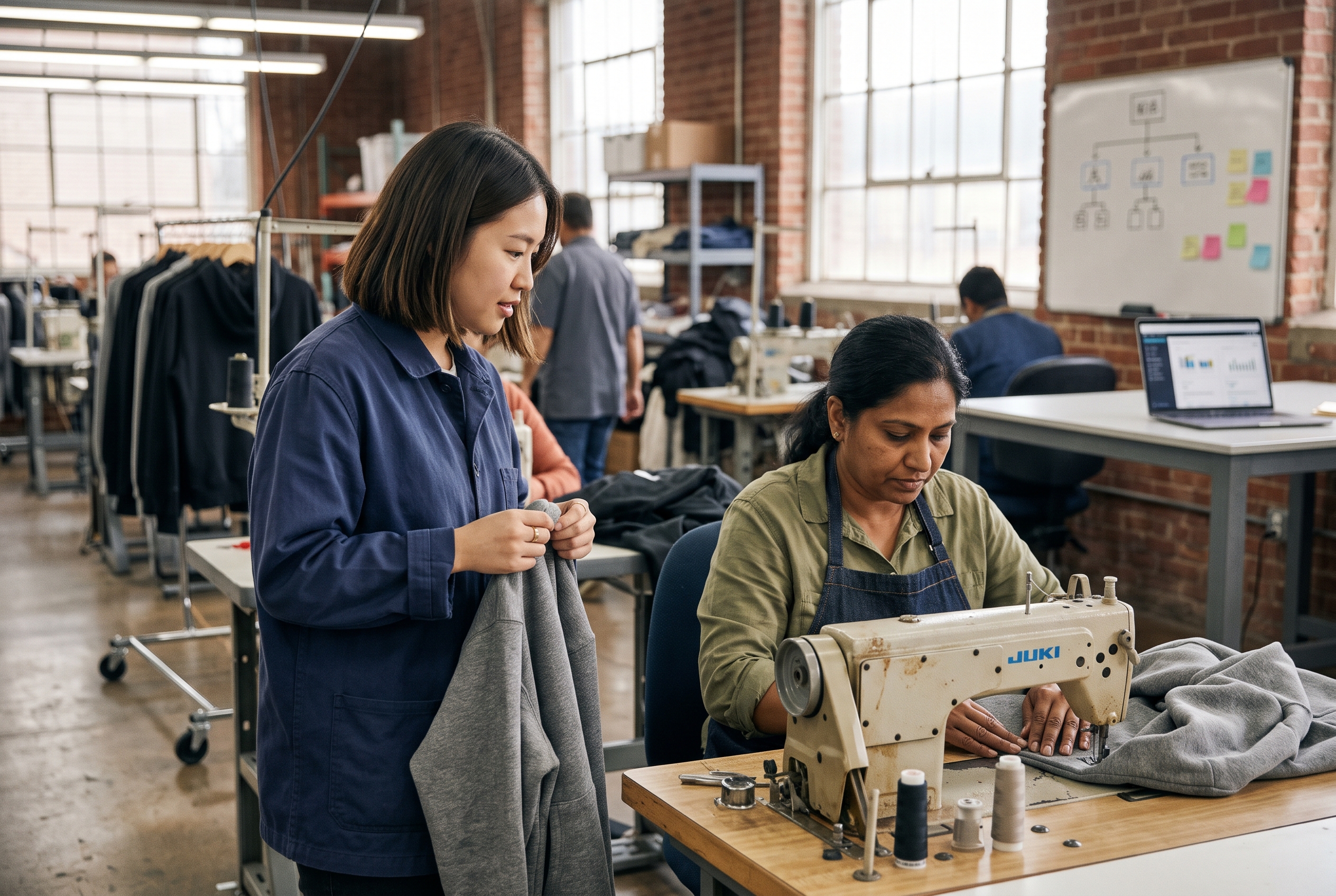
Break-Even Point and Cash Flow for a Clothing Brand
The break-even point for a clothing brand is your fixed costs divided by profit per unit. POD breaks even almost immediately because fixed costs are low. Manufacturing needs a few hundred sales to recover the production run, but reaches higher profit afterward.
Break-even point clothing brand: a worked example
Say you sell a $65 hoodie. Ad cost per sale is $15.
- POD: cost $34, fees $2.20, ads $15. Profit per sale about $13.80. With $300 in setup costs, you break even at roughly 22 sales.
- Manufacturing: cost $19 landed, fees $2.20, ads $15. Profit per sale about $28.80. With a $5,700 run plus $800 in samples and photography ($6,500 total), you break even at roughly 226 sales.
Past 226 sales, manufacturing earns you about $15 more per hoodie. At 1,000 hoodies, that's a $15,000 gap. But if you only ever sell 150, POD would've left you ahead.
Cash flow and clothing inventory
Cash flow clothing inventory problems kill more brands than bad design. Manufacturing locks cash for 60 to 120 days: sampling, production, shipping, then selling through. During that stretch you can't fund ads or restock winners.
Dead stock is the second hit. A brand with 200 unsold hoodies in one color has about $3,600 frozen at an $18 unit cost. POD has no such exposure, which is why it's the safer way to learn what sells. If you're starting lean, our guide on starting print on demand with no money covers the first steps.
Which Model Should You Choose? A Hybrid Plan
Start with POD to validate designs, then manufacture only your proven bestsellers. Many clothing brands end up hybrid, using each model where it pays.
- Test with POD (months 1 to 3). Launch 5 to 10 designs. Spend small on ads and track which ones convert.
- Set a trigger. When one design sells 30 to 50 units a month for two straight months, it's a manufacturing candidate.
- Manufacture that single style. Order the smallest run your factory allows, in the top two colors and core sizes.
- Keep POD for the long tail. New drops, seasonal designs, and slow sellers stay on-demand.
- Reinvest margin. Use the extra $10 to $15 per unit to fund ads and better photography.
How to raise POD margins without manufacturing
- Price on brand value, not on base cost. Premium positioning supports $35 to $45 tees.
- Bundle items so shipping and ad costs spread across a larger order.
- Move to higher-priced products like hoodies, embroidered pieces, and all-over prints.
- Negotiate or upgrade to a subscription tier with your POD provider for discounted base costs.
- Cut platform costs. Stacked app fees can quietly eat 3 to 5 points of margin, as covered in how to increase profit margins in ecommerce.
Common Questions About POD and Clothing Margins
What is a good profit margin for print on demand clothing?
Aim for 40% or more gross margin and at least 10% net after ads. Under 30% gross leaves too little room for marketing and returns.
Is manufacturing always more profitable?
Only at volume. Below roughly 200 to 300 units per style, POD often earns more total profit because you avoid unsold stock and upfront cost.
Do returns hurt margins differently?
Yes. With POD, many providers don't take back size-related returns, so you absorb the loss. With manufacturing, returned items can be restocked and resold, though you handle shipping and inspection yourself. Apparel return rates run high, so model for them. See clothing return rate benchmarks for the numbers.
What platform costs should I include?
Include your monthly subscription, payment fees, and any paid apps. According to Shopify's pricing page, plans start at $39 a month on monthly billing before apps and transaction fees, and that's before the extras apparel stores usually add for abandoned cart recovery, reviews, and wishlists.
Bottom Line: Print on Demand Profit Margin for Clothing
POD gives you low-risk learning and 40% to 50% gross margins that shrink toward 30% after discounts and returns. Manufacturing gives you 60% to 75% margins and the cash-flow burden that comes with them. Test on POD, then manufacture proven winners.
Whichever route you take, your store costs count toward margin. Rovela is an AI-powered e-commerce platform that builds a full clothing store from a plain-language conversation, with abandoned cart, wishlist, reviews, and Stripe checkout included in one flat subscription, so there's no app stack eating into your POD margin. Check the plans on the pricing page and get your store live in hours.