
By El Ghali Bennis · Published
Fitness Studio Online Store: How to Launch One in 2026
Launch a fitness studio online store that sells class packs, apparel and retail 24/7. Setup steps, pricing math, tax and inventory tips.

A fitness studio online store is a website where your studio sells class packs, memberships, apparel and retail products without front-desk help. The simplest version has three parts: a catalog of what you sell, a checkout that takes cards, and a way to deliver or redeem each purchase. You can launch one in days.

Most studios treat retail as an afterthought: a rack by the door, a card reader, and whatever the instructor remembers to mention. That leaves money on the table. Your members already trust your brand. They wear your logo to brunch. An online store lets them buy at 11 p.m. on the couch, and lets people who've never visited buy too.
This guide covers what to sell, how to structure it, the setup steps, sales tax, inventory and fulfillment, and the mistakes that kill studio retail.
Why does a fitness studio need an online store?
Because your best buying moments don't happen at the front desk. They happen after a great class, in a group chat, or when a friend asks "where did you get that?" An online store captures those moments and turns them into revenue you'd otherwise miss.
There are three practical reasons to do it:
- Revenue outside class hours. Class packs, gift cards and merch sell while you sleep.
- Reach beyond your zip code. A fitness brand merch store lets former members, travelers and fans buy from anywhere.
- Customer data you own. Every order gives you an email address and purchase history you can use for reminders and offers.
Strong studio brands show how far this can go. Boutique brands like SoulCycle and Barry's built apparel lines that members buy and wear well beyond the studio, turning customers into walking advertising. Most independent studios won't reach that scale, but the principle holds: identity sells.
Here is a worked example using illustrative numbers, not a case study. Say you have 300 active members and 15% buy something twice a year. That's 90 orders. At an average order of $45, you earn $4,050 in revenue. At a 55% gross margin, about $2,200 lands as profit with almost no added labor. Double the order rate by adding gift cards and a holiday drop, and the figure roughly doubles too.
For broader context, industry reports from groups such as the Health & Fitness Association (formerly IHRSA) track fitness participation and member spending each year, and are worth checking when you build a business case. If you're still deciding whether you need a site at all, our piece on whether you need a website to sell products online breaks down the trade-offs.
What should your fitness studio online store sell?
Start with products that match how members already spend money at your studio: class credits, merchandise, and a few retail extras. Keep the first catalog under 20 items. A small, clear store converts better than a sprawling one.
Sell class packs online
If you want to sell class packs online, treat them as your hero product. A 5-pack, 10-pack and monthly unlimited cover most buying styles. Add an intro offer for new clients, such as three classes for a fixed price valid for 30 days. Be explicit about expiry dates and whether packs are shareable.
One caution: class packs usually need to connect with your booking software so credits get applied. Many studios run their scheduling on a tool like Mindbody or Momence and use the store for physical goods and gift cards. Decide early which system is the source of truth for credits. Three common setups work:
- Booking tool sells packs, store sells goods. Simplest. Link to the booking tool's purchase page from your store navigation.
- Store sells packs and emails a code. Members redeem the code at the front desk or in the booking app. This needs a manual or automated step to apply credits.
- Memberships on recurring billing. Monthly unlimited plans need subscription billing and cancellation handling. See our subscription ecommerce guide for how recurring revenue works.
Whatever you choose, test one full purchase yourself, from payment through to the credit showing up on your account, before announcing anything.
Sell apparel for your fitness studio
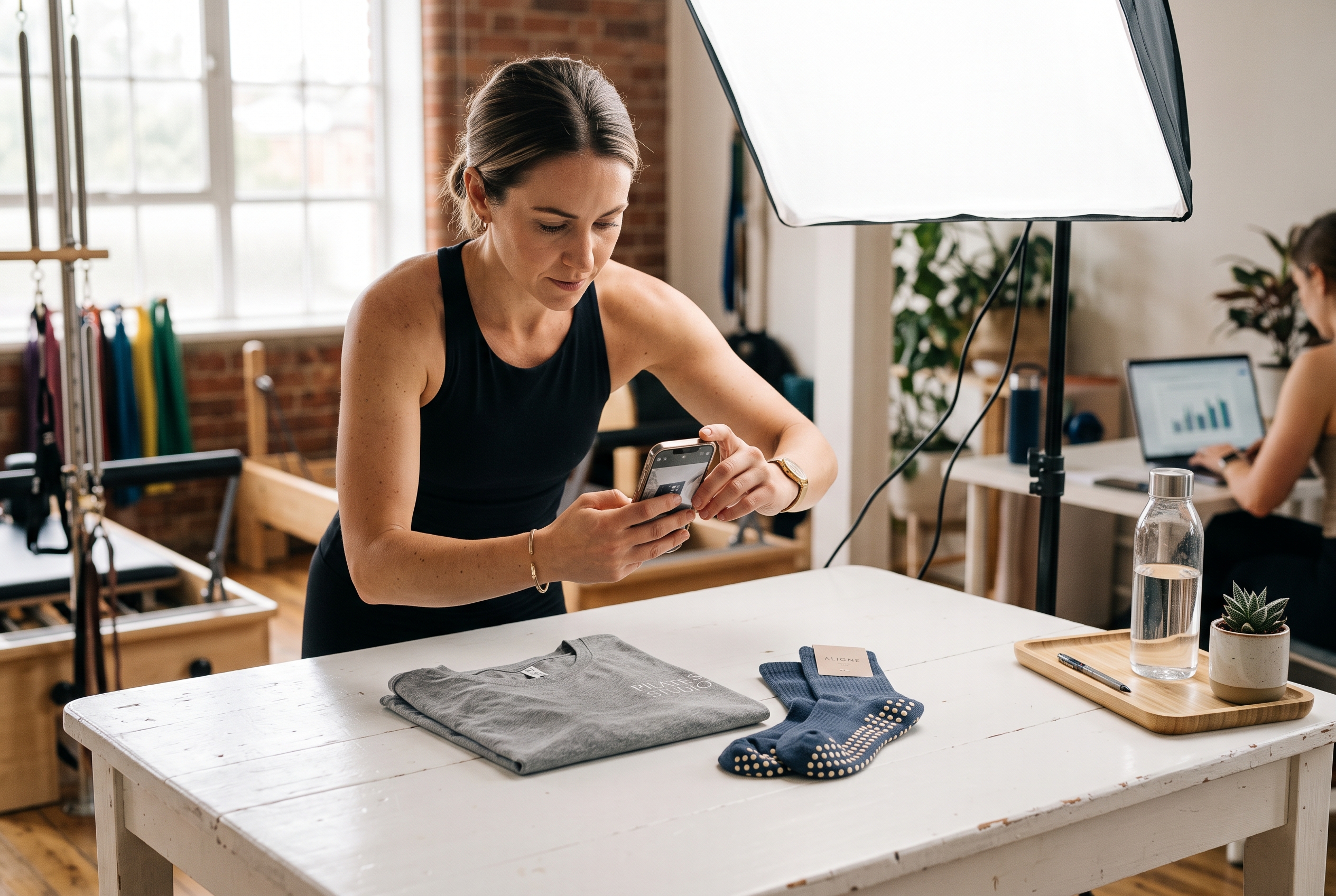
To sell apparel for fitness studio members, begin with the items people already ask about: a logo tee, a hoodie, a tote and a water bottle. Offer sizes honestly, publish a size chart, and take clear photos on real people. Apparel returns are mostly fit-related, so detail here saves you money. A simple trick: ask your instructors to model and note their height and size in the caption, such as "Sam is 5'6" and wears a medium."
Add studio retail extras
Good studio retail ecommerce goes beyond logos. Think about what you already recommend in class:
- Grip socks, yoga mats, straps and blocks
- Resistance bands and foam rollers
- Supplements or snacks you already stock (check local rules on selling consumables)
- Gift cards and class-pack gifts
- Digital items such as recorded classes or a 4-week program
For digital programs, see how to deliver digital products automatically so you aren't emailing files by hand.
How do you set up a fitness studio online store?
You set one up in six steps: choose a platform, define your catalog, build product pages, connect payments and shipping, set policies, and promote it to members. A focused studio can finish the first version in a weekend if the products are already photographed.
- Pick your platform. You'll choose between a general builder, a marketplace, a plugin-based setup, or an AI store builder. More on this below.
- Define your catalog. List every item, its price, sizes, and cost. Know your margin before you publish.
- Build product pages. Use two to four photos per item, a plain description, and the size chart. Our guide on how to add products to your online store walks through this part.
- Connect payments. Stripe and PayPal cover most studios. Turn on Apple Pay and Google Pay, since most members will buy from a phone.
- Set shipping and pickup. Offer free in-studio pickup. It costs you nothing, brings people through the door, and often leads to a second purchase. If you're near your members, local delivery setup can work too.
- Write your policies. Returns, expiry on class packs, and refund rules should be visible before checkout.
Sales tax and licensing
Sales tax rules vary by location and by product. Physical goods like apparel are generally taxable where you have a presence, while the treatment of class packs, memberships and digital items differs between jurisdictions. Some places tax fitness services and others don't. Confirm with your accountant or local tax authority, then set up tax rates in your platform so they apply at checkout. Our article on whether you need a business license to sell online covers the basics.
Inventory and fulfillment
Keep inventory simple. Track stock by size and color, set a low-stock alert at two or three units, and count shelves monthly. Store stock somewhere dry and separate from your studio supplies. For fulfillment, decide who packs orders and when: a weekly batch on a set day works for most studios, with pickup orders held at the desk and labeled by name. Tell customers your handling time on the product page so expectations match reality. Use sturdy poly mailers for apparel and a small box for bottles and accessories.
Which platform works best for a gym merchandise online store?
The best platform for a gym merchandise online store is the one that handles abandoned carts, wishlists, reviews and email without a stack of paid add-ons. Studios rarely have a developer, so low maintenance matters more than customization.
| Option | Typical cost | Best for | Watch out for |
|---|---|---|---|
| Shopify | From $39/month plus apps (per Shopify's pricing page) | Studios wanting a huge app ecosystem | Apps for cart recovery, wishlists and Q&A add monthly cost |
| WooCommerce | Hosting plus plugins plus upkeep | Studios with a developer on call | Plugin conflicts and security patching are on you |
| Wix / Squarespace | Entry store plans start in the high teens per month and climb to around $50 on higher tiers (check each vendor's pricing page) | Very small catalogs | Limited e-commerce depth, some features paywalled |
| Rovela | Single flat subscription | Studios wanting everything built in | Newer platform; confirm your booking tool setup |
If your store is mostly apparel and accessories, the platform's job is simple: show products fast, take payment, and follow up with people who didn't finish buying. For a deeper look, read our fitness ecommerce website builder comparison or the best Shopify alternative for fitness brands. For budget planning, see how much a fitness website costs.
You can also check current plan pricing directly on Shopify's pricing page and Stripe's pricing page so you're working from live numbers, not a blog's snapshot. Remember that card processing fees also apply on every sale, typically a percentage plus a fixed amount per transaction, so factor them into your margins.

How do you promote a yoga studio online shop?
Promote a yoga studio online shop where your members already pay attention: in class, in your email list, and on Instagram. Your first 50 orders will almost all come from people who already know you.
Use the room you already have
- Put a QR code on the front desk, mirrors, and in the changing room.
- Have instructors wear one new item per month and mention it once.
- Print the store URL on class-pack receipts and welcome cards.
Email and drops
Run limited drops: a seasonal color, an anniversary tee, a collaboration with a local brand. Scarcity works because members like owning something not everyone has. Send one announcement, one reminder, and a "last chance" note. Avoid emailing weekly about merch.
Recover lost sales
Plenty of shoppers add a hoodie to their cart and wander off. The Baymard Institute, which researches checkout usability, has long put average cart abandonment near 70%. An automated abandoned-cart email is one of the cheapest ways to win some of those sales back. Some platforms charge for this feature as an add-on; others include it.
Price and margin check
A healthy rule for branded apparel is to price at two to three times your landed cost. Landed cost means everything to get the item on your shelf: unit price, decoration, freight and duties. Here is the math on a hoodie:
- Blank hoodie plus embroidery: $19
- Freight and packaging: $3
- Landed cost: $22
- Retail price: $60
- Card fees at roughly 3%: about $1.80
- Profit before discounts: about $36, or 60% of price
That cushion lets you run a 15% member discount and still clear healthy margin. Track which items sell out first, and reorder those before a gap hurts momentum. Bulk orders often lower unit cost, but only buy deeper once an item has sold through a full run.
What mistakes should studios avoid?
The most common mistakes are launching too many products, ignoring fit and sizing, and splitting customer data across three disconnected tools. Each one is easy to avoid if you plan for it.
- Overbuying inventory. Order small first runs, or use print-on-demand for the first season.
- Weak photos. Phone photos in natural light beat stock mockups every time.
- No pickup option. Shipping costs can wipe out margin on a $30 tee.
- Confusing pack rules. If expiry and sharing aren't spelled out, you'll field refund requests.
- Slow mobile pages. Most members will shop on a phone. Keep apps and add-ons to what you truly use.
- Ignoring tax setup. Collecting the wrong amount creates cleanup work later.
It also helps to know what's realistic on timing. Our guide on how long it takes to build an online store sets expectations.
Ready to launch your studio store?
A fitness studio online store is a simple idea done well: a few strong products, clear policies, easy payment, and promotion inside the community you've already built. Start with class packs, a logo tee and a hoodie, then add based on what members actually buy.
If you'd rather not wire together apps, Rovela builds a complete store from a plain-language description. Checkout, abandoned-cart recovery, wishlists, reviews and an admin dashboard come included in one flat subscription, and you can check current pricing before you decide. Describe your studio, review what gets built, and open your doors online this week.
