By El Ghali Bennis · Published
Coffee Roasting Business Profit Margins: A Worked Example
Coffee roasting business profit margins explained with worked math: shrinkage, cost per pound, pricing and wholesale vs retail, so you know what you keep.
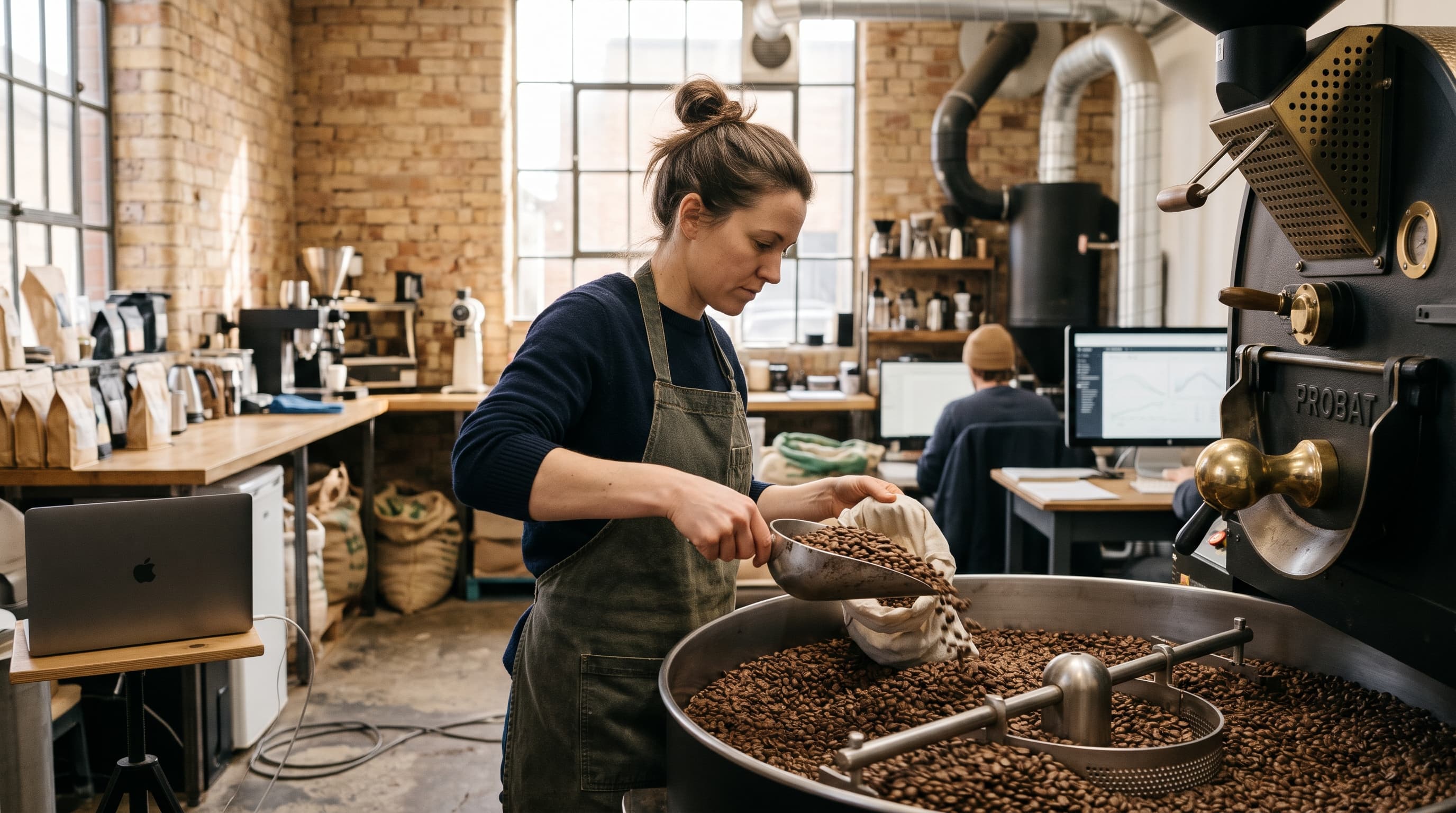
Coffee roasting business profit margins typically land between 40% and 65% gross, and 8% to 20% net once rent, labor, packaging, and marketing are paid. Direct-to-consumer bags earn the most per pound, wholesale earns the least but moves volume. Your real number depends on shrinkage, pricing, and channel mix.
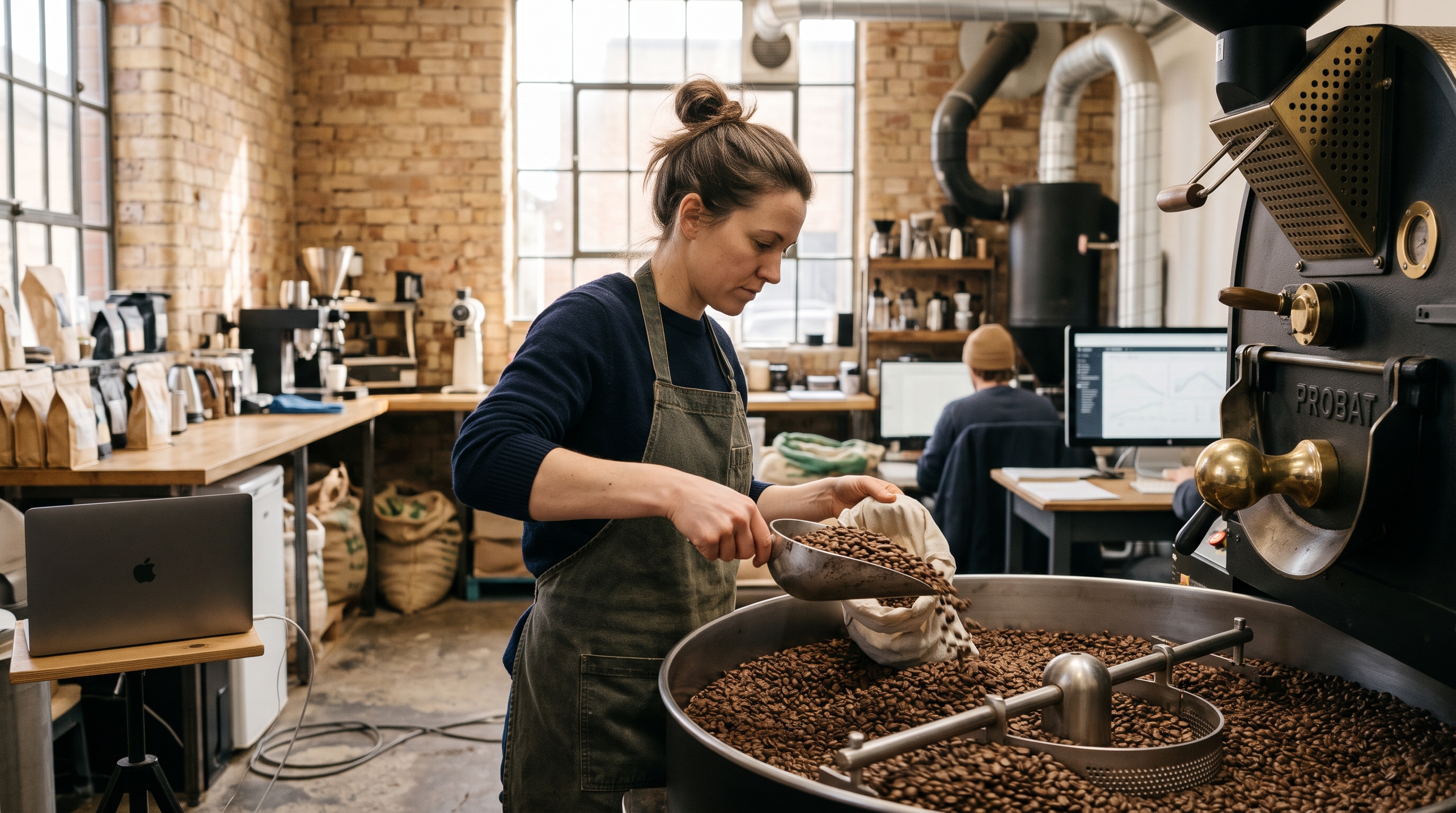
Treat the ranges above as planning figures, not guarantees. They are our estimates, built from the cost structure shown in the worked examples below rather than from a single audited survey. Your own numbers will move with green coffee prices, your local rent, and how much you sell direct. The shrinkage range is a widely cited roasting rule of thumb, and the SCA and your green coffee importer's own roast data are the best places to verify it. The rest of this guide shows you how to build the math yourself, line by line, so you aren't guessing.
Is a coffee roasting business profitable?
Yes, a coffee roasting business can be profitable, but it rewards discipline more than passion. Gross margins are healthy because roasting adds real value to green beans. Net margins are thin until you cover equipment, labor, and customer acquisition with enough volume.
The roasters who struggle usually make the same three mistakes. They price off competitors instead of costs, they ignore weight loss in the roaster, and they lean too hard on low-margin wholesale accounts. The roasters who do well treat the roastery like a small manufacturer with a retail arm.
Here's the rough shape of a healthy small roastery, using planning assumptions rather than audited data:
- Gross margin: 45% to 65% blended across channels.
- Net margin: 8% to 20% once you pay yourself a fair wage.
- Break-even: often 12 to 24 months for a small roaster with a 5 to 15 kg machine.
- Biggest swing factor: the share of revenue that comes from direct sales instead of wholesale.
The Specialty Coffee Association (sca.coffee) publishes industry resources and standards worth reading before you commit to equipment. Use them for quality benchmarks, then run your own financials.
Roasted coffee cost per pound: the full breakdown
Your roasted coffee cost per pound is green coffee cost, adjusted for weight loss, plus packaging, labor, energy, and overhead. Green beans are the biggest line, usually 50% to 70% of cost of goods sold, so every other number depends on getting this one right.
Start with a green coffee cost calculator
You don't need software. A simple formula works: green cost per lb ÷ (1 − shrinkage %) = cost per roasted lb before anything else.
Say you buy a specialty green at $5.50 per pound and lose 15% in the roaster. Your roasted cost is $5.50 ÷ 0.85, or about $6.47 per pound. That's before a bag, a label, a minute of labor, or a cent of gas.
Understand coffee roasting shrinkage
Coffee roasting shrinkage is the weight green beans lose as moisture and chaff burn off. It typically runs 12% to 20%, with light roasts near the low end and dark roasts near the high end. Dark roasting costs you more pounds of sellable product from the same sack.
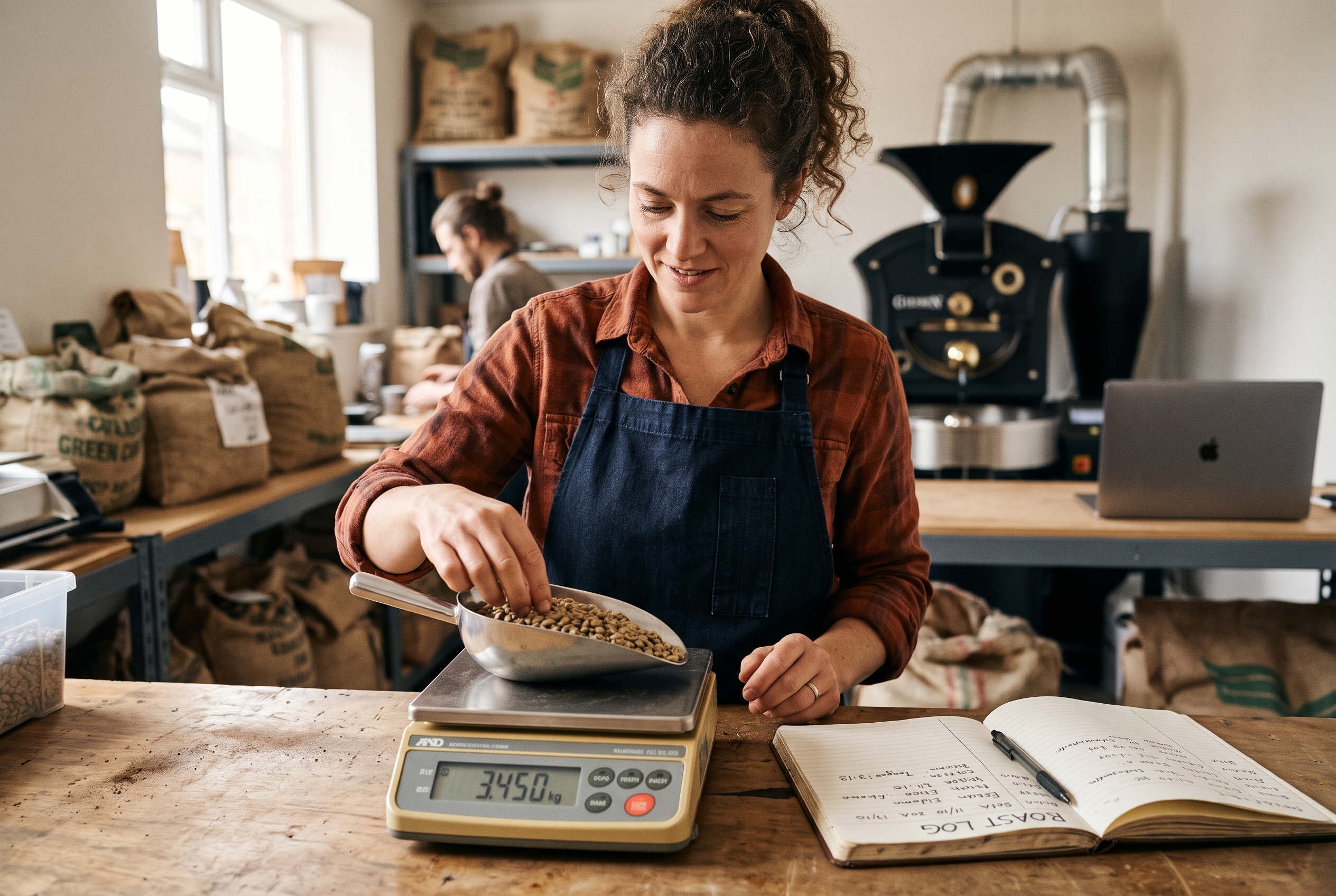
Track it per batch. Weigh green in, weigh roasted out, and log the percentage. Two points of drift across 1,000 pounds a month is real money, and it often hides a roast profile problem.
A sample cost-per-pound build
| Cost line | Per roasted lb | Notes |
|---|---|---|
| Green coffee (at 15% shrinkage) | $6.47 | $5.50/lb green |
| Packaging (bag, valve, label) | $0.55 | Cheaper in bulk |
| Labor (roast, pack, ship) | $1.20 | About 10 minutes at $18/hr plus extras |
| Energy and roaster upkeep | $0.35 | Gas, afterburner, maintenance |
| Overhead allocation | $0.90 | Rent, insurance, software |
| Total | $9.47 | Planning example only |
These are illustrative numbers. Swap in your invoices and the table becomes your pricing floor.
How to price roasted coffee beans for healthy profit margins
To price roasted coffee beans, start with your fully loaded cost per pound, then add the margin your channel requires. A common coffee roaster pricing strategy is a 2.5x to 3x multiple of cost for retail and roughly 1.6x to 2x for wholesale.
The step-by-step method
- Calculate fully loaded cost per roasted pound using the table above.
- Convert to your bag size. A 12 oz bag holds 0.75 lb, so cost is $9.47 × 0.75 = $7.10.
- Set a target gross margin by channel. Retail 60%+, wholesale 35% to 45%.
- Divide cost by (1 − margin). For a 60% margin, $7.10 ÷ 0.40 = $17.75.
- Round to a clean price point like $17.50 or $18, then sanity-check against local competitors.
Notice the competitor check comes last. If the market won't bear your price, the answer isn't to cut margin silently. It's to lower cost, raise perceived value through origin stories and freshness, or change the channel mix.
How much profit per bag of coffee?
Using the example above, a $18 retail bag with $7.10 in loaded cost leaves roughly $10.90 gross profit, about 60%. A wholesale bag of the same size at $11.50 leaves about $4.40, or 38%. Shipping, card fees, and ad spend come out of the retail figure.
That gap is why many roasters push subscriptions. A recurring customer on a $18 bag every two weeks is worth far more than a café account that squeezes you on price. Our guide on how to sell coffee beans online covers how to build that subscription engine.
Coffee bean wholesale vs retail price
The coffee bean wholesale vs retail price gap is usually 30% to 45%. Wholesale buyers get a lower per-pound price in exchange for volume, predictable orders, and less customer service. Retail buyers pay more because you carry marketing, shipping, and support costs.
| Factor | Retail / DTC | Wholesale |
|---|---|---|
| Price per 12 oz bag (example) | $18.00 | $11.50 |
| Gross margin | ~60% | ~38% |
| Costs on top | Shipping, ads, card fees | Delivery, net-30 terms, discounts |
| Cash flow | Paid at checkout | Often 15 to 30 days |
| Order size | Small, frequent | Large, steady |
| Risk | Acquisition cost | Customer concentration |
Neither channel is better in isolation. Wholesale keeps the roaster running at efficient batch sizes, which protects your per-pound labor and energy cost. Retail lifts the blended margin. We break the tradeoff down further in coffee wholesale vs direct to consumer.
A practical mix for a young roastery is 60% wholesale and 40% DTC by volume, then shifting toward DTC as your email list and subscriber base grow. Cap any single wholesale account at 20% of revenue so one lost café doesn't sink your month.
How to improve coffee roasting business profit margins
You improve coffee roasting business profit margins by cutting waste, raising average order value, and moving volume toward direct sales. Small changes compound because your cost base is mostly fixed once the roaster is running.
Seven levers that move the number
- Buy green in larger lots. Moving from 69 kg bags to pallet-level buys can cut green cost 5% to 10%, if you have storage and cash. Treat this as a figure to confirm by asking your importer for tiered quotes.
- Track shrinkage per batch. Find the roast profiles that burn extra weight.
- Roast to order for DTC. Fresher coffee justifies premium prices and reduces unsold inventory.
- Add subscriptions. Recurring revenue cuts acquisition cost per order.
- Sell bundles and gear. Filters, mugs, and brewers raise average order value.
- Raise wholesale minimums. Charge for small drop-offs or require a monthly minimum.
- Audit your platform costs. Apps and transaction fees quietly eat 3% to 8% of DTC revenue.
That last one catches many roasters off guard. On Shopify, base plans run from $39 to $399 per month according to Shopify's pricing page, and subscription, abandoned cart, and review tools usually come as paid apps on top. For a roaster doing $8,000 a month online, that stack can swallow a full point or two of margin. Our breakdown of Shopify app costs shows how fast it adds up, and the broader guide to increasing ecommerce profit margins covers the rest of the stack.
Watch the hidden costs
Roasters forget costs that don't show up on a green invoice. Afterburner maintenance, chaff disposal, insurance, health permits, sample coffee given away, and cupping time all belong in overhead. If you add them honestly, your cost per pound probably rises 5% to 10% compared to your first spreadsheet.
Also factor in free shipping. A $6 shipping label on an $18 bag erases a third of your gross profit. Set a free shipping threshold at two or three bags, and use subscriptions to spread the cost.
Coffee roasting business profit margins in practice: what a roaster keeps
Here's a simplified monthly P&L for a small roastery selling 1,000 roasted pounds, split evenly between wholesale and DTC. It's an illustrative model, not benchmark data.
| Line | Amount |
|---|---|
| DTC revenue (500 lb at $24/lb) | $12,000 |
| Wholesale revenue (500 lb at $15.33/lb) | $7,665 |
| Total revenue | $19,665 |
| Cost of goods (1,000 lb at about $8.57 excl. overhead) | $8,570 |
| Gross profit | $11,095 (56%) |
| Rent, insurance, software, utilities | $2,400 |
| Shipping, card fees, marketing | $3,300 |
| Owner and part-time labor beyond COGS | $2,300 |
| Net profit | about $3,100 (16%) |
Shift that mix to 70% wholesale and net drops toward 9% to 10%. Shift to 70% DTC and it climbs past 20%, assuming you can acquire customers affordably. That's the whole game: your channel mix is your margin.
Common questions
What's a good profit margin for a coffee roaster? Aim for 50%+ blended gross margin and 10% to 15% net. Below 8% net, you're working for free.
Is wholesale or retail more profitable? Retail has the higher percentage. Wholesale has lower acquisition cost and steadier volume. You want both.
How much does shrinkage matter? A lot. At $5.50 green, moving from 15% to 18% shrinkage adds about $0.23 to every roasted pound.
Turn better margins into a store you own
Margin math only works if you can sell direct without handing back a chunk of every order to apps and fees. That means a fast store, subscriptions, abandoned cart recovery, and reviews working together. If you're thinking about taking your roastery online, Rovela builds a complete store from a plain-language description, with those features included in one flat subscription and no commission on sales. You can check Rovela's pricing or see how a launch works on the homepage.
Whatever you choose, start with the spreadsheet. Know your green cost, your shrinkage, and your loaded cost per pound, then price from there. That's how you find out whether your roastery is profitable before the bills tell you.