July 5, 2026
How to Start a Print on Demand T-Shirt Business
A step-by-step guide to starting a print on demand t-shirt business: pick a niche, design, choose a supplier, and build a store that actually sells.

Learning how to start a print on demand t-shirt business is one of the lowest-risk ways to sell online. You don't buy inventory. You don't rent a warehouse. You upload a design, a partner prints and ships each order when a customer buys, and you keep the margin. The hard part isn't the printing — it's picking a niche people actually care about, making designs worth wearing, and building a store that turns visitors into buyers. This guide walks through all of it, in order, so you can go from idea to your first sale without wasting money on things you don't need yet.

What a print on demand t-shirt business actually is
Print on demand (POD) means shirts get printed only after someone orders them. There's no upfront stock. A supplier holds the blank garments, prints your artwork on demand, packs the order, and ships it to your customer — often with your branding on the label.
Your job is the front end: the brand, the designs, the store, and the marketing. The supplier handles fulfillment. That split is why a pod t-shirt business can be started for well under $100 and run from a laptop anywhere.
The tradeoff is margin. Because you're not buying in bulk, per-unit costs are higher than screen printing 500 shirts at once. A blank tee plus printing might cost you $12–$18, and you'll sell it for $25–$35. That's fine — you're paying for zero risk and zero inventory. As volume grows, you can negotiate better rates or move some bestsellers to bulk production later.
Who print on demand works best for
- Creators and communities — you already have an audience that wants merch.
- Niche hobbyists — dog owners, climbers, nurses, gamers, plant people.
- Designers — you can make art people want on their chest.
- Testers — anyone who wants to validate a clothing idea before committing cash.
How to start a print on demand t-shirt business step by step
Here's the full path, from zero to your first order. Do these in order — skipping the niche step is the single most common reason new stores never sell a shirt.
- Pick a specific niche and confirm demand.
- Create 8–15 designs that speak to that niche.
- Choose a print on demand supplier and order samples.
- Build a t-shirt website with real checkout and product pages.
- Price for profit after fees and shipping.
- Launch and drive traffic from one channel first.
Step 1: Pick a niche you can actually reach
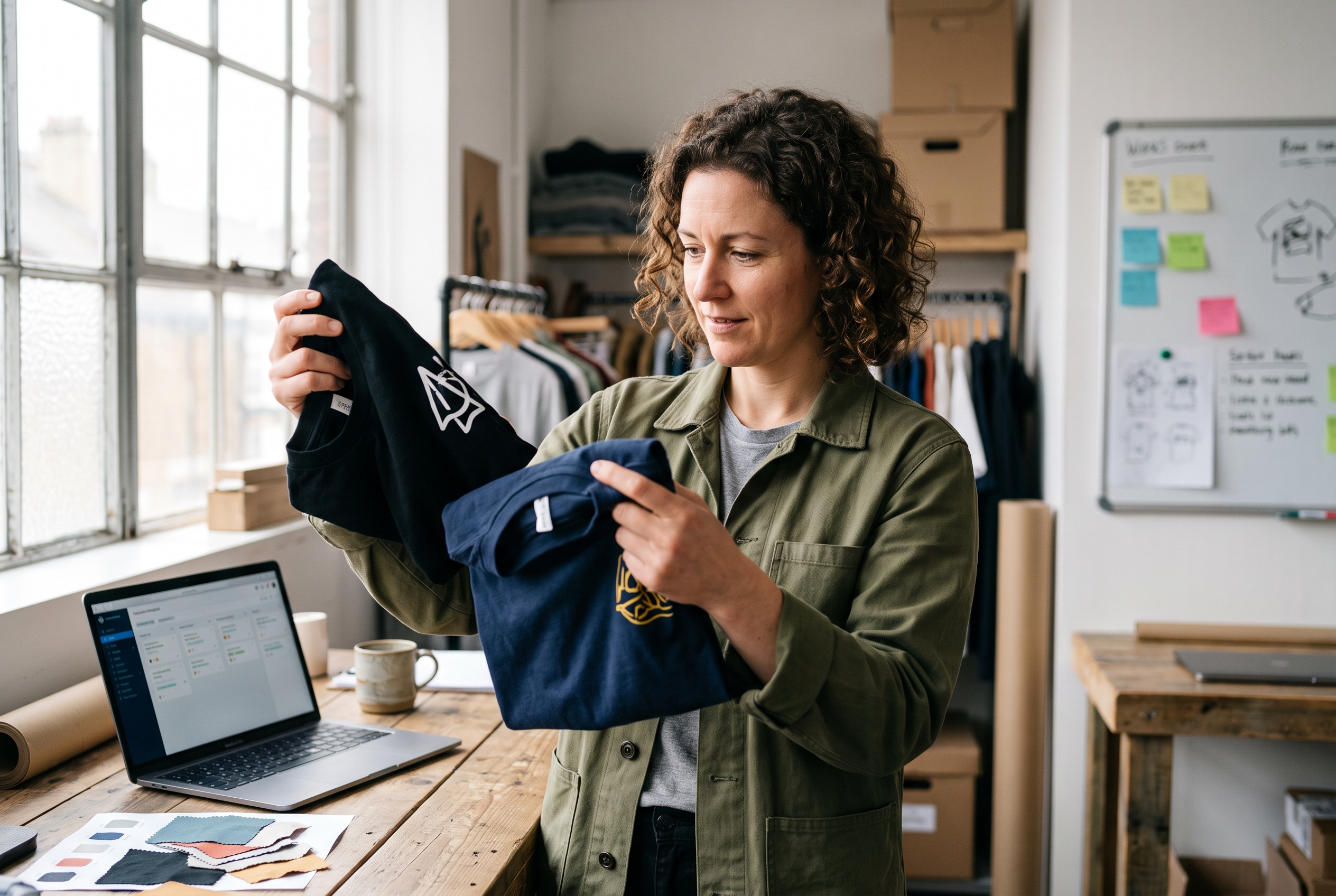
Generic t-shirts don't sell. "Funny shirts" competes with a million other sellers. A niche gives you a reason to exist and a specific audience to market to. Instead of "dog shirts," try "shirts for border collie owners." Instead of "gym shirts," try "sarcastic shirts for powerlifters."
Validate before you design. Search the niche on Etsy and Amazon to see how many sellers exist and whether reviews are recent. Check Google Trends for direction over time. Look for active Reddit communities, Facebook groups, or hashtags — that's where you'll sell later. If nobody's talking about it, there's no market.
Consider a real example of how narrow you can go: a store selling only shirts for people who own reef aquariums. It sounds tiny, but that audience is passionate, spends freely on the hobby, and gathers in a handful of forums and subreddits where a single well-placed design can spread fast. A focused audience of 20,000 obsessed hobbyists will out-earn a bland "cool tees" store aimed at everyone.
Step 2: Create designs worth wearing
People wear shirts that say something about who they are. Your designs need to be an inside joke, an identity marker, or a genuinely good piece of art — not just your logo slapped on cotton.
You don't need to be an illustrator. Tools like Canva and Adobe Express let you build clean typographic designs fast. For print, keep files at 300 DPI, use transparent PNGs, and design within the supplier's printable area. Text-based designs often outsell complex art because they're readable from across a room.
Stay clear of copyright and trademark trouble. This is the pitfall that gets new sellers' accounts shut down. You cannot legally sell shirts using someone else's logos, band names, sports teams, movie quotes, cartoon characters, or brand slogans — even parodies are risky. Fonts and stock graphics also come with licenses; check that yours allow commercial use. Before you commit to a phrase, run a quick search on the USPTO trademark database to make sure it isn't registered in the apparel class. Original art on an original idea is the only safe long-term foundation.
Start with 8–15 designs, not 100. You want enough to look like a real custom t-shirt store online, but few enough to see which themes resonate before you invest more time.
Step 3: Choose the best print on demand for t-shirts
Your supplier decides your print quality, shipping speed, and margins — so this matters. The best print on demand for t-shirts depends on where your customers are and how much you value control over the unboxing experience.
| Supplier | Base tee cost (approx.) | Best for | Notable strength |
|---|---|---|---|
| Printful | $13–$16 | Branding & quality | Custom labels, strong integrations, global network |
| Printify | $9–$13 | Margins & choice | Large print-partner network, lower base costs |
| Gelato | $12–$15 | International shipping | Local production in many countries |
| SPOD | $10–$14 | Fast turnaround | Quick production times on core products |
Base costs vary by garment brand, color, and print size, so treat these as starting points and confirm the exact price for the specific blank you plan to sell. Printify tends to win on raw margin because it routes to a network of independent print partners; Printful trades a slightly higher base cost for tighter quality control and better branding options.
Whatever you pick, order samples of your own designs before you launch. Feel the fabric. Wash it three times. Check whether the print cracks or fades. Your reputation rides on a product you never physically touch, so this $30 test is non-negotiable.
Step 4: Build a t-shirt website that converts
You can list on marketplaces like Etsy or Amazon, but you don't own the customer or the brand there, and fees eat your margin. To build a t-shirt website that becomes a real print on demand clothing store, you want your own site — where you control pricing, branding, email, and repeat customers.
A store that converts needs sharp product photos (use mockups plus at least one real sample shot), clear sizing info, trust signals like reviews, a fast mobile experience, and a checkout that doesn't make people bail. Every extra second of load time and every surprise at checkout costs you sales.
Sort out returns before your first sale. Returns are a real pain point in POD because your supplier prints each shirt to order — most won't accept a return just because a customer changed their mind, and the cost of a misprint or wrong size can land on you. Publish a clear policy: replace or refund defects and shipping errors, but be upfront that made-to-order apparel isn't returnable for buyer's remorse. Pair that with an accurate size chart and honest photos, and you'll cut return requests dramatically while keeping your print on demand t-shirt store reputation intact.

How to sell t-shirts online and price for profit
Once your store's live, the game becomes margins and traffic. Figuring out how to sell t-shirts online profitably starts with the math — because it's easy to price a shirt that sells and still loses you money after fees.
The pricing math that keeps you profitable
Work backward from your true costs. A typical breakdown looks like this:
- Base product + printing: $12–$18
- Shipping: $4–$8 (build it into the price or charge it)
- Payment processing: roughly 2.9% + $0.30 per order
- Platform or transaction fees: varies — this is where many sellers quietly bleed money
- Ad or marketing cost per sale: plan for $5–$15 if you run paid traffic
Sell at $28–$34 and you're often looking at $8–$14 profit per shirt before ads. That's healthy for POD — but only if your platform isn't skimming a commission on every sale on top of a monthly bill. This is exactly why the platform you build on matters as much as the supplier.
Where to drive traffic first
Don't spread yourself across six channels on day one. Pick one that matches your niche and go deep:
- Organic social (TikTok, Instagram, Pinterest) — great for visual, identity-driven niches.
- Communities — Reddit, Facebook groups, Discord servers where your buyers already gather.
- SEO — product and blog pages that rank for "[niche] t-shirt" searches over time.
- Paid ads — fastest feedback, but only once your store already converts organic visitors.
Post your designs where your niche lives, tag the identity, and let the audience tell you which ones hit. Your bestsellers will surprise you — lean into them, cut the duds, and make variations of what works. This is the core of how to sell custom shirts online: sell more of what already sells.
The hidden cost that kills most POD t-shirt stores
Here's what nobody tells you when you're figuring out how to start a print on demand t-shirt business: the store platform quietly becomes your biggest recurring expense. On the popular route, you pay a monthly base fee, then bolt on paid apps for the things that actually drive sales — abandoned cart recovery, reviews, wishlists, loyalty, email automation. Most stores end up running six or more apps, and the bill climbs fast.
Add a transaction fee on every sale on top of that, and a print on demand t-shirt store making $3,000 a month can lose several hundred to the stack — money that should've been your margin. Those extra features aren't luxuries either. Abandoned cart emails alone recover a meaningful slice of sales you'd otherwise lose. Before you commit to any platform, add up the base plan, the apps you'll realistically need, and the per-sale transaction cut — then compare that total, not just the sticker price.
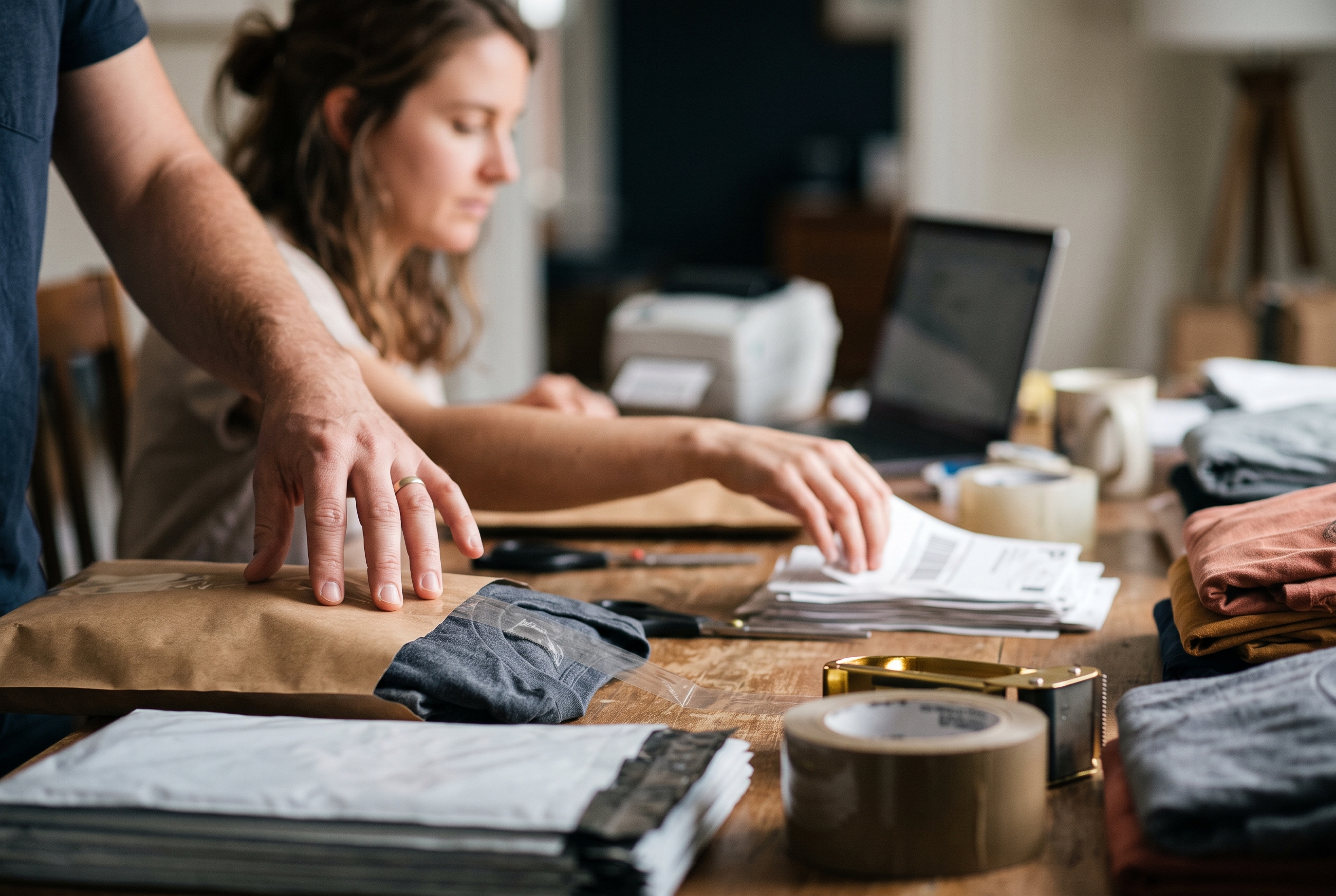
This is where Rovela takes a different approach. You describe your t-shirt business in plain words and get a complete store — storefront, catalog, Stripe checkout, customer accounts, and analytics — built in hours. The features you'd normally pay app-by-app for are included by default: abandoned cart, wishlist, reviews, loyalty, customer Q&A, and marketing automations. One flat subscription, no commission on your sales, and no growing plugin bill as you scale.
It was built by operators — a team that ran $15M+ in real e-commerce GMV and the crew behind PrestaShop, the platform powering 400,000+ merchants. Merchants typically see +15% revenue, +22% margins, and $5,000+ a year saved versus a base plan plus apps. And because every store runs on standard Next.js code you can download and own, you're never locked in — any developer can take over if you outgrow it. Compare that with Rovela's flat, all-in pricing and the math on a POD store changes.
Common questions about starting a POD t-shirt business
How much does it cost to start?
You can start for under $100. That covers a store subscription, a design tool (often free), and a few product samples to check quality. Because print on demand has no inventory, most of your real cost is the time you spend on designs and marketing, plus ad budget if you choose to run paid traffic.
Is a print on demand t-shirt business still profitable?
Yes — but margins are tighter than bulk printing, so profit comes from niche focus and repeat customers, not one-off sales. Keep platform and transaction fees low, build a brand people come back to, and price with enough room to cover ads. A focused store beats a generic one every time.
Do I need to buy inventory?
No. That's the entire point of POD. Your supplier prints and ships each shirt only after a customer pays, so you never hold stock or risk unsold product. You only pay the supplier once you've already been paid by your customer.
How do returns work with print on demand?
Because each shirt is made to order, most suppliers only cover defects and shipping errors — not buyer's remorse. Set a clear policy that replaces or refunds anything printed wrong or damaged in transit, and state upfront that made-to-order apparel isn't returnable for a change of mind. Accurate size charts and honest product photos are your best defense against returns.
Marketplace or my own store?
Start on your own store if you're building a brand you want to grow. Marketplaces like Etsy give you built-in traffic but take fees and own the customer relationship. Many sellers do both — test demand on a marketplace, then move serious buyers to their own custom t-shirt store online where the margins and the email list are theirs.
Your next move
Starting a print on demand t-shirt business comes down to a clear sequence: pick a niche you can actually reach, make 8–15 original designs people would proudly wear, choose a supplier and test their samples, then build a store that converts and keeps your margins intact. Nail the niche and the math, and the rest is momentum.
The one decision that quietly determines your profit is where you build. If you'd rather skip the app stack, the plugin bills, and the transaction fees — and get a store that already includes the features that drive t-shirt sales — you can describe your idea to Rovela and have a working store today. Browse more e-commerce growth guides on the Rovela blog when you're ready to grow it.