By El Ghali Bennis · Published · Updated
How to Start an Online Boutique With No Money in 2026
A practical, step-by-step guide to starting an online boutique with no money — from sourcing inventory to launching your storefront without burning savings.
Wondering how to start an online boutique with no money? You're in good company. Thousands of new fashion, jewelry, and lifestyle brands launch every month, and a surprising number of them began with less than $100 in the bank. The secret isn't a hidden funding source — it's choosing a model that delays cost until after the first sale, and using free or near-free tools for everything else. This guide walks you through exactly how to do that, from your first product idea to your first paying customer.
Can you really start an online boutique with no money?
Yes — but you need to redefine what "no money" means. Most successful boutique founders started with under $500 by avoiding inventory upfront, skipping paid software, and using free social channels for traffic. You'll still invest time, taste, and effort. The cash spend can stay near zero until your first sale lands.
The shift that made this possible: print-on-demand, dropshipping, and consignment models eliminate the need to buy stock before you sell it. Free trials on store builders mean you don't pay for software until you're generating revenue. Instagram, TikTok, and Pinterest give you traffic without an ad budget. Put those three together and the traditional barrier to entry essentially disappears.
The catch? You'll need to be patient with margins and aggressive with creativity. The cheapest way to start an online boutique is also the slowest way to build wealth — but it's the surest way to test whether your idea has legs before you risk real capital.
Step 1: Pick a niche you actually know something about
Generic boutiques fail. Specific ones win. If you try to sell "women's clothing," you're competing with Shein, Zara, and every TikTok shop. If you sell "linen sets for postpartum mothers" or "modest workout wear for hijabi runners," you have a fighting chance.
A good boutique niche has three qualities:
- A clear customer in mind. You should be able to describe one specific person who would buy from you — their age, lifestyle, what they wear now, what frustrates them.
- An emotional hook. People buy boutique items for identity, not utility. Your niche should make someone feel something specific.
- Search demand or social interest. Use free tools like Google Trends and Pinterest's predictions to confirm people are already looking for what you want to sell.
If you're still stuck, start with what you already buy. The most authentic boutique founders sell what they wish existed for themselves. That authenticity becomes your marketing once you launch.
Validate before you build
Before spending a single hour on a store, post your concept on Instagram or TikTok. Mock up three product images using free tools like Canva. If you get saves, shares, and comments asking "where can I buy this," you've validated demand. If you get crickets, change direction before you've sunk time into a logo.
Step 2: Source inventory with zero upfront cost
This is the part that scares most people, and it shouldn't. There are four proven ways to start a boutique with no capital, and each has its own tradeoffs.
Print-on-demand
Services like Printful, Printify, and Gelato manufacture and ship products only after a customer orders. You design once, upload, and they handle the rest. Margins are thinner (typically 20-40%) but you carry zero inventory risk. Ideal for graphic tees, hoodies, tote bags, hats, and home goods.
Dropshipping
You list products from a supplier (often via AliExpress, Spocket, or CJdropshipping) and they ship directly to your customer when an order comes in. Shipping times can be slow and quality varies, so vet suppliers carefully. Best for accessories, gadgets, and trend-driven categories where speed-to-market matters more than craft.
Consignment from local makers
If you know jewelry makers, candle pourers, ceramicists, or independent designers in your city, offer to sell their work in exchange for a commission (typically 20-40%). They keep the inventory, you handle the storefront and marketing. This is one of the most underused models for a free online boutique setup — and it builds real community.
Pre-orders and made-to-order
If you make things yourself, sell pre-orders. Customers pay upfront, you use that cash to buy materials and produce, then ship within a stated window (typically 2-4 weeks). You're effectively crowdfunding each batch.
Here's a quick comparison to help you choose:
| Model | Upfront cost | Typical margin | Best for |
|---|---|---|---|
| Print-on-demand | $0 | 20-40% | Apparel, accessories with designs |
| Dropshipping | $0 | 15-30% | Trend products, accessories |
| Consignment | $0 | 20-40% commission | Handmade goods, local makers |
| Pre-orders | $0 (customer funds it) | 40-70% | Handmade items, capsule drops |
Step 3: Build a brand identity for free
You don't need a designer. You need taste and a few free tools. The brands that look "premium" on Instagram aren't spending five figures on identity work — they're being deliberate with a handful of decisions.
Here's the minimum viable brand kit you can build in an afternoon:
- Name. Short, memorable, available as a .com or .store domain. Check social handles before you commit.
- Logo. A clean wordmark in a free font from Google Fonts beats a bad illustrated logo every time. Tools like Canva and Looka have free tiers.
- Color palette. Pick two or three colors and stick to them everywhere. Coolors.co generates palettes for free.
- Photography style. Decide whether your aesthetic is bright and clean, moody and editorial, or warm and handmade. Then shoot every photo to match.
- Voice. Write the way you'd talk to your ideal customer. Read your product descriptions out loud — if they sound like a stranger wrote them, rewrite them.
Don't agonize over this. Your brand will evolve as you learn what your customers respond to. Pick something that feels right today and ship.
Step 4: Launch your storefront on a budget
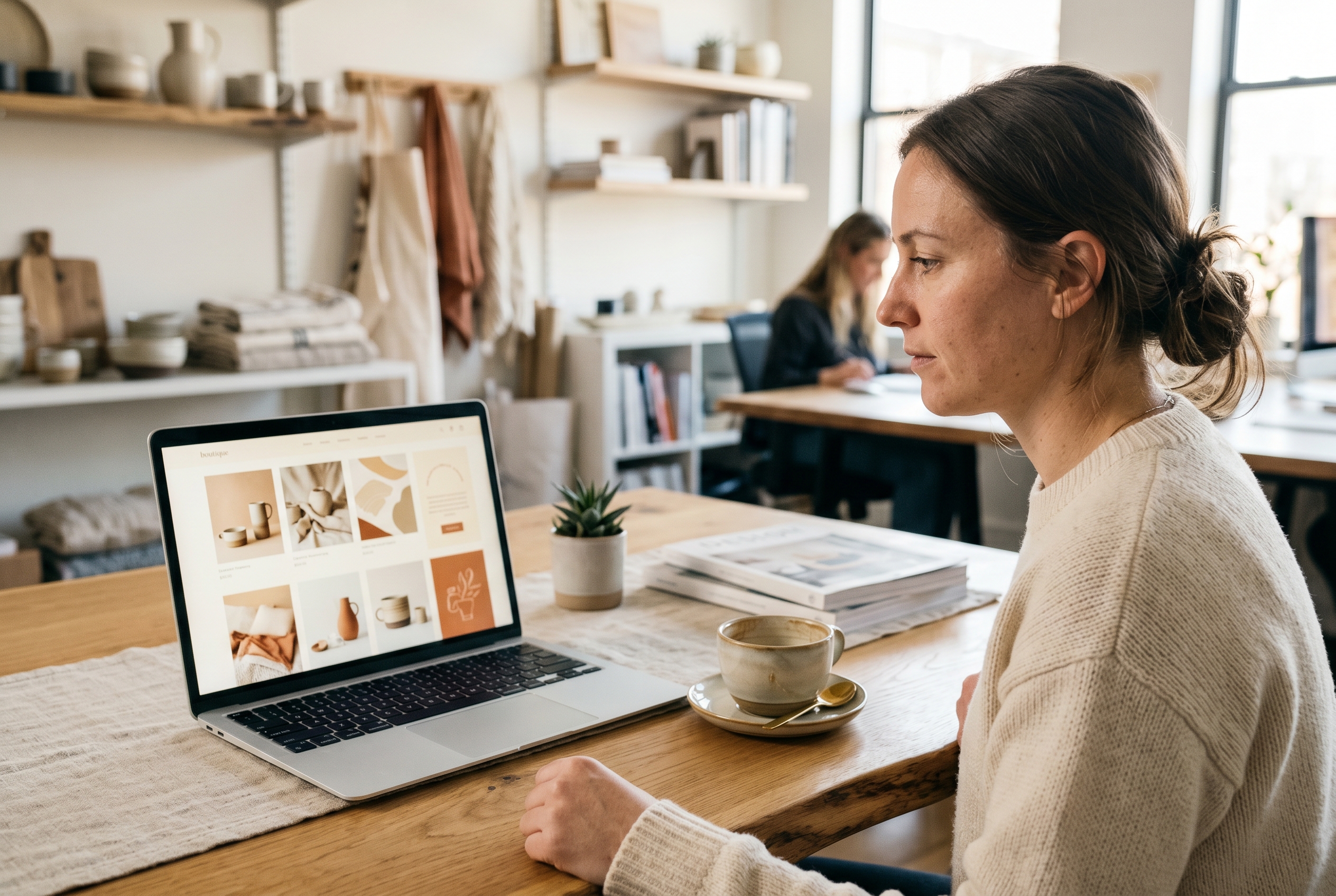
This is where most guides on starting an online boutique on a budget get expensive fast. Shopify's Basic plan is $39/month, and once you add apps for email, reviews, upsells, and inventory, you're easily at $150-$200/month before your first sale. For someone trying to start a boutique with no capital, that's a problem.
You have three realistic options:
Marketplace-first
Sell on Etsy, Depop, or Poshmark before you build your own store. Listing fees are tiny (Etsy is $0.20 per listing) and you get exposure to existing traffic. The downside: you're building someone else's audience, paying 5-10% in fees, and competing on a crowded surface. Use this to validate, not to scale.
Free trial store builders
Most store builders offer free trials between 3 and 30 days. Shopify, BigCommerce, and Squarespace all let you build before you pay. Use the trial to set up your store, then time your launch so the trial ends right as you're ready to take orders. This is the cheapest way to start an online boutique if you can move fast.
AI-generated stores
A newer option: AI store generators that build a complete, payment-ready boutique from a description of your business. Rovela, for example, generates a custom storefront with checkout, customer accounts, and an admin dashboard in under ten minutes — no templates, no plugins, no developer required. There's a free trial so you can see the store before you commit. The advantage over traditional builders is that you skip the weeks of template-tweaking and app-stacking that usually eat your time and savings.
Whichever route you choose, your storefront needs only these things to start selling: clear product photos, honest descriptions, a working checkout, a returns policy, and a way for customers to reach you. Everything else is optional.
Step 5: Get your first customers without paid ads
Paid ads are where new boutique owners burn cash they can't afford to lose. Skip them entirely for your first 90 days. Your goal is to get to 10 sales using only organic channels, because that's what proves your concept works.
Here's what actually drives traffic when you have no ad budget:
- Short-form video. TikTok and Instagram Reels are the single most effective free traffic source for boutiques right now. Post the story behind your products, your packing process, customer reactions, and "get ready with me" content featuring your items. Three posts a day for 30 days will teach you more about what works than any course.
- Pinterest. Underrated for boutiques. Pinterest users have purchase intent, the platform indexes well in Google, and pins keep driving traffic for months. Set up rich pins and publish 5-10 pins per day.
- Local press and micro-influencers. Reach out to local lifestyle bloggers, neighborhood newsletters, and small Instagram accounts (1K-10K followers) in your niche. Offer free product in exchange for honest content. The conversion rate from micro-influencer posts often beats paid ads by 3-5x.
- Email from day one. Capture emails before your store even launches with a simple "join the waitlist" page. Tools like MailerLite and Beehiiv have generous free tiers. Your email list will outperform every social platform within six months.
- Friends, family, and word of mouth. Don't be embarrassed to ask. Your first ten customers will almost certainly be people who already know you, and their reviews and photos become your social proof.
What to do with your first sale
Reinvest everything. Every dollar from your first 20-30 sales should go back into improving photography, ordering sample stock, or producing better content. Pay yourself only after you've hit a consistent monthly revenue you can rely on.
Step 6: Plan the move from scrappy to scalable
An online boutique with low investment can work for a long time, but eventually you'll hit a ceiling. Print-on-demand margins limit how much you can spend on customer acquisition. Dropshipping makes it hard to build a brand customers remember. Marketplace fees stack up.
Most boutique owners who cross $5K-$10K/month start making three shifts:
- From marketplaces to owned storefront. Building your own site means you own customer data, set your own margins, and aren't competing on a feed full of lookalikes.
- From dropshipping to small inventory orders. Buying 50-100 units of your best seller dramatically improves margins and shipping times.
- From all-organic to a small paid budget. Once you know your conversion rate and customer lifetime value, paid ads become an investment instead of a gamble.
This is also the point where the cost of running your store starts to matter. Many founders are surprised to learn that the typical Shopify boutique spends an average of $120/month on apps alone, on top of platform fees. If you're running tight margins, that stack can eat your profit before it reaches your bank account. It's worth comparing what an all-in-one option looks like before you lock into a fragmented setup — our pricing page shows how Rovela bundles checkout, hosting, and admin into one fee with no apps to add.
The honest tradeoffs of starting with no money
Starting a boutique with no capital works, but it comes with real costs that aren't financial:
- Time. Expect to spend 15-25 hours a week for the first three months. There's no shortcut.
- Slower margins. Print-on-demand and dropshipping pay less per sale than holding inventory. You'll need more volume to make the same money.
- Less control. When you don't own the inventory, you can't control quality, shipping speed, or packaging the way you could with handmade or stocked goods.
- Patience. Boutiques that bootstrap from $0 usually take 6-18 months to reach $1K/month in revenue. That's normal.
If you accept those tradeoffs going in, the no-money path is one of the smartest ways to test whether you actually want to run a boutique before committing serious capital.
Your launch checklist
Before you go live, make sure you've done these things:
- Picked a specific niche and validated it with social engagement
- Chosen an inventory model that requires zero upfront spend
- Set up a basic brand identity (name, logo, palette, voice)
- Built a working storefront with checkout, policies, and contact info
- Created social accounts on at least two platforms and published your first 10 posts
- Started capturing emails with a simple sign-up form
- Lined up your first 5-10 likely customers (friends, family, waitlist)
Hit all seven and you're ready to launch. Don't wait for perfection.
Ready to launch your boutique?
Starting an online boutique with no money is absolutely possible — it just requires picking the right model, using free tools relentlessly, and being patient enough to grow on organic traffic before you spend a cent on ads. The founders who succeed are the ones who ship in week three, not month six.
If you want to skip the weeks of fiddling with templates, apps, and plugins, Rovela generates a complete, payment-ready boutique from a description of your business in under ten minutes. You can try it free, see your store before you commit to anything, and only pay when you're ready to start selling. Take a look at the blog for more guides on launching, growing, and scaling your store.
Your boutique. Live. In minutes.