May 18, 2026
How to Start an Ecommerce Business: A 2026 Guide
A practical, no-fluff guide on how to start an ecommerce business in 2026 — from picking a product to launching your store and getting first sales.

You want to sell online. Maybe you've been sitting on a product idea for months, or you're tired of trading hours for a paycheck. Either way, figuring out how to start an ecommerce business in 2026 looks very different than it did even two years ago. The tools are faster, the buyer expectations are higher, and the playbook that worked in 2019 — pick a Shopify theme, install fifteen apps, hope for the best — has quietly stopped working for most people.
This guide walks you through the real path: validating an idea, sourcing products, building a store that converts, and getting your first paying customers. No filler. No "find your why." Just the moves that matter when you're starting an ecommerce business from scratch.

Decide what kind of ecommerce business you're actually building
Before you touch a logo or a domain name, get clear on the business model. The five common paths look similar from the outside but operate very differently behind the scenes:
- Private label / own brand. You design or curate a product, get it manufactured, and sell under your name. Highest margin, highest upfront work.
- Dropshipping. A supplier ships orders for you. Low capital, low margin, brutal competition.
- Print-on-demand. Designs printed only when someone buys. Great for creators, capped on margin.
- Wholesale / reselling. Buy products bulk, resell. Predictable but inventory-heavy.
- Digital products and services. Courses, templates, memberships, downloads. Near-zero fulfillment cost.
If you're wondering how can I start an ecommerce business without spending months figuring this out, pick the model that matches your starting resources. No inventory budget? Dropshipping, print-on-demand, or digital products. Some savings and a real product idea? Private label gives you the best long-term equity.
Pick a niche you can actually win in
"Selling supplements" is not a niche. "Magnesium gummies for parents of toddlers with sleep issues" is. Specificity is what makes new ecommerce brands defensible. The broader your category, the more you're competing on price with Amazon and the more you'll pay to acquire each customer.
Three filters for evaluating a niche:
- Demand exists but isn't saturated. Use Google Trends and keyword tools to confirm people search for it.
- Average order value is at least $40. Below that, paid ads rarely pencil out.
- You have an unfair angle. Personal experience, supplier access, an audience, or a real product improvement.
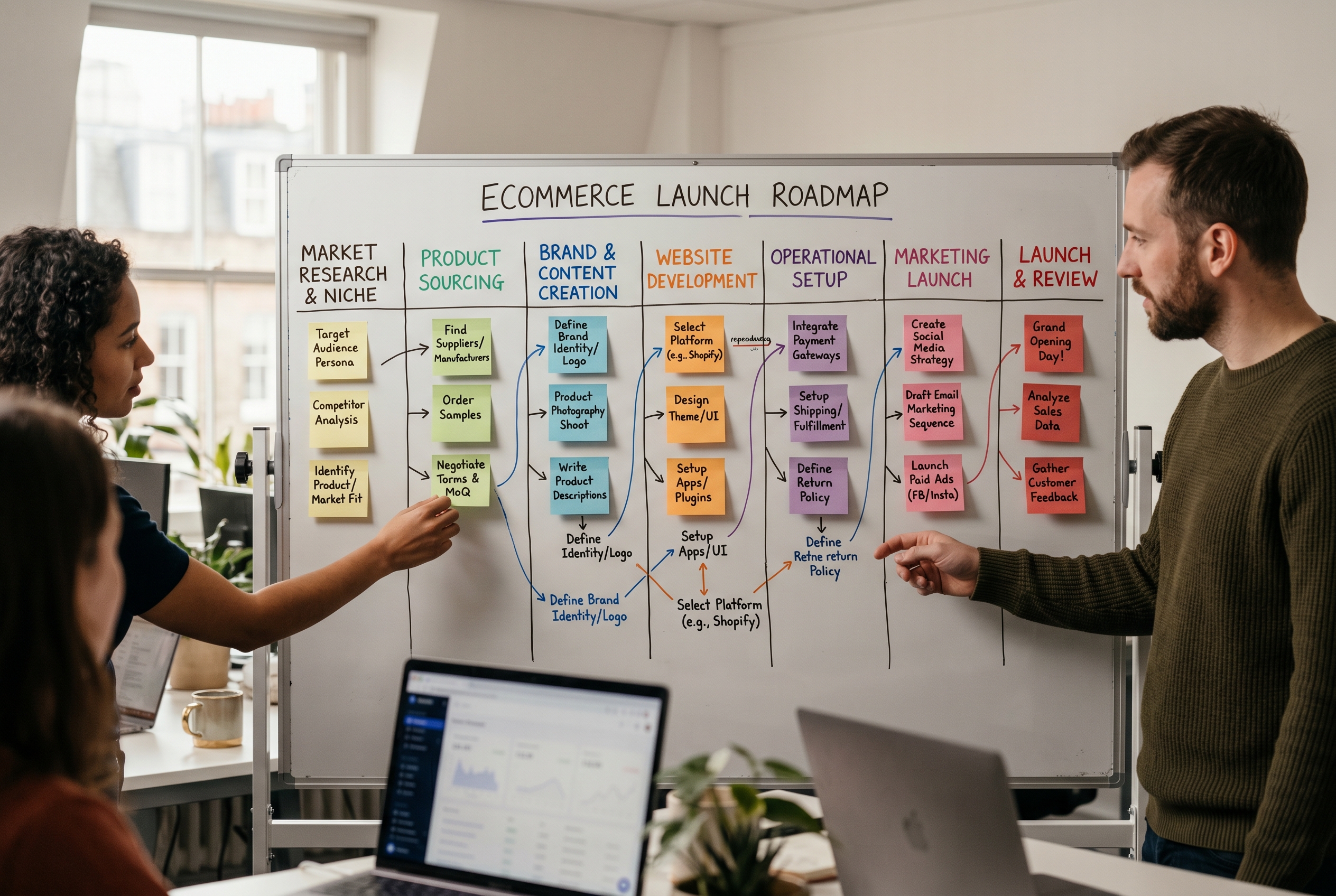
How to start an ecommerce business: the 7-step playbook
Here's the condensed answer to how do you start an ecommerce business in 2026. Each step expands below.
- Validate the product idea with real demand signals.
- Lock in suppliers, samples, and unit economics.
- Register the business and handle the legal basics.
- Build the store and set up payments.
- Write product pages that actually convert.
- Launch with one acquisition channel — not five.
- Measure, fix the leaks, and reinvest.
Step 1: Validate before you spend
Most first-time founders skip this and pay for it later. Validation isn't asking your friends if they'd buy — it's looking for evidence that strangers already want to buy something like what you'd sell.
Quick validation moves that cost almost nothing:
- Search your product on TikTok and check view counts on related content. Three videos with over 500K views is a green flag.
- Find the top five Amazon listings in your category. If they have thousands of reviews, demand is real. If they have under fifty, demand might not exist yet.
- Run a $50 ad test to a simple landing page that captures emails. If your cost per email is under $2, the angle works.
Step 2: Source products and understand your unit economics
If you're selling physical goods, your margin is decided here. Get samples from at least three suppliers — Alibaba for international manufacturing, Faire for domestic wholesale, or local makers if you're going premium. Don't fall in love with the first quote.
Your unit economics need to work like this:
| Line item | Healthy benchmark |
|---|---|
| Product cost (COGS) | 20–30% of selling price |
| Shipping & fulfillment | 10–15% |
| Payment processing | ~3% |
| Customer acquisition (paid) | 20–30% |
| Gross margin remaining | 30%+ |
If the math doesn't leave you with at least 30% after acquisition cost, raise prices, change suppliers, or change the product.
Step 3: Handle the legal basics
You don't need a lawyer to start. You do need:
- A business entity (LLC in the US is the default starting point — Stripe Atlas is popular for international founders).
- An EIN (free from the IRS).
- A business bank account, kept separate from personal.
- Sales tax registration in states or countries where you have nexus. Tools like TaxJar or Avalara automate this once you're scaling.
- Basic terms of service, privacy policy, and refund policy on your store.
How to start an ecommerce business without money (or with very little)
You don't need $10,000 to launch. The cheapest functional path looks like this: digital product or print-on-demand model, free store trial, free email tool until 500 contacts, organic content as your only marketing channel. Total cash out: under $100 for a domain and a few months of low-tier tooling.
If you're researching how to start an ecommerce business without money, the trade you're making is time for capital. Organic distribution — short-form video, SEO, community building — works, but it compounds over six to twelve months, not six to twelve days. Be honest with yourself about which one you have more of.

Bootstrapped founders who've done it well usually share three habits:
- They post on one platform every day for ninety days before declaring the channel "dead."
- They reinvest 100% of early profit into more inventory or content.
- They build an email list from day one. A thousand engaged subscribers is worth more than ten thousand random followers.
The free tools stack that actually works
You can run a real store on:
- A free trial of a store builder (most give you 14–30 days fully functional).
- Canva for product photography editing and ad creative.
- A free email platform up to a low send volume.
- Organic Instagram, TikTok, or Pinterest for traffic.
- Stripe or PayPal for payments — no monthly fee, you pay per transaction.
Choosing the right tools to build your store
This is where most ecommerce business startup guide articles get lazy and tell you to "pick Shopify." That advice is six years old. The category has split into three real options, each with very different economics.
The three paths in 2026
1. Template platforms (Shopify, Wix, Squarespace, BigCommerce). You pick a theme, install apps to fill gaps, and customize. Base subscription looks cheap — $39 to $399 a month — but the real cost adds up fast. Shopify merchants average $120 a month in app fees, and 87% use apps. Add a developer for any custom work and the typical "Shopify store" actually costs $500 to $3,000+ a month once it's running properly.
2. Open-source (WooCommerce on WordPress). Free to install, but you own all the maintenance, security, and plugin conflicts. A serious WooCommerce store typically lands at $5,000–$15,000 a year in hosting, plugins, and developer time. About 20% of WooCommerce stores disappear within six months — usually because the technical burden burns the founder out.
3. AI-generated stores. A newer category where you describe your business in plain language and the system produces a complete, payment-ready store. The promise is no theme picking, no plugin shopping, no developer. The execution varies wildly between providers.
What to look for, whichever path you pick
- Payments out of the box. If accepting Stripe or Apple Pay requires a third-party app and a transaction surcharge, that's a red flag.
- A real admin dashboard. You need to see orders, customers, and revenue without logging into five tools.
- Mobile-first checkout. Over 70% of ecommerce traffic is mobile. Test the checkout on your phone before going live.
- Email and customer accounts built in. Two more apps you don't want to buy.
At Rovela, we built around exactly this complaint — that starting an ecommerce business in 2026 shouldn't mean assembling fifteen separate tools and praying they talk to each other. You describe your business, and your store goes live with payments, hosting, an admin dashboard, and customer accounts already wired up. If you want to compare what's included against the traditional stack, the pricing page breaks it down.
Launching: getting your first 100 customers
The hardest part of starting an ecommerce business isn't building the store. It's getting strangers to trust you with their credit card. Plan for the first 100 customers to be hard-won, mostly through channels you can influence directly.

Pick one acquisition channel and go deep
New founders almost always try to do everything: Meta ads, Google ads, TikTok, SEO, influencer outreach, email, podcasts. They end up doing none of them well. Pick one based on where your buyers already spend time:
- Visual or impulse products (fashion, beauty, home decor) — TikTok organic or Meta ads.
- Search-driven needs (replacement parts, specialty supplements, B2B) — Google Ads and SEO.
- Community-driven products (hobbies, fitness, niche interests) — Reddit, Discord, niche forums.
- Aspirational lifestyle brands — Instagram and creator partnerships.
Set up the basics that protect every sale
Before you spend a dollar on ads, make sure these are live:
- Abandoned cart emails. The single highest-ROI automation in ecommerce. Expect to recover 5–15% of lost carts.
- A welcome email series. Three to five emails introducing your brand. Most stores see 25%+ of email revenue from this single series.
- Clear shipping and return policies on every product page. Surprise costs at checkout are the number one reason carts get abandoned.
- Reviews on product pages. Even five real reviews lift conversion noticeably. Ask every customer.
Measure what matters in the first 90 days
Three numbers tell you whether the business is working:
- Conversion rate. A healthy new store sits between 1.5% and 3%. Below 1%, the store or the traffic isn't matching.
- Average order value. Move this up with bundles, free shipping thresholds, and upsells before chasing more traffic.
- Cost per acquisition vs. lifetime value. If LTV isn't at least 3x CAC, the model doesn't scale on paid ads.
Common mistakes that kill new ecommerce businesses
From watching hundreds of new stores launch, the same handful of mistakes show up over and over. Avoiding these puts you ahead of most first-time founders.
- Building for months before selling. Your store doesn't need to be perfect. It needs to take payment. Launch ugly, fix in public.
- Picking products you love but no one's searching for. Passion without demand is a hobby.
- Underpricing. First-time founders almost universally price too low. Doubling your price rarely halves your conversion rate.
- Spreading thin across channels. One channel, ninety days, then evaluate.
- Ignoring email. Email and SMS will be your highest-margin revenue for years. Build the list from day one.
- Stacking tools. Every app you add is a monthly bill, a security risk, and a thing that can break. The fewer moving parts, the better.
How long does it actually take?
Realistic timelines for a focused founder:
- Week 1: Niche locked, supplier samples ordered, business entity started.
- Week 2–3: Store built, payments live, first product photos done.
- Week 4: Soft launch to friends, family, and any audience you have.
- Month 2–3: First 100 customers, abandoned cart and welcome flows running, content engine started.
- Month 4–6: First profitable acquisition channel, $1K–$10K monthly revenue depending on niche and channel.
Founders who beat these timelines usually had an existing audience or a clear product advantage. Founders who fall behind usually got stuck building the store instead of selling.
Your next move
Knowing how do I start an ecommerce business is the easy part. The path is well-documented. What separates the businesses that exist from the businesses that just get talked about is the willingness to launch before you feel ready, take the first order, learn what's actually broken, and fix it.
Pick the niche. Order the sample. Build the store this week, not next quarter. If you want a faster route — one where you describe your business in plain language and your store goes live with payments and everything else already wired in — that's exactly what Rovela was built for. You can read more guides like this one on the Rovela blog or start your store today and see your idea live in under ten minutes.
The window for new brands has never been wider. Customers are buying online for categories nobody thought possible five years ago, and the tools to launch are an order of magnitude better than what the first wave of ecommerce founders had. Your move.