July 8, 2026
How to Sell Supplements Online: A Complete Guide
A practical, operator-tested guide to selling supplements online — from compliance and sourcing to building a store that actually converts and scales.

Supplements are one of the most profitable products you can put in a cart. Margins run 40% to 70%, customers reorder on a predictable cycle, and the category keeps growing every year. But learning how to sell supplements online is more involved than dropshipping a phone case. You're dealing with health claims, label rules, and buyers who won't hand over their credit card unless your store looks like it belongs to a real brand. This guide walks you through the whole thing — compliance, sourcing, pricing, and the store setup that turns first-time visitors into repeat customers.

Is it legal to sell supplements online?
Yes, it's legal to sell supplements online in most countries, but the category is regulated. In the United States, dietary supplements fall under the FDA's rules for food, not drugs. You don't need pre-market approval, but you can't claim a product treats, cures, or prevents disease. Get the labeling and claims right before you sell a single bottle.
The single most important thing to understand: supplements are governed by DSHEA, the Dietary Supplement Health and Education Act. Under those rules, you're responsible for making sure your product is safe and your labels are truthful. You can say a product "supports immune function." You cannot say it "prevents the flu." That line matters, and it's where most new sellers get into trouble.
A few non-negotiables before you start a supplement business online:
- Structure/function claims only — describe what an ingredient does in the body, never a disease it treats.
- The FDA disclaimer — the "This statement has not been evaluated by the FDA" line belongs on any product page making a claim.
- Compliant Supplement Facts panels — every product needs a correctly formatted label with serving size, ingredients, and allergen warnings.
- GMP-certified manufacturing — source from facilities that follow Good Manufacturing Practices.
Read the FDA's dietary supplement guidance directly rather than relying on secondhand summaries. Rules shift, and one bad claim can trigger a warning letter that shuts your store down.
Choosing your product and sourcing model
Before your online supplement store setup even begins, you need a product decision. The supplement market is huge — protein powders, vitamins, pre-workout, greens powders, sleep aids, collagen. Picking a lane you understand gives you an edge in copy, community, and repeat purchases.

The three sourcing paths
There are three realistic ways to get product to sell, and they trade off control against startup cost.
- Private label / white label — a contract manufacturer makes a stock formula, you put your brand on it. Lowest barrier to a real brand. Order minimums usually start around 500–1,000 units.
- Custom formulation — you develop a unique formula with a manufacturer. Highest cost and longest lead time, but you own something nobody else sells.
- Reselling / distribution — you buy finished branded product wholesale and resell it. Fast to launch, thinner margins, and you don't control the brand.
Most people learning how to sell vitamins online start with private label. It gives you a defensible brand without the six-figure cost of custom formulation. Whatever you choose, ask every supplier for a Certificate of Analysis and proof of GMP certification. If they hesitate, walk away.
Margins and pricing to plan for
Supplements support strong margins, which is why the category is so attractive. Here's a rough picture of what to expect when you sell protein powder online or move into capsules and vitamins.
| Product type | Typical cost per unit | Typical retail price | Gross margin |
|---|---|---|---|
| Protein powder (2 lb) | $8–$14 | $35–$55 | 60–75% |
| Multivitamin (60 ct) | $3–$6 | $20–$35 | 70–85% |
| Pre-workout | $6–$10 | $30–$45 | 65–78% |
| Collagen / greens | $10–$16 | $40–$60 | 60–74% |
Those margins have to cover more than product cost — factor in shipping, payment fees, returns, and marketing. The businesses that win aren't the ones with the cheapest product. They're the ones that get customers to reorder month after month, which drops customer acquisition cost to near zero on the second purchase.
How to sell supplements online: the store setup
Once compliance and sourcing are handled, you need a place to actually sell. This is where most founders overspend and overcomplicate. Here's the practical path to a supplement store that converts, without a developer and without a stack of paid plugins.

Step 1: Pick a platform that includes what supplements need
Supplement stores live or die on a few specific features: subscriptions for reorders, reviews for social proof, abandoned cart recovery, and fast product pages that load ingredient panels without lag. On most platforms, each of those is a separate paid app.
On Shopify, for example, the base plan runs $39 to $399 a month, and the average store adds around six apps on top — often $50 to $200 more per month. Subscriptions, loyalty, and advanced reviews are all extra. For a supplement business built on recurring orders, that app bill adds up fast.
This is exactly the problem Rovela was built to solve. You describe your supplement brand in plain language and get a complete store — subscriptions, reviews, wishlist, abandoned cart, loyalty, and Klaviyo integration included by default, on one flat subscription with no per-app billing and no commission on sales.
Step 2: Build product pages that answer buyer questions
Supplement buyers are cautious. They want to know what's in it, why it works, and whether other people trust it. A converting product page for a supplement includes:
- A clear Supplement Facts panel — photograph the real label so buyers can read every ingredient.
- Benefit-led headline plus honest claims — describe what the product supports without crossing into disease claims.
- Real reviews and customer Q&A — social proof is the single biggest conversion lever in this category.
- Third-party testing badges — if your product is tested for purity, show it prominently.
- A subscribe-and-save option — reorders are where the money is; make the recurring choice the default.
Step 3: Set up payments and shipping
Connect a payment processor — Stripe and PayPal cover most buyers. Supplements are considered low-risk by most processors, but always confirm your product category is allowed, especially for anything containing herbal or nootropic ingredients.
For shipping, weight matters. A tub of protein powder ships very differently from a bottle of capsules. Set real-time carrier rates or flat-rate tiers, and offer free shipping over a threshold that protects your margin — usually around $50 for supplements.
Marketing your online supplement store
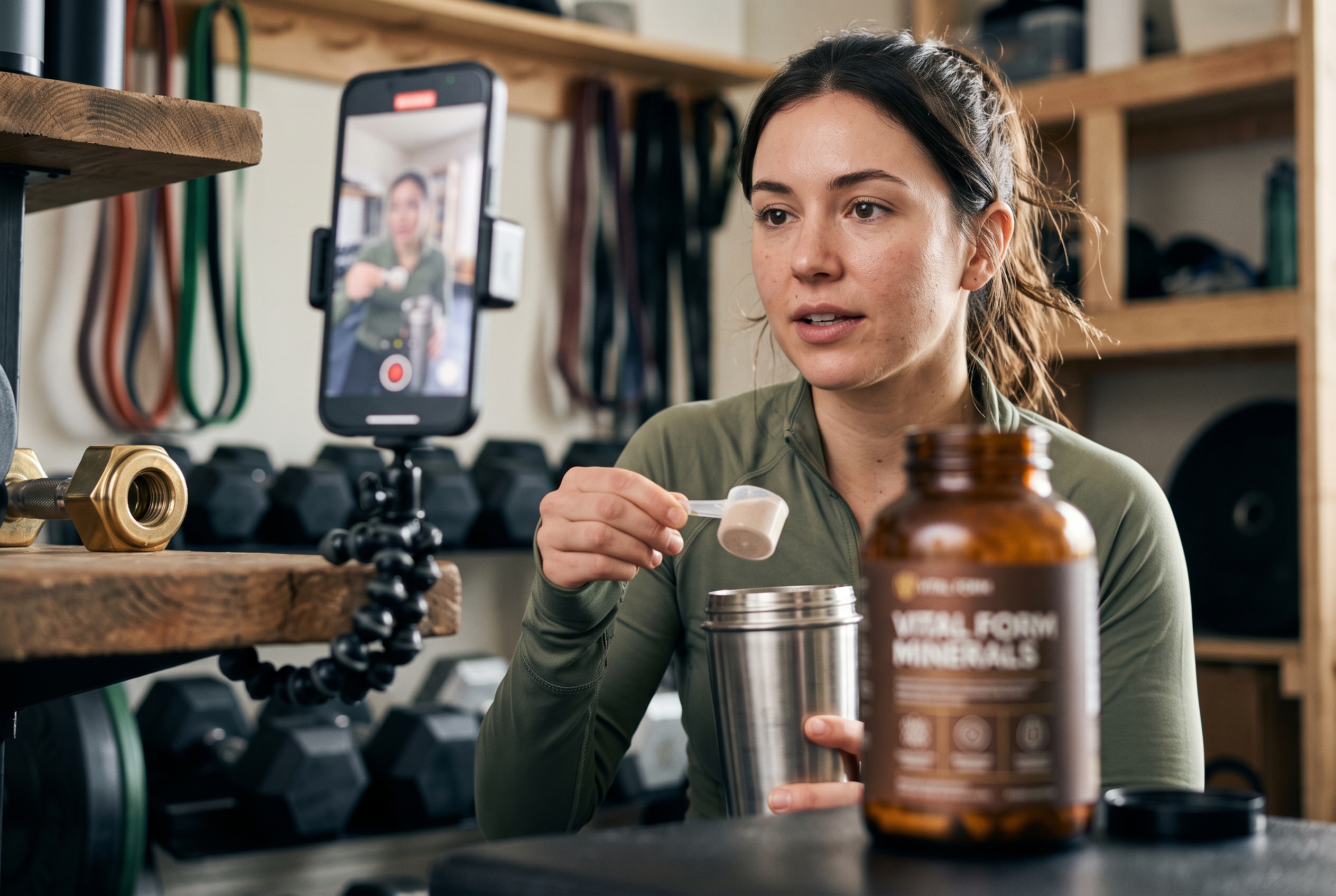
A great store with no traffic sells nothing. Selling fitness products online is competitive, so your marketing has to build trust and drive repeat purchases, not just chase one-time sales.
The channels that work for supplements
Not every channel pays off equally in this category. Based on what actually moves supplement revenue, prioritize in roughly this order:
- Email and SMS flows — abandoned cart, post-purchase, and reorder reminders. This is the highest-ROI channel for supplements because the reorder cycle is predictable.
- Content and SEO — write genuinely useful guides around your ingredients and use cases. A "sell protein powder online" competitor might rank for recipes; you can rank for real questions your buyers ask.
- Influencer and affiliate — micro-creators in fitness and wellness convert far better than broad paid ads for this audience.
- Paid social — effective once you have proof and reviews, but expensive to start cold. Health claims also trigger ad restrictions, so keep creative compliant.
Lean into the reorder cycle
The economics of a supplement business live in retention. A customer who buys once at a $40 acquisition cost is barely profitable. The same customer subscribing to monthly delivery becomes worth $400+ over a year. Build every marketing decision around the second, third, and tenth order.
The average supplement customer reorders every 30 to 60 days. If you're not automating that reminder, you're leaving most of your revenue on the table.
That's why automation matters more than a big launch. Set up your abandoned cart, win-back, and replenishment flows before you spend a dollar on ads. A store with strong built-in automations recovers revenue you'd otherwise lose — one reason to choose a platform where those flows ship by default rather than as an add-on you configure later.
Common mistakes when you start a supplement business online
Most supplement stores that fail make the same handful of errors. Avoiding them puts you ahead of most of your competition before you launch.
- Making disease claims — the fastest way to get an FDA warning letter and lose your payment processor. Stick to structure/function language.
- Cheap-looking product pages — supplements are trust purchases. A template-y store signals risk and kills conversion.
- Ignoring reviews early — new brands with zero reviews convert poorly. Seed authentic reviews from real early customers as fast as you can.
- Underpricing — racing to the bottom on price destroys the margin you need for marketing and reorders.
- Overbuilding the tech stack — stacking a dozen apps slows your site and drains cash. Slow product pages hurt both SEO and conversion.
The tech mistake is the sneakiest. Founders assemble Shopify plus a subscription app plus a review app plus a loyalty app plus a page builder, and end up with a slow, expensive store that's a nightmare to change. A modern approach — where the features are built in and the site stays fast no matter how many are active — sidesteps that entirely. If you want to see how the pieces fit together and what a single flat plan looks like, the Rovela pricing page lays it out plainly.
Your supplement ecommerce guide checklist
Pull it all together. Here's the sequence to follow, start to finish, when you sell supplements online.
- Validate your niche — pick a category you understand with real reorder demand.
- Sort compliance — labels, claims, disclaimers, and GMP-certified sourcing.
- Choose a sourcing model — private label is the usual starting point.
- Run the numbers — confirm your margins survive shipping, fees, and marketing.
- Build the store — subscriptions, reviews, Q&A, and fast product pages.
- Set up payments and shipping — confirm your category is approved.
- Turn on automations — abandoned cart, post-purchase, and replenishment flows.
- Drive traffic — email, content, and creators before cold paid ads.
Selling supplements online rewards operators who get the fundamentals right: honest claims, strong margins, a store that earns trust, and relentless focus on the reorder. Nail those and the category's economics work in your favor.
If you'd rather skip the plugin stack and get a complete supplement store — subscriptions, reviews, abandoned cart, and analytics all included — Rovela builds and refines your store from a plain-language conversation, and it's live in hours instead of weeks. Want to see how other founders are launching in your category? Browse the Rovela blog for more practical playbooks.