By El Ghali Bennis · Published · Updated
Food Ecommerce Website Builder: 6 Options Ranked & Reviewed
Compare 6 food ecommerce website builders ranked for 2026 — real costs, food-specific features, and honest pros/cons to launch your store fast.
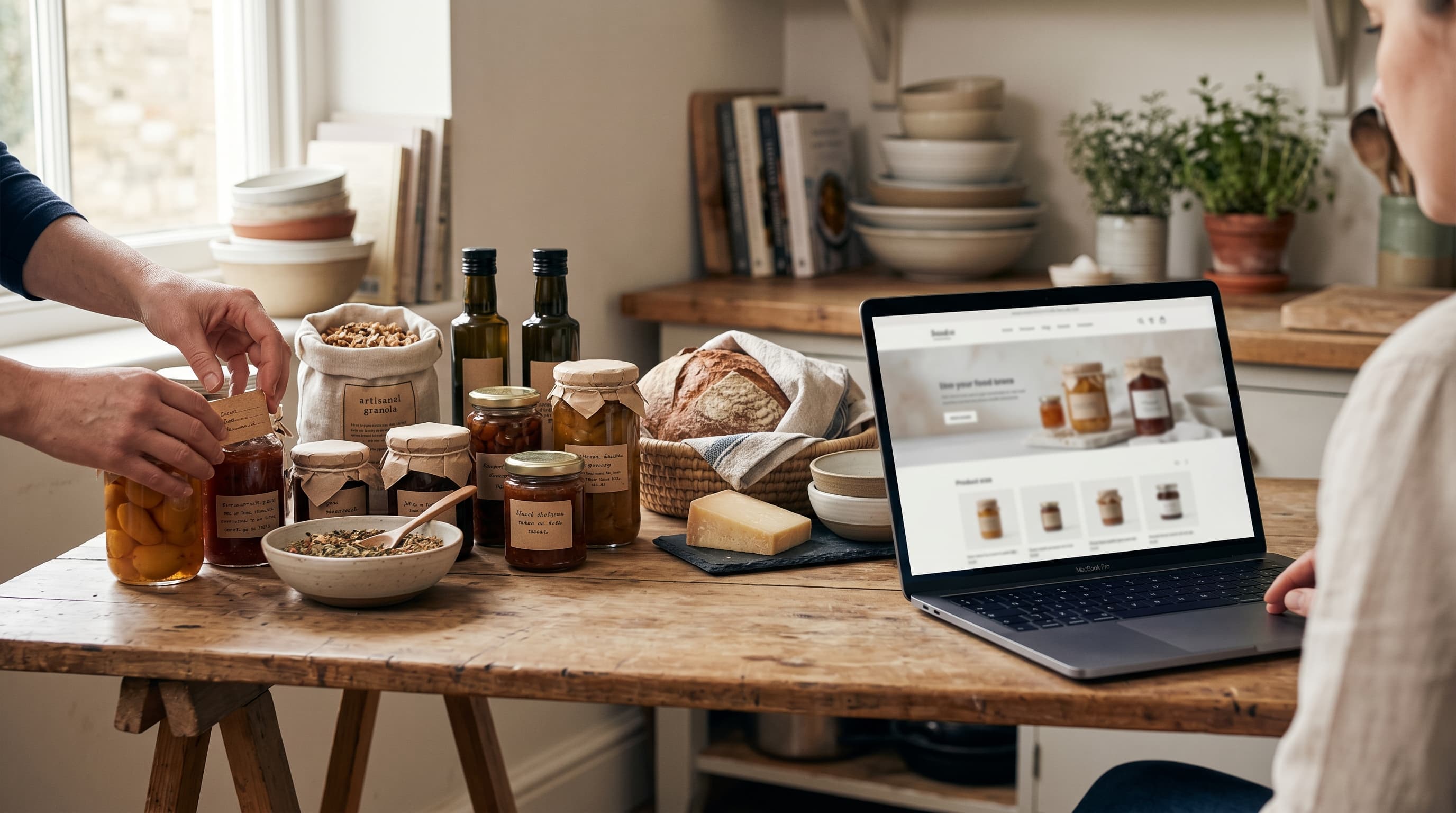
Selling food online sounds straightforward until you realize your website needs to handle perishable shipping rules, dietary filter options, subscription boxes, and product photography that actually makes people hungry. A generic website builder won't cut it. You need a food ecommerce website builder that understands the unique demands of selling consumable products — from compliance copy to checkout flows optimized for repeat purchases.
The food and beverage ecommerce market hit $1.2 trillion globally in 2025 according to Statista's Digital Market Outlook, and it's still growing at double-digit rates. Whether you're launching a specialty food online store for artisan hot sauces, a subscription coffee brand, or a local bakery expanding beyond your neighborhood, the builder you choose shapes everything — your costs, your customer experience, and how fast you can get to market.
Here's an honest comparison of six options to help you build a food store online that actually converts.
What Is a Food Ecommerce Website Builder?
A food ecommerce website builder is a platform specifically suited to creating online stores that sell consumable products — from snacks and beverages to meal kits and specialty ingredients. Unlike generic website builders, these tools support features like allergen labeling, weight-based shipping, subscription management, and compliance-ready product pages that food brands need to operate legally and profitably.
Before comparing platforms, it helps to know what separates a good food brand website builder from a generic one. Food businesses have requirements that a clothing brand or digital product seller never thinks about.
Product complexity is higher. You're dealing with weight-based pricing, variant combinations (size, flavor, roast level), ingredients lists, allergen warnings, and nutritional information. Your builder needs flexible product pages that display all of this without cluttering the experience.
Shipping is harder. Perishable goods need expedited shipping options, temperature-sensitive packaging calculations, and regional delivery restrictions. Some products can't ship to certain states. Your checkout flow needs to handle all of this gracefully.
Repeat purchases drive the business. Food is inherently consumable. Subscription management, reorder buttons, and loyalty programs aren't nice-to-haves — they're core revenue drivers. According to research from Bain & Company, repeat customers spend significantly more per order than first-time buyers, and food brands commonly see 40–60% of revenue from returning customers.
Trust signals matter more. People are putting your product in their bodies. Certifications (organic, non-GMO, kosher, halal), sourcing stories, and professional photography carry more weight here than in almost any other vertical.
Payment processing fees add up. Most platforms charge 2.4–2.9% + $0.30 per transaction, but some add surcharges for third-party gateways. On a food business doing $20K/month in sales, the difference between 2.4% and 2.9% processing fees is $1,200/year — real money for a bootstrapped brand. Always factor transaction fees into your total cost comparison.
6 Food Ecommerce Website Builders Ranked
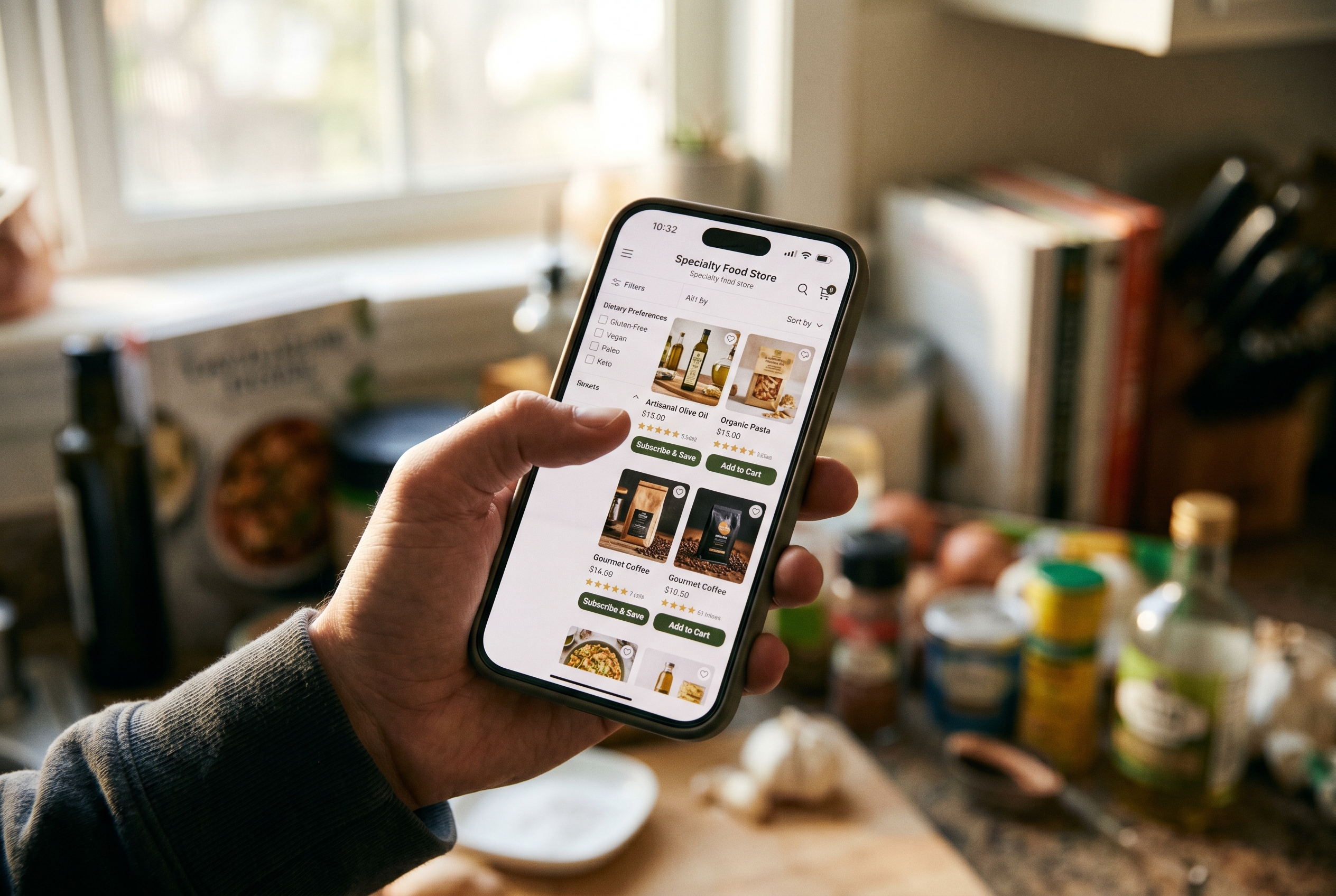
Each of these platforms can technically power a food and beverage ecommerce business. The differences are in cost, complexity, and how much work falls on you.
| Platform | Starting Price | Best For | Food-Specific Features | Setup Time |
|---|---|---|---|---|
| Shopify | $39/mo + apps | Established food brands scaling up | Via apps (adds $50-200/mo) | 2-4 weeks |
| WooCommerce | Free + hosting ($30-200/mo) | Technical founders who want full control | Via plugins (variable quality) | 4-8 weeks |
| Squarespace | $33/mo | Beautiful brand-first food sites | Limited, mostly manual | 1-3 weeks |
| Wix | $17/mo | Budget-conscious small food businesses | Basic, via Wix Restaurants add-on | 1-2 weeks |
| BigCommerce | $39/mo | Multi-channel food brands (wholesale + DTC) | Strong native catalog tools | 2-4 weeks |
| Rovela | Free trial, then $29/mo | New food brands launching fast | AI-generated, business-model aware | Under 10 minutes |
Shopify: The Market Leader with Hidden Costs
Shopify powers more online food stores than any other platform. Its ecosystem includes apps for subscription management (Recharge, $99/mo), product bundles, and allergen labeling. The core platform is reliable, checkout converts well, and you won't outgrow it quickly. Brands like Magic Spoon (cereal) and Fly By Jing (chili sauce) built their DTC empires on Shopify, leveraging its app ecosystem to handle subscriptions, reviews, and complex shipping rules for perishable goods.
The catch? Shopify's base pricing is misleading for food businesses. You'll likely need 4-6 apps to handle subscriptions, reviews, email marketing, and shipping rules. That adds $120-300/month on top of your plan. A food brand doing $500K/year in revenue commonly spends $300-600/month on their total Shopify stack. Shopify also charges 2.4–2.9% + $0.30 per transaction on its native gateway, and an additional 0.5–2% fee if you use a third-party payment processor.
WooCommerce: Maximum Control, Maximum Responsibility
WooCommerce gives you complete flexibility. You can customize every aspect of your food store, integrate with any fulfillment provider, and own your code. For food businesses with a developer on staff (or a technical founder), it's powerful. Brands like Nguyen Coffee Supply used WooCommerce early on to build a highly customized Vietnamese coffee experience — including origin story pages, brewing guides, and subscription options tailored to their audience — before eventually migrating to larger platforms as they scaled.
The downside is maintenance. WordPress security updates, plugin conflicts, and hosting management eat real time. Industry analyses from WebsitePlanet consistently show high churn rates among WooCommerce stores — largely because the technical overhead becomes unsustainable for small teams without dedicated developers.
Squarespace: Beautiful but Limited
Squarespace templates look stunning out of the box, and food photography shines on their layouts. If your brand story and visual identity are your primary competitive advantage, Squarespace delivers. Their commerce plans include basic inventory management and integrated checkout. Small-batch brands like Doan's Bakery have used Squarespace to showcase their products with editorial-quality visuals that make their high-end baked goods feel as premium online as they taste in person.
The limitation? Squarespace's ecommerce features are shallow compared to dedicated platforms. No native subscription management. Limited product variant options. Weak inventory tools. You'll hit a ceiling fast if your catalog grows beyond 50-100 SKUs. Squarespace charges 3% per transaction on its Business plan, dropping to 0% on Commerce plans ($33/mo+), so factor that into your cost comparison.
Wix: Affordable Simplicity for Small Food Businesses
Wix works well for simple food businesses — a local jam company selling 10-20 products, or a food blogger monetizing recipes with a small shop. At $17/month, it's the most affordable option on this list, and its drag-and-drop editor requires zero technical knowledge. The Wix Restaurants add-on handles basic online ordering for food delivery or pickup, making it a viable food delivery website builder for local businesses.
Brands like Bee & The Blossoms, a small-batch honey company, use Wix to sell a focused product line with minimal overhead. The platform handles their needs — simple product pages, a clean checkout, and basic shipping configuration — without the complexity or cost of larger platforms.
Where Wix falls short is scalability. Product variant options are limited compared to Shopify or BigCommerce, and there's no native subscription management. SEO tools are improving but still lag behind WordPress and Shopify. Wix charges 2.9% + $0.30 per transaction through Wix Payments, which is competitive but offers fewer gateway alternatives than other platforms. If you plan to grow beyond 50 products or need advanced shipping rules, you'll likely outgrow Wix within a year. It's a solid online food store builder for getting started, but plan for a migration if your food brand takes off.
BigCommerce: Built for Multi-Channel Food Brands
BigCommerce sits at the opposite end of the spectrum from Wix. It's designed for food brands selling wholesale and direct-to-consumer simultaneously — think a specialty food company that sells on Amazon, through retail partners, and on its own website. Brands like Skinny Mixes use BigCommerce to manage complex catalogs of flavored syrups and drink mixes across multiple sales channels, including their own DTC site, Amazon, and retail partnerships.
BigCommerce's native catalog tools handle complex product variants better than most competitors without requiring apps. It supports up to 600 SKUs per product with options like size, flavor, and bundle configuration — critical for food and beverage ecommerce brands with extensive product lines. It also charges no additional transaction fees regardless of which payment gateway you use — a meaningful advantage for food businesses processing high volumes. On $50K/month in sales, avoiding even a 0.5% surcharge saves $3,000/year.
The tradeoff is a steeper learning curve and fewer design templates than Shopify or Squarespace. BigCommerce also enforces annual sales thresholds per plan tier — if you exceed $180K/year on the Standard plan, you're automatically upgraded. It's best suited for food brands already doing meaningful revenue that need robust back-end tools to build a food store online with multi-channel reach.

How AI Food Store Builders Are Changing the Game
The newest option for food entrepreneurs is the ai food store builder — tools that generate your entire store from a description of your business. Instead of choosing templates, installing apps, and configuring settings for weeks, you describe what you sell and get a working store. This ai food store builder approach eliminates the technical barrier that stops many food entrepreneurs from getting online quickly.
This approach matters for food businesses specifically because the category has so many unique requirements. An AI that understands you're selling perishable subscription snack boxes should generate different checkout flows, shipping options, and product page layouts than one built for shelf-stable spices. The food and beverage ecommerce space benefits especially from this intelligence because the gap between a generic store and a properly configured food store is so wide.
Rovela's AI-powered store builder takes this approach. You describe your food business — what you sell, who you sell to, what makes your brand different — and the AI analyzes your business model before generating a complete store with payments, an admin dashboard, and customer accounts built in. No apps to install, no plugins to configure. The entire process takes minutes instead of weeks.
That said, Rovela has limitations worth noting. As a newer platform, its third-party integration ecosystem is smaller than Shopify's or BigCommerce's. If you need deep integrations with specific ERPs, fulfillment networks, or marketplace channels like Amazon or Faire, you may find fewer plug-and-play options. It's also less proven at high-volume scale compared to platforms that have powered food brands doing $10M+ annually. And while the AI generates a strong starting point, you may still need to manually refine product descriptions, adjust shipping zones, or customize checkout fields for specific compliance requirements.
For someone launching their first specialty food online store, the speed advantage is significant. You can start taking orders while competitors are still comparing Shopify themes. But if you're already doing seven figures, evaluate whether the platform's current feature set matches your operational complexity.
How to Choose the Right Food Business Website Builder
Your decision should come down to three factors: where you are today, where you're headed, and how much time you have.
If you're pre-launch and bootstrapping, speed and cost matter most. You need to validate demand before investing thousands in a custom setup. An online food store builder that gets you live quickly — whether that's Wix for its simplicity or an AI-powered option like Rovela's free trial — lets you test your market without overcommitting.
If you're doing $100K-$500K in annual revenue, you need reliability and room to grow. Shopify or BigCommerce give you the ecosystem and integrations to scale. Just budget for the real total cost, not the sticker price — including payment processing fees, app subscriptions, and any agency support you'll need.
If you're an established food brand spending too much on your current stack, it's worth evaluating whether you're paying for complexity you don't need. Many food brands on Shopify Plus are spending $8K-$20K/month on platform fees, apps, and agency retainers. Consolidating to a simpler stack can free up significant budget for what actually grows your business — product development, marketing, and customer acquisition.
Also consider adjacent needs: if you're building a food delivery website or a restaurant website builder solution with online ordering, platforms like Wix (with its Restaurants add-on) or Square Online may be more purpose-built for that use case than a general food ecommerce website builder.

Food-Specific Features Worth Paying For
Regardless of which food ecommerce website builder you choose, make sure it supports (or can be configured to support) these features. They're not optional for serious food and beverage ecommerce businesses looking to build a food store online that lasts.
- Subscription and auto-reorder: Coffee, snacks, meal kits, and supplements all benefit from recurring revenue. Your platform should handle subscription management natively or through a well-integrated app.
- Weight-based and zone-based shipping: Food shipping costs vary wildly by weight, destination, and temperature requirements. Flat-rate shipping kills your margins on heavy items.
- Product bundling and gift sets: Food is one of the strongest gifting categories in ecommerce. Build-your-own-box and curated gift set functionality drives higher average order values.
- Compliance-ready product pages: Nutritional facts, ingredient lists, allergen warnings, and certification badges need dedicated space on your product pages — not crammed into a generic description field.
- Mobile-first checkout: According to Google's consumer research, the majority of food ecommerce traffic now comes from mobile devices. If your checkout isn't optimized for thumbs, you're losing sales.
Check whether these features come built in or require additional apps and costs. The difference between "included" and "available via third-party app for $49/month" adds up fast when you need five or six of them.
Frequently Asked Questions
What is the best website builder for a food business?
The best food business website builder depends on your stage and needs. Shopify is ideal for established brands with budget for apps. Wix suits small, simple food shops. BigCommerce works for multi-channel sellers. And AI-powered builders like Rovela are best for new food brands that want to launch fast without technical setup.
How do I sell food online?
To sell food online, you need a food-safe product, any required licenses or permits for your state, and an ecommerce website with compliant product pages, secure checkout, and shipping configured for your product type. Choose a food ecommerce website builder that supports allergen labeling, nutritional info, and the shipping methods your products require (refrigerated, expedited, etc.).
How much does it cost to build a food ecommerce website?
Costs range from $17/month (Wix) to $300-600/month (Shopify with apps) depending on the platform and features you need. Factor in payment processing fees (2.4–2.9% per transaction), app subscriptions, and any design or development help. AI-powered options like Rovela start at $29/month with most food-specific features included, reducing the need for add-ons.
Making Your Decision
The best food business website builder is the one that matches your current stage, not the one with the longest feature list. A pre-launch hot sauce brand has fundamentally different needs than a $5M specialty food company — and that's okay.
Start by listing your non-negotiables. Do you need subscriptions on day one? Multi-channel selling? A specific shipping integration? Then map those requirements against the platforms above. You'll likely eliminate three or four options immediately.
For new food brands looking to get to market fast without the usual weeks of setup, Rovela generates a complete, payment-ready store from your business description in minutes — no templates, no app installations, no developer needed. You can explore what it builds for your specific food business with a free trial.
Whatever you choose, don't let the platform decision delay your launch. The food ecommerce brands that win are the ones that start selling, learn from real customers, and iterate. Your first store doesn't need to be perfect. It needs to be live.